

How mice and rats live
How Long Do Rats Live? In the Wild, Around Your Home and as Pets
Most wild rats live a year or less. Government and university guides put a Norway rat at about 6 months to a year and a roof rat at about 9 to 12 months, while a pet rat lives roughly 1½ to 3 years. That short life does not mean rats under your house will soon be gone: a rat can breed from about 3 months old, so a colony with food and shelter outlives every rat in it. Here is what each source says, why the numbers differ, and what it means if you have rats.
How long rats live, by source
Each figure below is the one the source actually gives. They do not all agree. Some describe a typical wild rat, some an average, and some the longest a rat has lived in a cage.
| Rat | How long it lives | Source |
|---|---|---|
| Norway rat, wild | Usually about 6 months | National Park Service |
| About one year on average | California Department of Food and Agriculture | |
| Assumed to live up to about 2 years | Animal Diversity Web | |
| Roof rat, wild | Usually 9 to 12 months | National Park Service |
| About a year, with 91 to 97% dying each year | Animal Diversity Web | |
| Rats in captivity | Norway rat: typically 2 to 3 years, up to 4; roof rat: up to 4 years | Animal Diversity Web |
| Pet rat: 1.5 to 3 years | Merck Veterinary Manual |
The two lowest figures come from pest management guides that describe rats as you meet them: a park, a yard, a building. The higher wild figure for Norway rats in Animal Diversity Web is phrased as an assumption, not a measurement. So for a wild rat around a house, “a year or less” is a fair reading of all of them. If you are not sure which rat you have, roof rat vs Norway rat covers the differences, and mouse vs rat explains how to tell a young rat from a mouse.
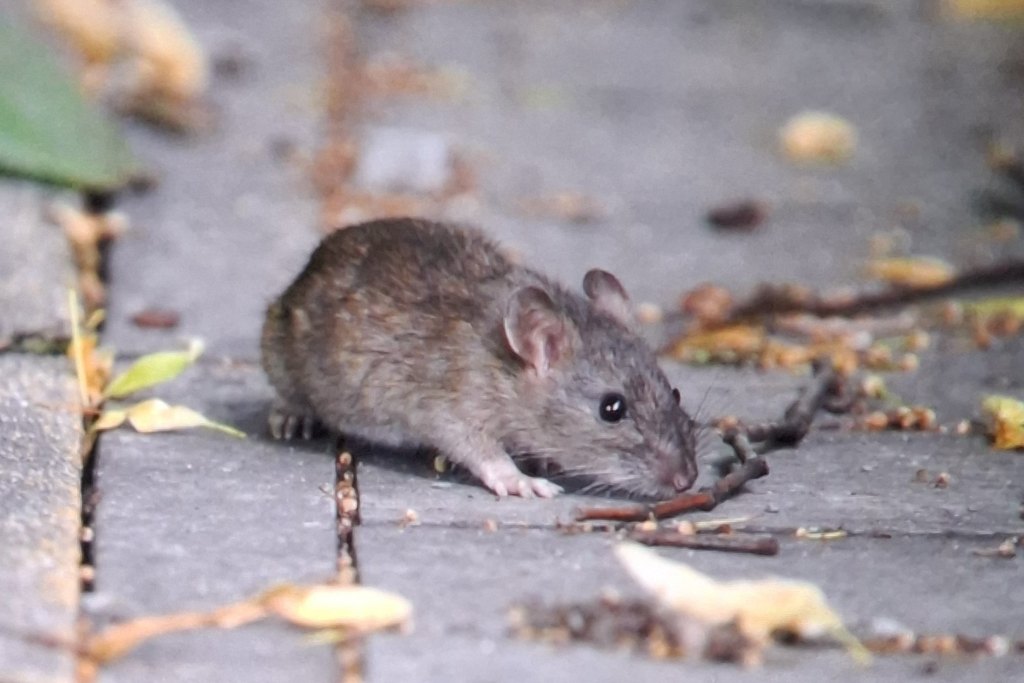
Why wild rats die young
The gap between a cage and a backyard is large. Animal Diversity Web says a roof rat can live up to 4 years in captivity but about one in the wild, and gives an annual death rate of 91 to 97%. Its account of the Norway rat lists dogs and other canids, owls, cats, snakes, lizards and people among the animals that kill them. For roof rats in towns and suburbs, it names house cats as the main threat.
Predators do not keep numbers down, though. UC IPM says cats and owls eat rats, but predators cannot do much against animals that colonize and breed as well as rats do. The rodent chapter on roof rats in Prevention and Control of Wildlife Damage, the University of Nebraska handbook, says cats and owls have little effect on established roof rat populations, and that the high birth rate of rats lets their numbers recover quickly. The Norway rat chapter adds that around most buildings, rats can find places to hide and raise young where predators cannot reach them.
A rat’s life, from birth to breeding
The handbook chapters and ICWDM give the same timeline for both rats, with small differences:
- Birth. Young are born 21 to 23 days after conception: 6 to 12 in a Norway rat litter and 5 to 8 in a roof rat litter (ICWDM). The Merck Veterinary Manual gives 8 to 18 young for pet rats.
- First weeks. Roof rats grow hair within a week, open their eyes at 9 to 14 days and start exploring near the nest. Norway rats eat solid food at 2½ to 3 weeks and are independent at 3 to 4 weeks (ICWDM). Young rats generally cannot be trapped until they are about a month old, according to the roof rat chapter.
- Breeding age. About 3 months for both species (ICWDM and the handbook). The California Department of Food and Agriculture gives 3 to 5 months for Norway rats.
- The rest of the year. Norway rats average 4 to 6 litters per female each year, raising 20 or more young to weaning (UC IPM and the handbook); ICWDM gives 3 to 6 litters. She can mate again within a day or two of giving birth. Roof rats usually have 3 or more litters a year (ICWDM), or 3 to 5 (UC IPM).
Put together, a rat that lives a year spends about three quarters of it able to breed. Where rats nest and raise those litters is covered in what a rat nest looks like.
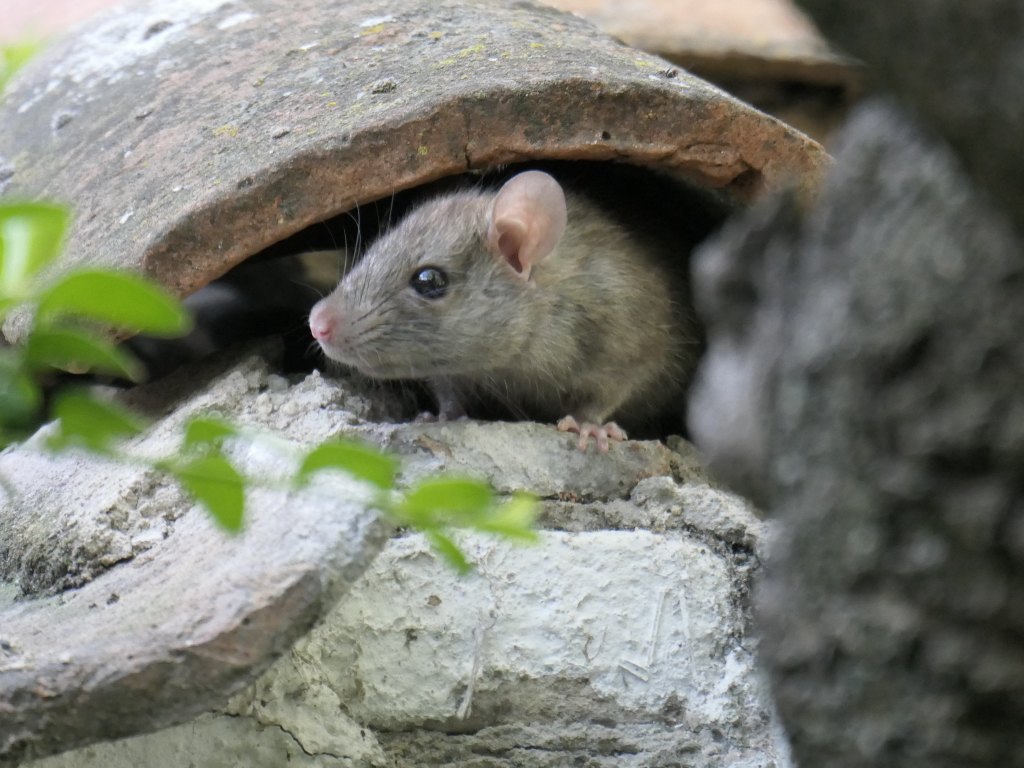
Will rats around your house die off on their own?
Not while they have food, water and shelter. UC IPM says rat numbers can grow quickly when those three are available, and a rat that dies after a year has usually left several litters behind it. The roof rat chapter puts it the same way: how many rats an area holds depends mainly on the food and cover nearby, not on how long each rat lives. Winter does not clear them out either; see do rats hibernate?
Waiting also has costs. The Norway rat chapter estimates that one rat eats 20 to 40 pounds of feed a year and spoils about ten times that with urine and droppings. The same chapter notes that rats gnaw electrical wires and water pipes, and their droppings and urine can carry disease (what rodent droppings can carry). The approach that works is the one in how to get rid of rats: take away food, water and shelter, seal the openings, and trap the rats already there. Best rat traps covers trap choice and placement.
How long can a rat live without food or water?
We did not find a source that gives a number of days for either. What the sources do say is that rats depend on water far more than mice do. The handbook and ICWDM say a rat needs ½ to 1 ounce of water a day when it eats dry food, and less when its food is moist. Cornell’s integrated pest management program says Norway rats need to drink standing water every day. Roof rats usually need water daily too, unless their food is high in moisture (ICWDM). How much food a rat needs a day, and which foods draw it in, is in what do rats eat.
That is why water matters in rat control. The Norway rat chapter notes that rats need water every day and can be drawn to water stations where other water is scarce. Fixing a dripping outdoor tap or a leaking irrigation line takes away one of the things that keeps rats around. Food is the other half: household garbage gives Norway rats a balanced diet and most of the moisture they need (ICWDM).
How long does a rat live if you release it somewhere else?
None of our sources gives a survival time for a released rat, and they advise against doing it. UC IPM says live trapping is not recommended for homeowners because by law a caught rat has to be either humanely euthanized or let go right away at the spot where it was trapped (UC IPM writes for California; rules differ by state). It adds that releasing rats simply moves the health problem to the neighbors. CDC also recommends snap traps, not live traps, in homes.
More questions about how long rats live
How long do pet rats live?
The Merck Veterinary Manual gives 1.5 to 3 years for pet rats, and Animal Diversity Web gives 2 to 3 years as typical for Norway rats in captivity, with a maximum of 4. This guide is about wild rats around homes; for a pet, ask a veterinarian.
Do roof rats or Norway rats live longer?
There is no clear answer. The National Park Service gives about 6 months for wild Norway rats and 9 to 12 months for roof rats, which would make roof rats the longer-lived. Other sources give Norway rats about a year or more. The figures come from different sources and methods, so treat them as rough.
Do rats live longer than mice?
In the wild, not by much. Wild house mice live about a year by most guides, close to the figures for wild rats; how long do mice live lists the sources. Mice start breeding sooner, at about 6 weeks rather than 3 months.
How long do rats live in the walls or attic?
No source gives a separate figure for rats living indoors. What matters more is that a rat living in a wall or attic is sheltered and usually close to food, which is what lets a colony settle in. See rat in the attic for the signs and the steps that fit that case.
In short
A wild rat lives about a year or less: around 6 months to a year for Norway rats and 9 to 12 months for roof rats, depending on the source. In a cage, rats live 1.5 to 3 years and sometimes 4. Rats reach breeding age at about 3 months and can have several litters a year, so a colony with food, water and shelter lasts long after the first rats are gone. Remove what keeps them there, seal the openings and trap, rather than wait.
Sources and verification
- National Park Service — Integrated Pest Management Manual: Rats (archived copy, May 2010)Wild life span of Norway rats usually about 6 months and of roof rats usually 9 to 12 months.
- California Department of Food and Agriculture — Vertebrate Pest Control Handbook: Norway RatAverage life of about one year; sexual maturity at 3 to 5 months; predation by owls, hawks, weasels and foxes.
- Animal Diversity Web — Rattus norvegicus (University of Michigan, 2004) and Rattus rattus (2004)Norway rat: up to 4 years in captivity, typically 2 to 3, and assumed up to about 2 years in the wild; predators. Roof rat: about a year in the wild with 91 to 97% annual mortality, up to 4 years in captivity; house cats as the main urban predator.
- Merck Veterinary Manual — Rats at a GlancePet rat life span 1.5 to 3 years; gestation 21 to 23 days; litter of 8 to 18.
- UC IPM — Pest Notes: Rats (June 2025)Litters and young weaned per year for Norway and roof rats; fast population growth with food, water and shelter; cats and owls cannot control rats; live trapping and release not recommended.
- ICWDM — Norway Rat Biology and Roof Rat BiologyMaturity at 3 months; gestation 21 to 23 days; litter sizes; 3 to 6 litters a year; development of the young; ½ to 1 ounce of water a day on dry food; roof rats usually need water daily; garbage as a balanced diet.
- Prevention and Control of Wildlife Damage (University of Nebraska–Lincoln, 1994): Norway Rats (Timm) and Roof Rats (Marsh)Breeding timeline; 4 to 6 litters and 20 or more young a year; water needs and water stations; feed eaten and spoiled per rat; hiding places out of reach of predators; predators of little value against roof rats; quick population recovery; density set by food and cover; young not trappable until about a month old.
- Cornell CALS (NYS IPM) — Mouse and Rat Biology and BehaviorNorway rats need to drink standing water every day.
- CDC — How to Trap Up to Remove RodentsSnap traps recommended; no live traps.