
Rooms and places
How to Get Rid of Rats in Your Yard: Signs, Food and Cover, Outdoor Traps and Bait Stations
Rats in a yard are there for food, water and cover, and they will stay as long as all three are close together. This guide covers what university and federal sources say about outdoor signs, removing what keeps rats in the yard, trapping safely around pets and children, burrows, bait stations, what does not work, and keeping rats out of the house.
Short answer
- Take away food and cover first. UC IPM, CDC and NYC Health point to pet food, birdseed, fallen fruit, compost scraps, open garbage, ivy and woodpiles.
- Trap with snap traps inside boxes or stations. UC IPM calls rat-sized snap traps the safest, most effective and most economical option, and says to cover or enclose them wherever pets, children or birds could reach them. Never use glue boards outdoors.
- Collapse burrows, do not just cover them. NYC Health says to collapse earthen burrows with a shovel; covering an entrance with wood, blocks or rocks will not keep rats out.
- Bait outdoors only in tamper-resistant stations. EPA and UC IPM require stations for outdoor above-ground baiting. Dead and dying rats that ate bait can poison dogs, cats, owls and other wildlife.
- Repellents, ultrasonic devices and owl boxes are not a fix. UC IPM says no repellent has solved a rat problem for more than a very short time, and that predators generally cannot control rats.
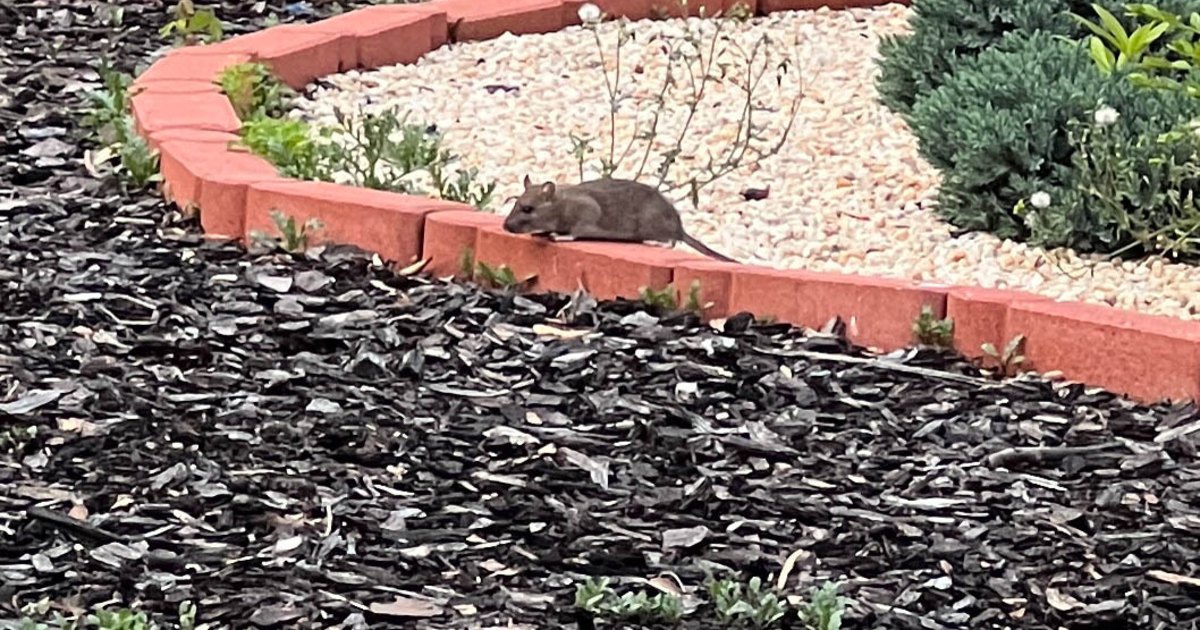
Signs of rats in the yard
Rats keep out of sight, so the yard usually shows what they have been doing before you see one. UC IPM lists these outdoor signs:
- Burrows. Holes in the soil under garbage cans, compost piles or among garden plants. Norway rats also burrow along building foundations and under rubbish or woodpiles. How big the holes are and how to tell whether one is in use is in rat nest.
- Gnawed fruit and nuts. Fruit eaten on the tree or on the ground, often by roof rats. UC IPM notes that roof rats eat avocados and citrus while the fruit is still hanging.
- Runways. ICWDM says rats use obvious runways, and NYC Health describes worn paths along foundations, walls, fences and bushes.
- Droppings. UC IPM points to droppings around pet dishes, pet food containers and recycling bins. To tell them from mouse droppings, see mouse droppings vs rat droppings.
- Other clues. UC IPM adds rats on utility lines or fence tops at dusk, nests in firewood, digging under a shed, and drowned rats in a pool. NYC Health adds greasy rub marks.
The full list of signs, inside and out, is in signs of rats. Rats up in trees and on wires are likely roof rats; burrowing rats are likely Norway rats. The difference changes where traps go; see roof rat vs Norway rat.
Why rats chose your yard
NYC Health says rats look for food, water, shelter and safe travel routes, and a yard often has all four. The attractants are covered in what attracts rats? Rats feeding in your yard may not live in it: UC IPM says roof rats travel 300 feet or more for food and may live in one yard while feeding in another’s fruit trees, and Norway rats forage 100 to 500 feet from their nests.
Remove food, water and shelter outdoors
ICWDM says sanitation alone will not always eliminate rats, but traps and bait compete with every other meal in the yard. What the sources recommend:
| Source of food or cover | What to do (and who says so) |
|---|---|
| Bird feeders | Keep them away from the house and use squirrel guards (CDC). Clean up spilled seed. While you are dealing with rats, pausing feeding altogether is the simplest option. |
| Pet food | Feed pets only what they eat in one feeding, or bring the food in at night, and store it in rodent-proof containers (UC IPM). NYC Health says not to leave food outdoors for cats, pigeons or squirrels. |
| Pet droppings | Pick up dog and cat feces with gloves, because rats eat them (UC IPM). |
| Compost | Use rigid plastic or metal bins with tight lids, and keep meat, fish, eggs and eggshells out (UC IPM). Keep bins at least 100 feet from the house (CDC). |
| Fallen fruit and nuts, garden debris | Pick them up regularly and clear garden debris (UC IPM). |
| Garbage | A thick plastic or metal can with a tight lid and no holes (CDC); put it out close to collection time (NYC Health). ICWDM suggests putting cans on racks or stands so they do not shelter rats. |
| Grills and stored feed | Keep grills clean; store grain and animal feed in thick plastic or metal containers with tight lids (CDC). Poultry owners: see rats in a chicken coop. |
| Ivy and dense plants | Thin or remove climbing Algerian or English ivy, star jasmine and honeysuckle on fences and walls; leave at least 2 feet between shrubs and between shrubs and buildings; cut limbs that overhang the roof (UC IPM). |
| Woodpiles, lumber, clutter | Store tidily and off the ground (UC IPM). CDC says 100 feet or more from the home and at least 1 foot off the ground. |
| Water | Fix dripping outdoor taps and empty standing water. |
A gravel strip along the foundation. ICWDM describes a band of heavy gravel, at least 1 inch in diameter, 2 feet wide and 6 inches deep, laid along foundations to reduce burrowing next to the building. It discourages new digging; it does not remove rats already there.
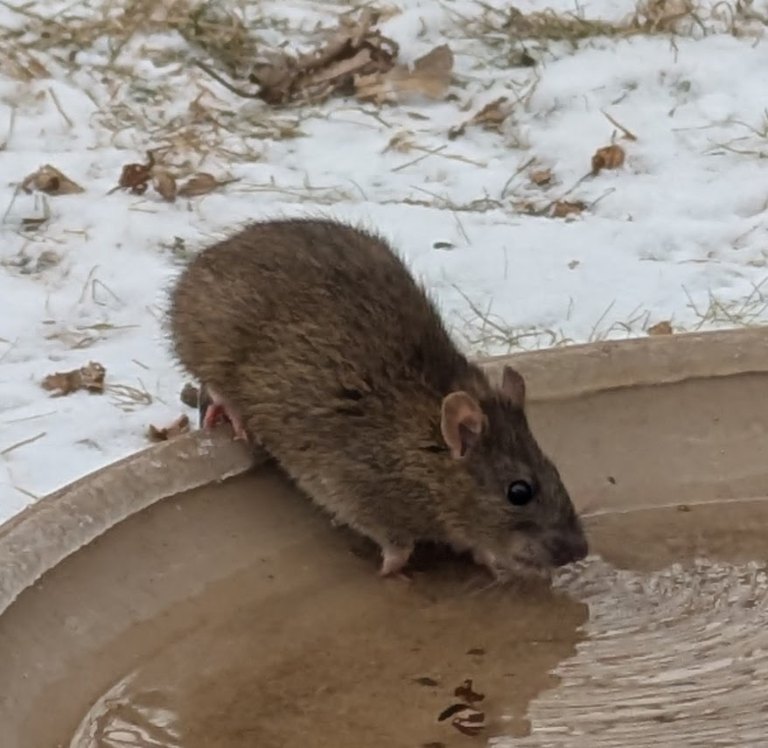
Trapping rats outdoors safely
Trapping is the main way to remove rats already in a yard. Bait and trap numbers are in how to get rid of rats, and trap choice is in best rat traps. Outdoors, the difference is other animals.
- Enclose the traps. UC IPM says that where children, pets, birds or other nontarget animals might come across traps, they should go inside boxes or stations or behind a barrier. ICWDM adds slanted boards or hard-to-reach spots.
- Put them on the runways. For Norway rats, UC IPM says close to walls, behind objects and in dark corners; ICWDM says not directly in front of holes. For roof rats, also set traps up on fences, ledges or branches (UC IPM). UC IPM adds that trapping at night reduces trouble with birds.
- Let the rats get used to them. ICWDM advises leaving traps unset for several days first, because rats are wary of new objects.
- No glue boards outside. UC IPM says glue boards should never be used outdoors because wildlife gets stuck on them.
- Skip live traps. UC IPM does not recommend live trapping for nonprofessionals.
Handle dead rats with disposable gloves and seal them in a plastic bag for the trash, or bury them where pets and scavengers cannot dig them up (UC IPM).
Treating rat burrows
- Find out which burrows are active. ICWDM suggests plugging holes loosely with paper; a hole that is open again a day or so later is in use.
- Collapse burrows with a shovel. NYC Health’s advice. It says covering an entrance with wood, cinder blocks or rocks will not keep rats out, and not to put broken glass or chemicals in a burrow.
- Filling alone is not control. We found no university or federal source that says filling or collapsing burrows on its own removes a rat population. In the sources it is part of the work, alongside trapping and removing food.
- Gas cartridges are not for use near homes. UC IPM says smoke or gas cartridges are not recommended around homes: toxic gas can get inside, and they are a fire hazard.
- Carbon monoxide and fumigants are for professionals. UC IPM says carbon monoxide devices are intended for professionals and, for Norway rats, cannot be used within 65 feet of a structure; using engine exhaust is not allowed. ICWDM says aluminum phosphide fumigant is limited to licensed operators.
Rodenticide bait stations outdoors
Poison bait carries the most risk to everything else in your yard. The rules and cautions:
- What you can buy. EPA says products sold to consumers are ready-to-use bait stations holding block or paste bait; no loose pellets, and no second-generation anticoagulants such as brodifacoum or bromadiolone, which are for professionals. UC IPM dates the rule to mid-2011.
- Where you can use it. EPA says consumer labels limit use to indoors, or indoors and outdoors within 50 feet of buildings. Tamper-resistant stations are required for all above-ground outdoor use and wherever children, pets or wildlife could reach bait.
- State rules can be stricter. In California, UC IPM says most uses of first- and second-generation anticoagulants are now prohibited, with limited agricultural exemptions.
- Place and secure stations. UC IPM says on travel routes or near burrows, and elevated stations for roof rats must be secured so they cannot fall. ICWDM warns that tamper-resistant stations are not tamper-proof.
- Seal the house first. UC IPM advises closing entry points before baiting outdoors, so poisoned rats do not die inside walls.
Secondary poisoning. UC IPM says anticoagulants are cumulative, so a dead rat can carry several lethal doses, and a pet can be poisoned by eating one; most pet deaths involve dogs, and one dead rodent may be enough. ICWDM says residues in dead rodents can be toxic to scavengers and predators. EPA says to pick up dead rodents promptly. If you have pets, read mouse and rat poison around pets first. If a pet may have eaten bait or a poisoned rat, call your veterinarian right away.
What does not work
- Repellents. UC IPM says no repellent has solved a rat problem for more than a very short time and ICWDM calls chemical repellents seldom practical.
- Ultrasonic devices. UC IPM says they are ineffective in homes and gardens because rats quickly get used to repeated sounds. More in do ultrasonic pest repellers work?
- Cats and dogs. UC IPM says predators generally cannot control prolific breeders such as rats, and that feeding cats outdoors gives rats a steady food source. ICWDM says pets rarely control large populations.
- Owl boxes. Barn owls eat rodents, but a UC Agriculture and Natural Resources article on farm barn owl boxes calls them not a proven method for sustained rodent control on their own. Its studies are from farmland, where owls ate mostly gophers, mice and voles. We found no university or federal source showing that a backyard owl box reduces rats.
Neighbors and community programs
Because rats forage hundreds of feet, one clean yard next to a yard with open compost and fallen fruit may keep seeing rats. NYC Health says rats can affect a single property, a whole block or a neighborhood, and recommends coordinated action, even one professional servicing every property on a block.
Some cities offer help. In New York City, residents can report rats through 311, check inspections by address in the Rat Information Portal, and host the Health Department’s free rat control training. Elsewhere, ask your local health department. Talking to neighbors about feeders, compost and fruit trees costs nothing.
When to call a professional
Consider professional help when burrows keep reopening after weeks of trapping and cleanup, when rats are active in several yards on the street, when burrows run under the house, slab or patio, or when you want burrow treatment or bait you cannot legally use yourself. UC IPM notes professionals can get products not sold to the public. NYC Health recommends homeowners hire a licensed professional for poison bait. For rats on overhead utility lines, UC IPM says to contact a pest professional or the utility. See when to call an exterminator for mice or rats.
Keep yard rats from moving into the house
A yard with rats is one gap away from a house with rats. UC IPM says Norway rat burrows can extend under a house, and roof rats travel along utility lines and fence tops. Check the foundation, vents, gaps around pipes and door bottoms, and trim limbs over the roof. Entry points and sealing are in how do rats get in your house? See also rats in the garage. If rats are already inside, follow the indoor plan in how to get rid of rats.
Questions people ask
Why do I have rats in my yard all of a sudden?
Often a food source has appeared nearby: a bird feeder, ripening fruit, a compost pile, a neighbor’s chickens. UC IPM says rats travel hundreds of feet for food, so the cause may be next door.
Should I fill in rat holes in my yard?
NYC Health says to collapse earthen burrows with a shovel and not to just cover them with rocks or boards. Filling alone does not remove the rats.
Is it safe to use rat poison in the yard if I have a dog?
It carries real risk. UC IPM says most pet poisonings from rodenticides involve dogs, either from bait or from eating a poisoned rat. Outdoor bait must be in secured tamper-resistant stations.
Does seeing a rat in the yard in daytime mean a big infestation?
We found no university or federal source that sets a rule on this. UC IPM describes rats out on fences and wires at dusk, so a daytime sighting is worth taking seriously, but it is not proof of numbers on its own. Burrows, runways and droppings tell you more.
What is the best way to get rid of rats outside without poison?
Remove food, water and cover, collapse and monitor burrows, and trap with rat-sized snap traps inside boxes or stations along runways.
In short
Rats stay in a yard for food, water and cover. Remove pet food, birdseed, fallen fruit, compost scraps and open garbage; thin ivy; raise woodpiles. Trap with snap traps in boxes or stations, never glue boards. Collapse burrows. Keep any bait in secured stations and remember the risk to pets and wildlife. Repellents, ultrasound and owl boxes are not a fix; neighbors working together often are. Then seal the house.
Sources and verification
- UC IPM — Pest Notes: RatsOutdoor signs; foraging distances; outdoor sanitation; snap traps, enclosing traps, no glue boards outdoors; gas cartridges and carbon monoxide; bait station placement, California restrictions, secondary poisoning; repellents, ultrasound, predators; professionals.
- ICWDM — Norway Rat Damage Prevention and Control MethodsRunways; gravel band; garbage on racks; trap placement; plugging holes with paper; fumigants; stations not tamper-proof; secondary poisoning; repellents and pets.
- CDC — How to Seal Up to Prevent RodentsGarbage cans, grills, compost, bird feeders, woodpiles, feed storage.
- EPA — Restrictions on Rodenticide ProductsWhat consumers can buy; second-generation anticoagulants; 50-foot limit; stations outdoors.
- EPA — Safely Use Rodent Bait ProductsRemoving dead rodents to protect wildlife and pets.
- NYC Health — Rats: Information for Tenants and Property OwnersBurrows, runways and rub marks; collapsing burrows; garbage; licensed professionals; 311.
- NYC Health — Rat Prevention: Working in Your CommunityBlock coordination; training; Rat Information Portal.
- UC Agriculture and Natural Resources — Barn Owls: Biological ControlOwl boxes not proven for sustained rodent control.