
Evidence and signs
Mouse droppings vs rat droppings
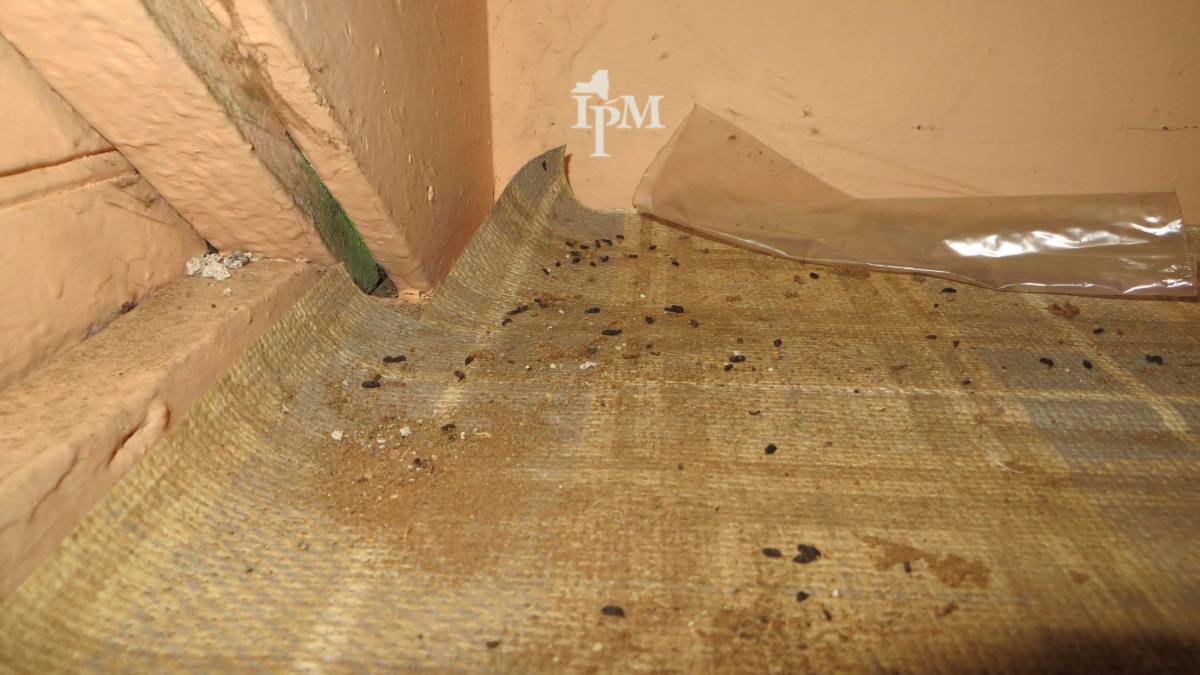
Size is the fastest way to tell which animal you have, and it changes what you do next: which trap to buy, how much of the room to clean, and whether this is a weekend job or a phone call. Here is the comparison at actual size, plus the two mistakes that send people to the wrong conclusion.
Before you touch anything: do not sweep or vacuum dry droppings. CDC guidance is to ventilate the room for 30 minutes and leave it, then wet the material down with disinfectant before you wipe it up. Dry sweeping puts contaminated particles into the air you are standing in. The full cleanup procedure is here.
The short answer
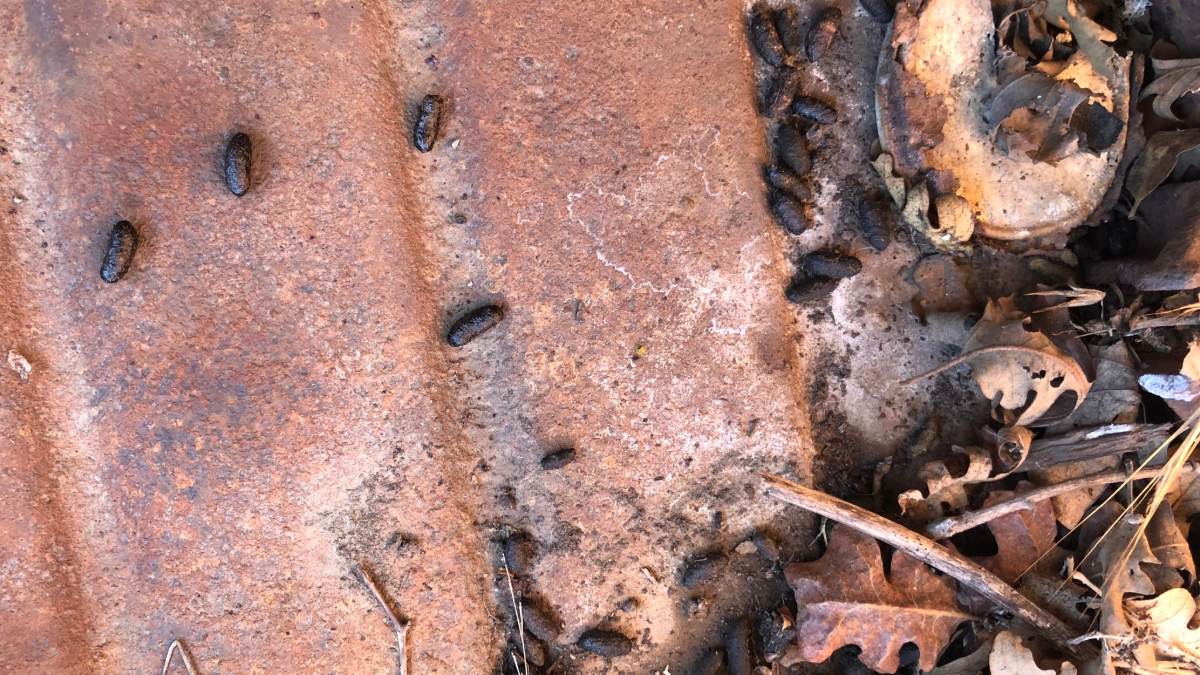
House mouse droppings average about 1/4 inch (6 mm) and are usually pointed at both ends — Penn State Extension describes them as roughly the size of a grain of rice. Rat droppings are visibly larger and thicker, and the two rat species differ from each other: roof rat droppings are narrower with tapered ends, Norway rat droppings are the biggest and blunter at the ends.
If what you are looking at could sit comfortably on a grain of rice, you are almost certainly dealing with mice. If it is closer to the size of an olive pit, you have rats.
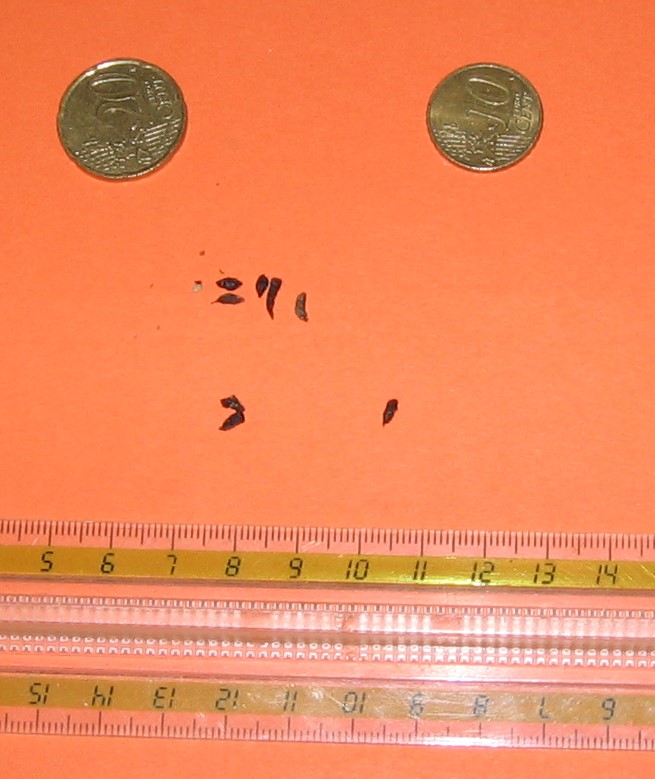
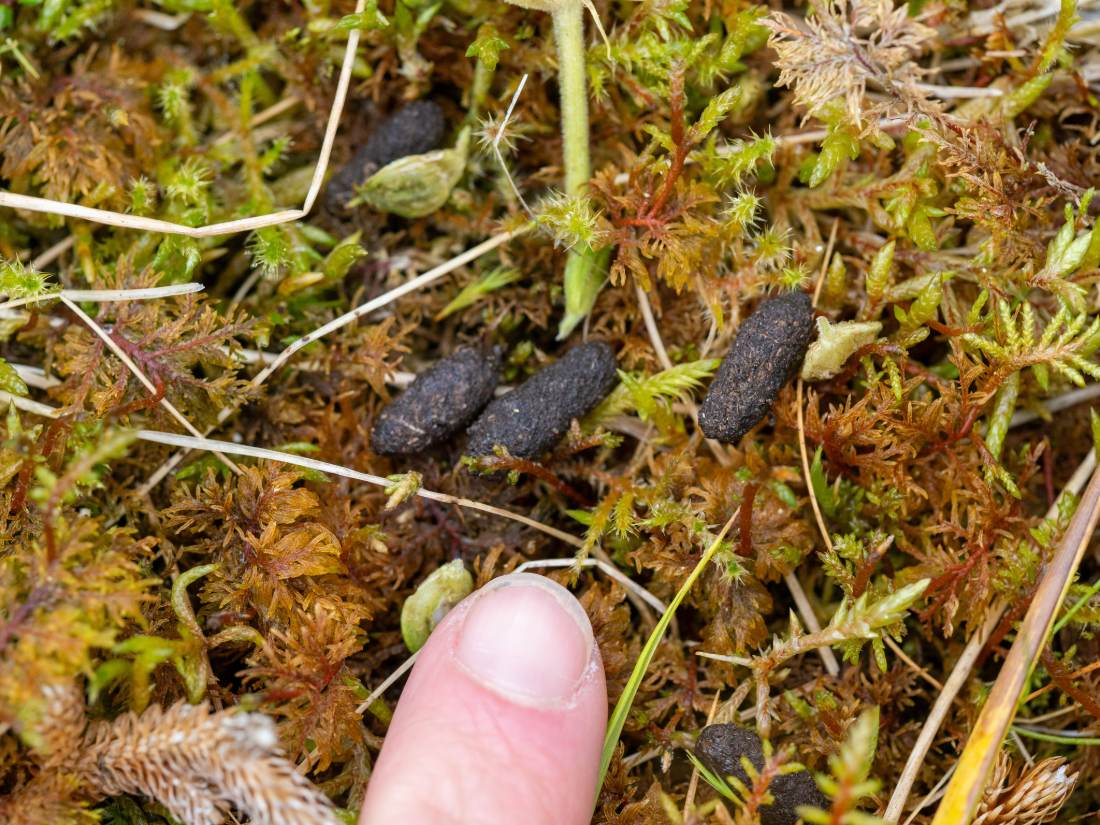
The catch that trips people up: a young rat can overlap an adult mouse in apparent body size. Head and foot proportions are often more useful than body size alone, so use several signs together rather than relying on one measurement — the full sign-by-sign check is here. If you saw the animal itself, here is how to tell a young rat from an adult mouse.
Compare them at actual size
Photographs of droppings are almost useless for judging size, because you have no idea what scale the photograph was taken at. The block below draws them at true physical size instead. Hold any 85.6 mm plastic reference, such as a library pass or loyalty pass, against the outline; if it does not line up, drag the slider until it does, and every size on this page corrects itself.
Hold any 85.6 mm plastic reference, such as a library pass or loyalty pass, against the outline below. If it does not line up, drag the slider until it does — every size in this block rescales with it.
-
House mouse3–6 mmSmall and often pointed at both ends. Scattered widely — along baseboards, in drawers, inside cabinets, wherever the animal travels.
-
Roof rat10–13 mmNarrower than Norway-rat droppings, with tapered ends. Roof rats nest in enclosed elevated spaces: attics, rafters, wall and ceiling voids.
-
Norway rat16–19 mmThe largest, with blunter ends. Norway rats burrow and stay low: basements, ground floors, along foundations, under decks and woodpiles.
Typical ranges, not a measurement standard. Body size can overlap between a young rat and an adult mouse. Droppings should be assessed separately using their own size and shape characteristics, alongside location and the other signs rather than on their own.
Where you found them narrows it further
The two rat species divide a building between them, and UC IPM notes that where they share one, Norway rats occupy the basement and ground floor while roof rats take the upper floors. That gives you a second, independent check on the size reading. If the droppings are in a basement, what to do about mice in a basement covers the entry points, trap placement and sealing for that space.
| Animal | Size | Shape | Where you typically find them |
|---|---|---|---|
| House mouse | About 1/4 in (6 mm) | Pointed at both ends, rice-grain-like | Everywhere it travels — drawers, under sinks, along baseboards, in pantries |
| Roof rat | Roughly 1/2 in (10–13 mm) | Narrower, tapered ends, often slightly curved | High: attics, rafters, ceiling and wall voids, tops of cabinets |
| Norway rat | Roughly 3/4 in (16–19 mm) | Thick, blunt ends | Low: basements, crawl spaces, ground floors, near burrows outside |
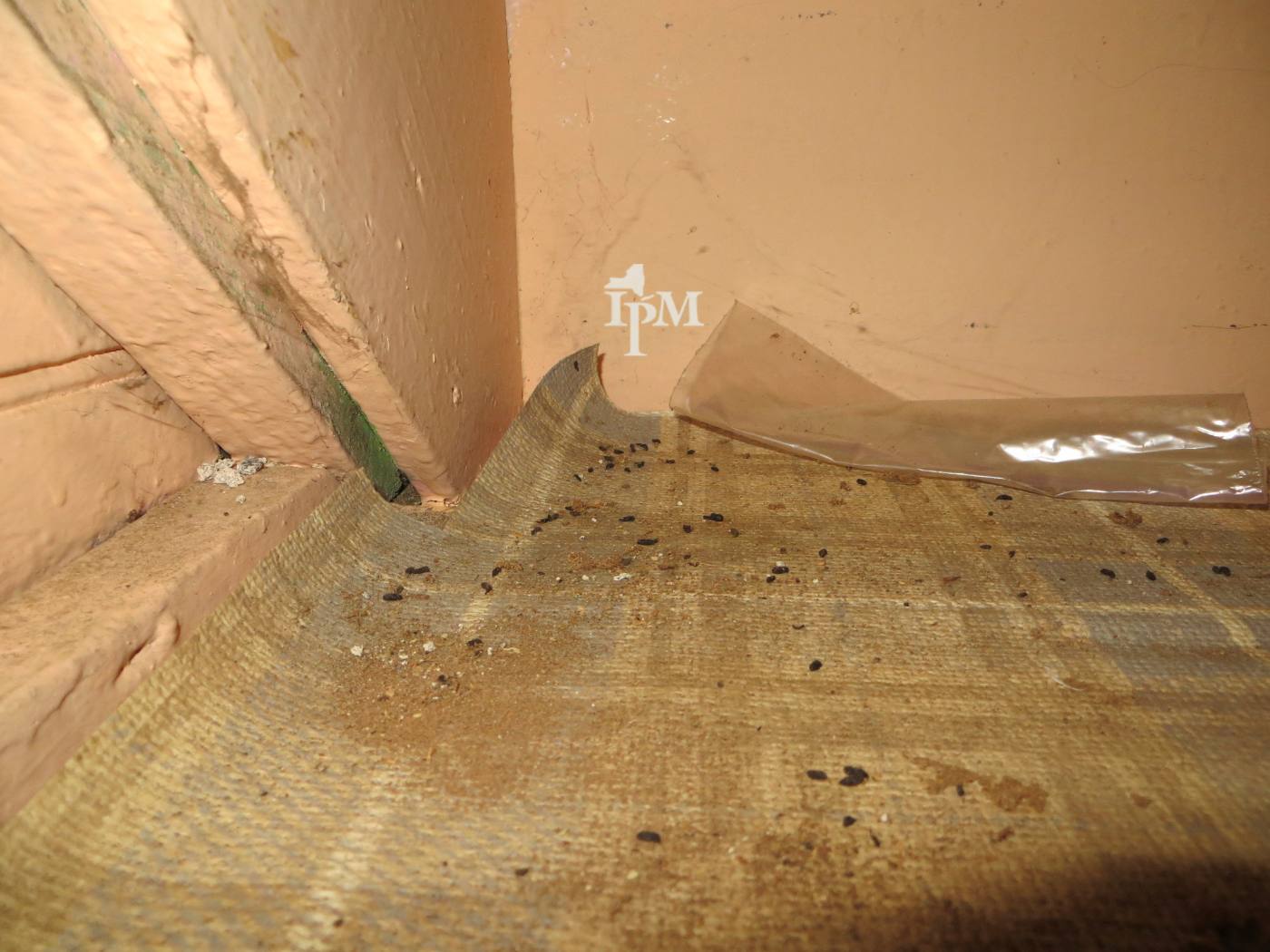
Scatter pattern helps too. Mice leave droppings more or less continuously as they move, so you find them spread thinly over a wide area. Rats tend to deposit in fewer, more concentrated places. A drawer with three dozen small pellets spread across it reads as mice; a dozen large ones piled in one corner of an attic reads as rats.
Two things that are not rodent droppings
Before you plan a response, rule out the two look-alikes people most often mistake.
- Cockroach droppings. These overlap the mouse range in length — the Internet Center for Wildlife Damage Management puts them at 1/8 to 1/4 inch — but under a magnifying glass they “show distinct longitudinal ridges and squared-off ends.” Rodent droppings have no ridges and taper or blunt at the ends rather than looking cut off.
- Bat guano. Bat droppings can resemble rodent droppings, especially when size is judged without a scale. Guano often contains visible insect fragments and tends to accumulate beneath a roost, but do not crush or crumble suspected bat droppings to identify them. Disturbing bat droppings can create an inhalation hazard.
Fresh or old? Do not trust appearance — use a baseline
The usual advice is that fresh droppings look dark and soft and old ones turn grey and crumbly. That is broadly true, but it depends on humidity, on the surface, and on what the animal has been eating, and people routinely talk themselves into the answer they want. Fresh vs old mouse droppings goes through what appearance can and cannot tell you.
There is a test that does not depend on judgement at all:
- Clean the area properly — following the cleanup procedure, not by sweeping.
- Leave it and note the date.
- Re-inspect the same spot. If new droppings appear after the area was cleaned, CDC says that indicates active rodent presence. A surface that remains clean is useful evidence for that specific location, but it does not by itself prove that rodents are gone from the building.
CDC does not give a 24-, 48-, or 72-hour waiting period for this cleanup-and-monitor check. The useful evidence is whether new droppings appear after a documented cleanup. Keep this separate from CDC’s trapping guidance, which uses its own monitoring procedure.
Does this mean I have one mouse, or many?
Droppings alone will not give you a count, but two facts set the scale. UC IPM reports that house mice seldom venture more than about 30 feet from their nest sites and food supply. Droppings found far apart therefore can suggest more than one activity area, but droppings alone cannot tell you how many nests or mice are present. And a single female may produce 5 to 10 litters of about 5 or 6 pups each in a year, which is why a problem left alone rarely stays the size it was when you found it.
How to estimate what you are dealing with goes into this properly.
What to do next
The order matters, and there is one rule that overrides convenience: do not close up an active entry point in a way that seals rodents inside the structure.
- Clean what is there, wet, with disinfectant, never dry. It also gives you the baseline described above. Cleanup procedure
- Trap what is inside. CDC recommends ordinary snap traps and advises against glue traps and live traps, because a frightened rodent urinates and that increases your exposure. Choosing and placing traps
- Then close the way in. Mice can use an opening around 1/4 inch; the working rule from university IPM programs is to seal anything larger than that. Sealing guide
- Verify. CDC suggests keeping traps set for at least 15 days and calling it resolved only after a week with no captures and no new sign. Verification checklist
About the disease risk, honestly
Rodent droppings are the reason cleanup guidance exists, and hantavirus is the specific worry. Two things are worth stating plainly.
The most common hantavirus that causes HPS in the United States is spread by the deer mouse rather than by the house mouse you are most likely to meet in a city kitchen — the house mouse is not among the rodents CDC names as spreading the hantaviruses that cause HPS. Deer mice are a rural and semi-rural animal, and exposure is associated with cabins, sheds, garages, crawl spaces and outbuildings that have been shut up for a while.
That said, CDC’s position is that people get hantavirus from contact with rodents generally — rats and mice — and especially from their urine, droppings and saliva. The cleanup precautions apply to all rodent waste, whichever species left it. The disease is uncommon, but CDC currently says HPS is fatal in nearly 4 in 10 people who are infected. That asymmetry is the whole argument for spending ten minutes on ventilation and a spray bottle rather than reaching for the vacuum.
What the risks actually are covers this in more detail, including the other diseases associated with rodents.
When this stops being a DIY job. Droppings across several rooms, activity during daylight hours, a rat in the attic, gnawed wiring, or any sign that rodents have reached the heating and cooling ducts. CDC specifically advises calling a professional service where there is evidence rodents have accessed the ventilation system. Where the line sits
Sources
- CDC — How to Clean Up After RodentsVentilation, disinfectant, contact time, disposal, and the instruction not to sweep or vacuum.
- CDC — How to Trap Up to Remove RodentsSnap traps recommended; glue traps and live traps advised against; the 15-day and one-clear-week criteria.
- CDC — How to Seal Up to Prevent RodentsThe 1/4-inch opening figure for mice and the list of materials that hold.
- CDC — About HantavirusDeer mouse as the carrier of the most common HPS-causing hantavirus in the US, and routes of exposure.
- CDC — Clinician Brief: Hantavirus Pulmonary SyndromeThe case fatality figure quoted above: HPS is fatal in nearly 4 in 10 people who are infected.
- CDC — You Can Prevent Hantavirus (2021 booklet)The four North American rodents CDC names as spreading the hantaviruses that cause HPS — deer mouse, white-footed mouse, rice rat and cotton rat.
- UC IPM — RatsWhere each rat species nests, how they divide a building, and the 1/4-inch sealing threshold.
- UC IPM — House MouseThe 30-foot home range and the litter figures.
- ICWDM — House MiceMouse dropping length, gnaw-mark widths, and the cockroach-dropping comparison.
- Penn State Extension — Is There a Mouse in the House?The rice-grain description of mouse droppings.