
Traps and materials
How to Seal Mouse Entry Points: Where to Look and What to Use
Mouse-proofing is not just filling holes. It means finding the opening, putting a gnaw-resistant barrier where mice can reach it, sealing it in a way that holds, and leaving the building’s drainage and ventilation working. This guide covers all four, and flags two openings you should never simply close.
Found droppings or nesting material at an opening? Do not sweep or vacuum them before you start work. Clean them up wet, following the cleanup procedure, then seal.
The short answer
- Treat any opening around 1/4 inch as a possible mouse entry. CDC says mice can fit through a hole the width of a pencil, about 1/4 inch.
- Use metal or masonry where mice can reach the repair. Fillers such as steel wool or copper mesh need to be fixed in place; larger holes need hardware cloth, sheet metal, lath metal or cement.
- Do not rely on expanding foam alone. It can hold a metal filler in place, but on its own it is not a gnaw-resistant barrier.
- Do not block drainage or required ventilation. Do not screen a dryer exhaust terminal, and do not plug brick weep holes. Each needs a pest-resistant solution that preserves its original function.
- Sealing does not remove mice already inside. Trapping and sealing are parts of the same job; the full sequence is in how to get rid of mice.
Before you seal: are mice already inside?
Closing an opening stops new mice from using it. It does nothing about mice that are already in the walls, the basement or the attic. UC IPM notes that when dealing with an infestation, some form of population reduction is almost always necessary alongside exclusion. In practice, that means setting traps indoors at the same time as you seal. If they are living in the walls, see mice or rats in the walls for where to trap and how to test which holes are still in use.
Cornell’s guidance on excluding animals from buildings adds a rule worth following before you close an opening you are not sure about: be certain animals will not be trapped inside. Where you cannot tell whether an entry site is active, it suggests plugging it loosely — newspaper, stapled cardboard or duct tape — and monitoring it for at least two days. That guidance is written for animals in buildings generally, not for mice specifically.
If the opening is high on the house and you have heard activity at dusk, it may not be mice at all. Bats and squirrels have their own exclusion rules, and sealing an active bat or squirrel opening can trap animals inside. How to tell mice, rats, squirrels and bats apart covers what to check before you close anything up there.
How small a gap can a mouse use?
CDC gives the figure as 1/4 inch (about 6 mm), roughly the width of a pencil. UC IPM uses the same working rule: keep mice out by eliminating all gaps and openings larger than 1/4 inch. A pencil is therefore a practical gauge during inspection: if one fits, treat the opening as a possible way in.
Gaps slightly smaller than that are not automatically safe. Building America notes that rodents feel for gaps with their whiskers and then gnaw and dig to make the gap big enough, which is why the repair material matters as much as the size of the hole.
If the evidence points to rats rather than mice, UC IPM applies the same threshold: seal all holes larger than 1/4 inch to exclude both. Checking which animal you have still matters, because it changes trap choice.
How to find where mice are getting in
An inspection works best as a system rather than a hunt for one hole. Keep going after you find the first opening. How mice reach openings above the ground, and how to prove which one they are using, is in how do mice get in your house.
- Start where the signs cluster. Droppings, fresh gnaw marks and nesting material show where mice are active. NPIC adds that mice leave brown or gray smudges on surfaces they travel along, and those marks can identify heavily used paths or entrances. If you are unsure whether the droppings are from mice, compare them against rat droppings first.
- Walk the outside, then the inside. Check every place where something passes through the building shell — pipes, wires, vents — and every joint between materials, such as where the foundation meets the ground or the siding.
- Look up as well as down. UC IPM describes house mice as excellent climbers that can run up rough vertical surfaces and along wires, so the roofline and upper-level penetrations belong in the inspection.
- Use daylight at doors. Building America’s test: stand inside while it is light outside, turn off the interior lights, and look for light at the bottom or lower corners of the door. It works for house doors and garage doors.
- Write down what you find. A simple list — location, rough size, what the surface is made of — tells you which repair each opening needs.
Outside the house: what to check
This list follows CDC’s outdoor checklist, with the vent and siding points from Building America added. It is not ranked; no source used here gives prevalence data for which opening mice use most.
- Where the foundation meets the ground, and any cracks or penetrations in the foundation itself.
- Doors, including the threshold, the lower corners and the garage door. CDC notes doors and windows without weather stripping in particular.
- Windows, including frames and screens.
- Holes for electrical, plumbing, cable and gas lines.
- Attic and crawl space vents. Building America notes that crawlspace vent covers are sometimes missing or pushed aside to route a dryer duct or wiring through the opening.
- The roof: rafters, gables, eaves and soffits, plus roof and ridge vents. Ridge vent end caps can work loose.
- Brick weep holes and the dryer exhaust outlet — check them, but see the section below before you do anything to them.
- Garages and outbuildings. CDC advises sealing these as well. Mice in the garage covers the garage door, side door and utility lines.
Inside the house: what to check
Indoors, CDC’s list covers the places where pipes, ducts and structure meet:
- Inside, under and behind kitchen cabinets, and behind appliances.
- Floor areas in closets, especially corners, and the junction between floor and wall.
- Around pipes under sinks and washing machines, and pipes leading to water heaters and furnaces.
- Around all electrical, water, gas and sewer lines, and around floor air vents and dryer vents.
- Around floor drains, such as in a basement or laundry room.
- Around the fireplace, windows and doors.
- The attic, and the basement or crawl space. Rats or mice in the attic covers roof and vent openings, and mice in the basement covers the sill plate, rim joist and foundation penetrations in more detail.
NC State Extension adds the interiors of cupboards, the area around bathtubs and chimneys, and open chases around conduits, wires, pipes, exhaust ducts and air conditioners. Sealing inside keeps mice from moving between rooms; it does not replace sealing the outside.
If you found droppings in a kitchen cabinet, sealing the route is only part of the response. The kitchen-cabinet guide explains which exposed food to discard and how to clean the shelf safely.
Which material should you use?
The right repair depends on the size of the opening, what it is made of, and whether it has a job to do. The table summarizes what the sources below describe for each situation.
| Opening | Repair the sources describe | Watch out for |
|---|---|---|
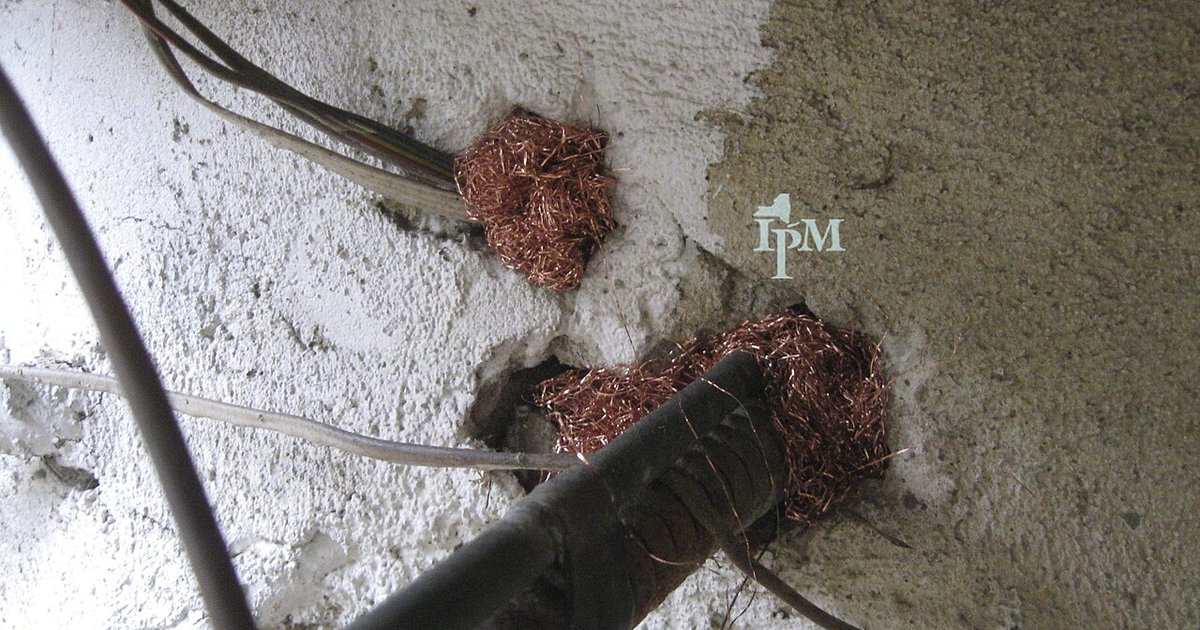
| Small hole or irregular crack | Steel wool or copper mesh packed in, held with caulk (CDC also allows spray foam to hold steel wool) | A loose filler can be pushed aside or worked around |
| Larger hole | Lath metal, 1/4-inch hardware cloth, sheet metal or cement | Every edge of sheet metal must be fastened |
| Foundation crack | Metal or concrete | Match the repair to the masonry |
| Pipe, wire or cable penetration | Wire mesh covered with a hardening compound, or an escutcheon plate | Foam on its own around the line |
| Gap under an exterior or garage door | Rodent-proof door sweep, metal threshold or kick plate; no more than 1/4 inch clearance | Ordinary weather stripping and vinyl sweeps are not rodent barriers |
| Attic, soffit, roof or crawlspace vent | Metal vent cover or 1/4-inch metal screen, permanently fastened | Do not cut the airflow the vent is there to provide |
| Dryer exhaust outlet | Gravity louver or a vent designed to exclude animals | No screen over the outlet — lint builds up |
| Brick weep hole | Screen cover or insert that keeps it open | Never fill with foam, caulk or mortar |
| Chimney | Commercial chimney cover | Homemade covers may not meet fire code |
Steel wool or copper mesh?
Both are compressible fillers for small, irregular openings, and both need to be fixed in place.
- Steel wool is the filler CDC names for small holes, with caulk around it to keep it in place. UC IPM calls steel wool scouring pads good temporary plugs that may rust over time. NC State Extension notes that it rusts and is flammable, and that rodents often work their way between the steel wool and the edges of the opening — so always caulk over it.
- Copper mesh does not rust, according to NC State, but rodents can push it aside, so it should also be caulked over.
- Stainless steel mesh is another option. Cornell notes it is stronger than galvanized mesh and will not rust, but it costs more and is harder to cut and shape.
Neither filler is a finished repair on its own. The filler resists gnawing; the sealant over it keeps it from being pulled or pushed out. For a large opening, a filler is the wrong tool altogether.
When to use hardware cloth, sheet metal or cement
For larger holes, CDC lists lath screen or metal, cement, hardware cloth, or metal sheeting, cut to fit around pipes. CDC does not give a single size at which a hole stops being “small”, so use the material that fits the opening and can be fastened securely.
- Hardware cloth: use the 1/4-inch mesh for mice. Cornell notes that half-inch mesh is stronger but that quarter-inch is more appropriate for smaller animals such as mice.
- Sheet metal: galvanized sheet metal attached with screws is durable. NC State says to make sure all edges are securely attached. Building America lists 24-gauge or heavier galvanized sheet metal for wall and pipe barriers.
- Lath metal: a light-gauge galvanized mesh that compresses into odd-shaped openings. NC State suggests expanding its edges with a screwdriver after forcing it in, so it fills the edges of the hole.
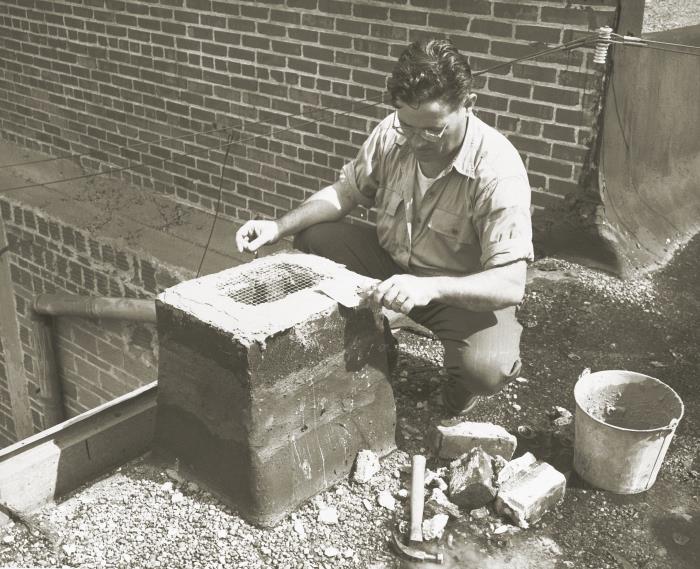
- Cement or concrete: for masonry and foundation openings.
Aluminum flashing is not on this list for a reason: Cornell and Building America both note that rodents can usually chew or claw through it. Whatever you use, Building America advises making the final patch smooth, because an uneven surface invites gnawing.
Why expanding foam alone is not enough
The sources are not identical on foam, so here is what each one says.
- CDC allows spray foam as one way to hold steel wool in place.
- UC IPM lists insulating (expanding) foam among gnawable materials that are ineffective for plugging holes used by house mice.
- NC State Extension does not recommend expanding foam, because mice may chew through it.
- Building America accepts foam or caulk for small gaps at utility penetrations but says larger gaps need reinforcement, and advises against blown foam where it alone is expected to block rodents or where it is exposed to the sun.
These positions fit together once you separate two jobs: sealing an air gap and stopping a gnawing animal. Foam can be part of a repair, but for an active mouse entry hole it should not be the gnaw-resistant barrier by itself. The metal does that job; the foam or caulk holds it in and closes the air gap.
Doors and garage doors
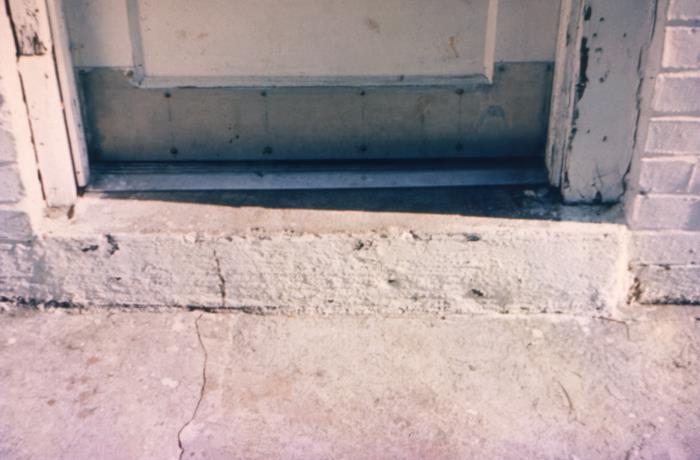
Building America recommends that doors fit with less than 1/4 inch between the bottom of the door and the threshold. If you see daylight at the bottom or the lower corners during the test above:
- Fit a rodent-proof door sweep, not a vinyl one. Building America notes that rodents can chew through vinyl, and describes a metal-and-rubber sweep that runs the full width of the door, reaches the corners, and brushes the floor without holding the door open, which would be a fire hazard.
- Do not count weather stripping as a rodent barrier. NC State Extension states that rodent-proof door sweeps are not the same as weather stripping; the rodent-proof type is filled with metal mesh.
- Check the threshold as well as the sweep. NC State lists metal thresholds and metal kick plates alongside sweeps, so a worn threshold may need repair rather than just a new sweep.
- Protect gnawed edges. UC IPM notes it may be necessary to cover the edges of doors and windows with metal to prevent gnawing.
- Garage doors: the same daylight check applies. Building America mentions a rubber seal along the bottom of the garage door to improve durability and discourage gnawing.
Pipes, wires and utility penetrations
Building America’s method for a utility opening is to stuff the hole with wire mesh and cover it with a hardening compound, or cover it with a metal escutcheon plate, on both the interior and exterior surfaces. Small gaps can be closed with foam, spackle or caulk; larger gaps need that metal reinforcement. UC IPM describes the same principle for openings around water pipes, vents and utility cables: seal them with metal or concrete.
Work carefully around gas lines, electrical service and anything connected to a heating appliance. If a penetration involves equipment you are not qualified to work on, have the repair done by someone who is.
Foundation, sill and masonry gaps
CDC points to the line between the foundation and the ground. UC IPM advises sealing cracks in building foundations with metal or concrete. Building America shows an unsealed seam between the sill plate and the foundation wall as an example of what to fix, and advises covering cracks and holes on both the interior and exterior surfaces.
For a manufactured home, CDC adds two specific steps: fix gaps in the skirting and use flashing around the base.
Attic, soffit, roof and crawlspace vents
Vents have to stay open, so the repair is a durable cover rather than a plug.
- Crawlspace vents: Building America says to make sure every one, including any under a deck, is covered with a 1/4-inch metal screen fastened in place with permanent fasteners.
- Attic and crawl space openings: NC State recommends commercially available screened vents, or screening with 1/4-inch hardware cloth.
- Soffit vents: sturdy metal vent covers mechanically fastened to the framing; where the vent openings are larger than 1/4 inch, Building America says to back them with 1/4-inch hardware cloth.
- Roof and gable vents: 1/4-inch metal screening in roof vents; plastic gable louvers replaced with metal ones and screened on the back. Secure loose ridge vent end caps.
- Chimneys: Cornell notes that commercially produced covers meet the ventilation safety requirements of fire codes, while many homemade covers do not.
Building America’s caution applies to all of these: do not reduce ventilation too much when you modify a vent, and check the requirements for each piece of equipment before you change its vent.
Two openings you should not simply close.
Dryer exhaust outlet. Building America is explicit: do not install screens over dryer exhaust duct terminals; cover them with gravity louvers instead. Its pest guide explains why — lint builds up on a screen, which can damage the dryer and cause fires. Cornell gives the same warning. If the outlet needs protecting, use a vent designed to exclude animals without trapping lint.
Brick weep holes. The small open joints near the bottom of a brick wall let water drain and air move out of the cavity behind the brick. Building America notes that mice can get into that cavity, and that weep holes must be protected with screen covers. It shows weep holes filled with spray foam as a mistake that prevents drainage. Use a screen or insert that keeps the hole open; never fill it with foam, caulk or mortar.
After sealing: how to tell whether it worked
A finished repair is not proof that mice have stopped getting in. Verify it with evidence.
- Keep trapping indoors. Captures after sealing mean mice were already inside, or that an opening was missed. A single capture does not tell you which, so keep checking both.
- Clean the old evidence first, so anything new stands out. New droppings after cleanup are evidence of current activity. How to clean up safely.
- Do not over-read a clean spot. A spot that stays clean is evidence for that spot, not proof the building is mouse-free.
- Re-inspect the repairs. Look for gnawing at patch edges, filler that has been pushed out, rusting steel wool, foam left exposed to the sun, and door sweeps that have worn or lifted.
- If signs come back in one area, inspect around it again — including above it. Mice climb.
When professional help makes sense
- You cannot reach the openings safely, such as roofline work at height. This is RodentVerify’s editorial judgment rather than a source recommendation: a ladder at the eaves is not a DIY task for everyone.
- Rodents have reached places you cannot get into to clean. CDC says a pest control specialist can be contacted in that situation, and suggests contacting your local or state health department if you are concerned about an infestation.
- Activity continues despite sealing and trapping, or the openings are too many to find and close yourself. NC State notes that some pest management companies offer exclusion services for a fee.
- The opening may be used by bats or squirrels, where timing and local rules matter. See the wall-noise guide.
- The repair involves gas, electrical, heating or venting equipment.
Sources & verification
- CDC — How to Seal Up to Prevent RodentsThe pencil-width, 1/4-inch figure; the indoor and outdoor inspection lists; steel wool held with caulk or spray foam; materials for larger holes; skirting and flashing; when to contact a health department or pest control specialist.
- UC IPM — House Mouse (Pest Notes 7483)Sealing openings larger than 1/4 inch; steel wool as a temporary plug that may rust; foam and other gnawable materials ineffective for holes used by mice; climbing ability; population reduction alongside exclusion.
- UC IPM — RatsThe same 1/4-inch sealing threshold for excluding both rats and mice.
- NC State Extension — Surveillance and Management of Common Structure-Invading MiceSteel wool versus copper mesh; caulking over fillers; lath metal and sheet metal; foam not recommended; rodent-proof door sweeps versus weather stripping; interior sealing points; vent screening.
- Building America Solution Center — Reduce Pest IntrusionDoor daylight test and sweep specifications; utility penetrations; limits on blown foam; smooth patches; crawlspace, soffit, roof and gable vents; dryer-vent lint and fire risk; material gauges.
- Building America Solution Center — Screens and Other Deterrents for Birds, Rodents, and Other PestsNo screens over dryer exhaust terminals; gravity louvers instead.
- Building America Solution Center — Moisture-, Impact-, Fire-, and Pest-Resistant Exterior SidingWeep holes drain and ventilate the wall cavity, mice can enter it, and weep holes need screen covers rather than foam.
- Cornell IPM — Pest ExclusionChecking that animals will not be trapped inside before closing an opening; hardware cloth mesh size; stainless steel mesh; aluminum flashing; chimney covers and fire codes.
- National Pesticide Information Center — MiceBrown or gray smudge marks as indicators of heavily used paths and entrances.