
Traps and materials
Do Ultrasonic Pest Repellers Work on Mice and Rats?
Not reliably. University pest experts in California, Arizona and Georgia all say home sound repellers have not been shown to work, and the Federal Trade Commission has repeatedly told sellers to back up their claims. Mice and rats can hear ultrasound and may react at first, but the sound does not pass through walls or furniture and the animals get used to it. One small study in a single house did report fewer mice, which we cover below. For a real infestation, sealing gaps, removing food and trapping are what the evidence supports.
Short answer: do not count on a sound repeller to get rid of mice or rats that are already inside. At best it may make them avoid the area right in front of it for a while. If you see droppings or gnaw marks, seal, trap and clean up as CDC recommends.
What university pest experts say
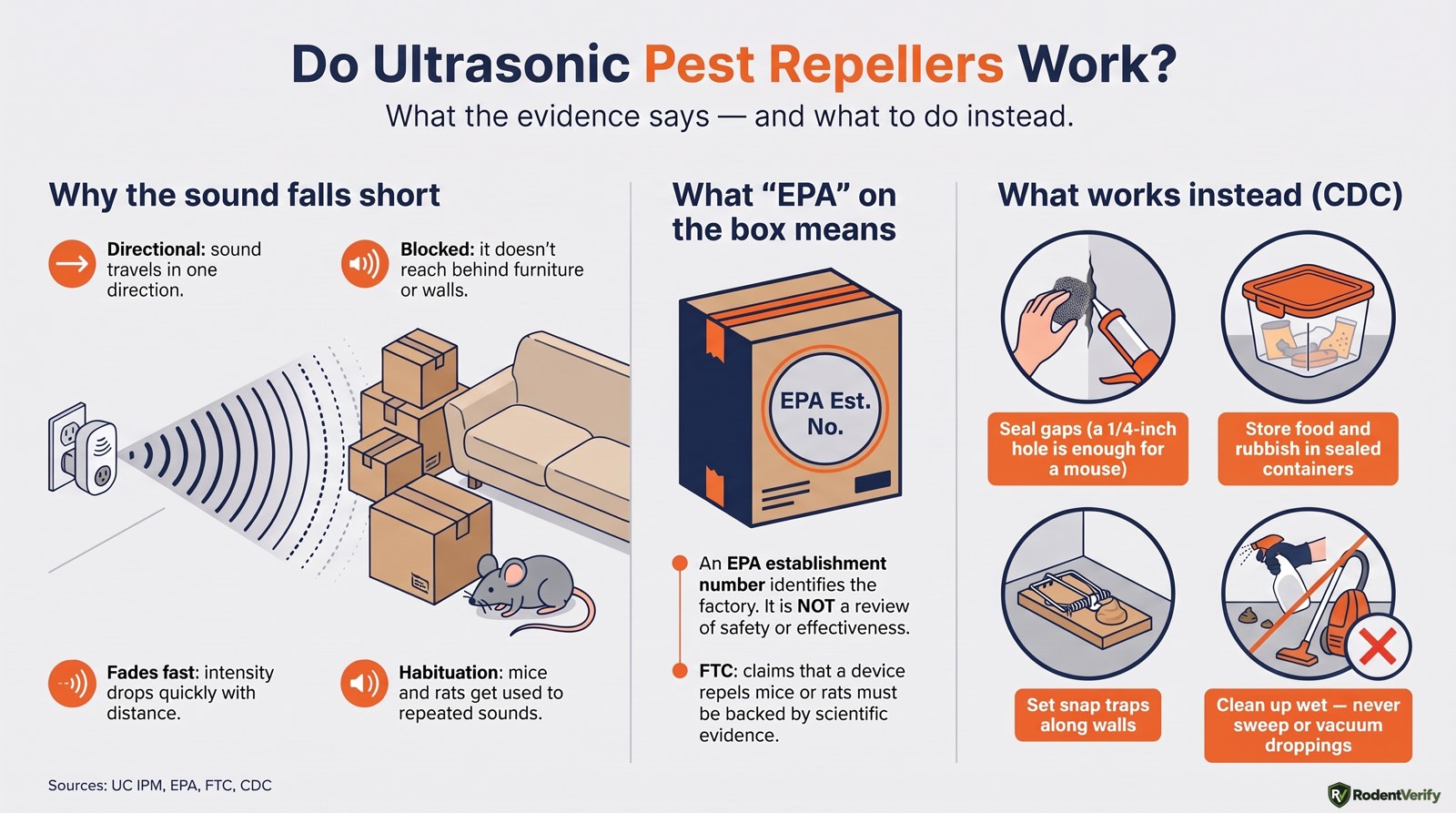
The University of California’s pest management program is blunt. For house mice, UC IPM says: “High frequency electronic devices aren’t effective.” It explains that mice quickly get used to regularly repeated sounds, that ultrasound is directional and does not penetrate behind objects, and that it loses intensity quickly with distance. It adds that “there is little evidence that sound, or magnetic or vibrational devices of any kind will drive established house mice or rats from buildings or provide any prevention or control.”
For rats, UC IPM says they “quickly become accustomed to repeated sounds,” which makes frightening devices, including high frequency and ultrasonic sounds, ineffective for controlling rats in homes and gardens.
Other extension services agree:
- University of Arizona (Sonic Pest Repellents, 2015): residential sonic devices “have not been shown to be effective in scientific studies,” and “use of these devices is not advised to treat common pest problems.”
- University of Georgia (Repellents and Wildlife Damage Control, reviewed 2024): “Plug-in ultrasonic repellents that claim to rid dwellings of snakes, rats, mice, and bugs are almost completely useless.”
- Iowa State University (Ultrasonic Pest Control – Buyer Beware, 2001): “there is no research to support the claims that ultrasonic devices will eliminate unwanted rodent and insect pests.”
Is there any study where a repeller helped?
Yes, one, and it is worth knowing what it does and does not show. In a paper for the 2018 Vertebrate Pest Conference, Philip Whitford of Capital University in Ohio switched a sonic/ultrasonic unit on and off in an old farmhouse over several years. With the unit on, nine mice were caught and 14 droppings were found on the kitchen counter; with it off, 91 mice were caught and 154 droppings were counted. The author concluded that the unit plus snap traps made the house nearly mouse-free.
The limits matter. It was one house, not a controlled trial across many homes. Six snap traps stayed in place the whole time, so the device was never tested on its own. And the mice there were native white-footed deer mice, not the house mice most people deal with. It is a genuine positive report, but it does not outweigh the expert guidance above. If you are unsure which mouse you have, see deer mouse vs house mouse.
Our own experience
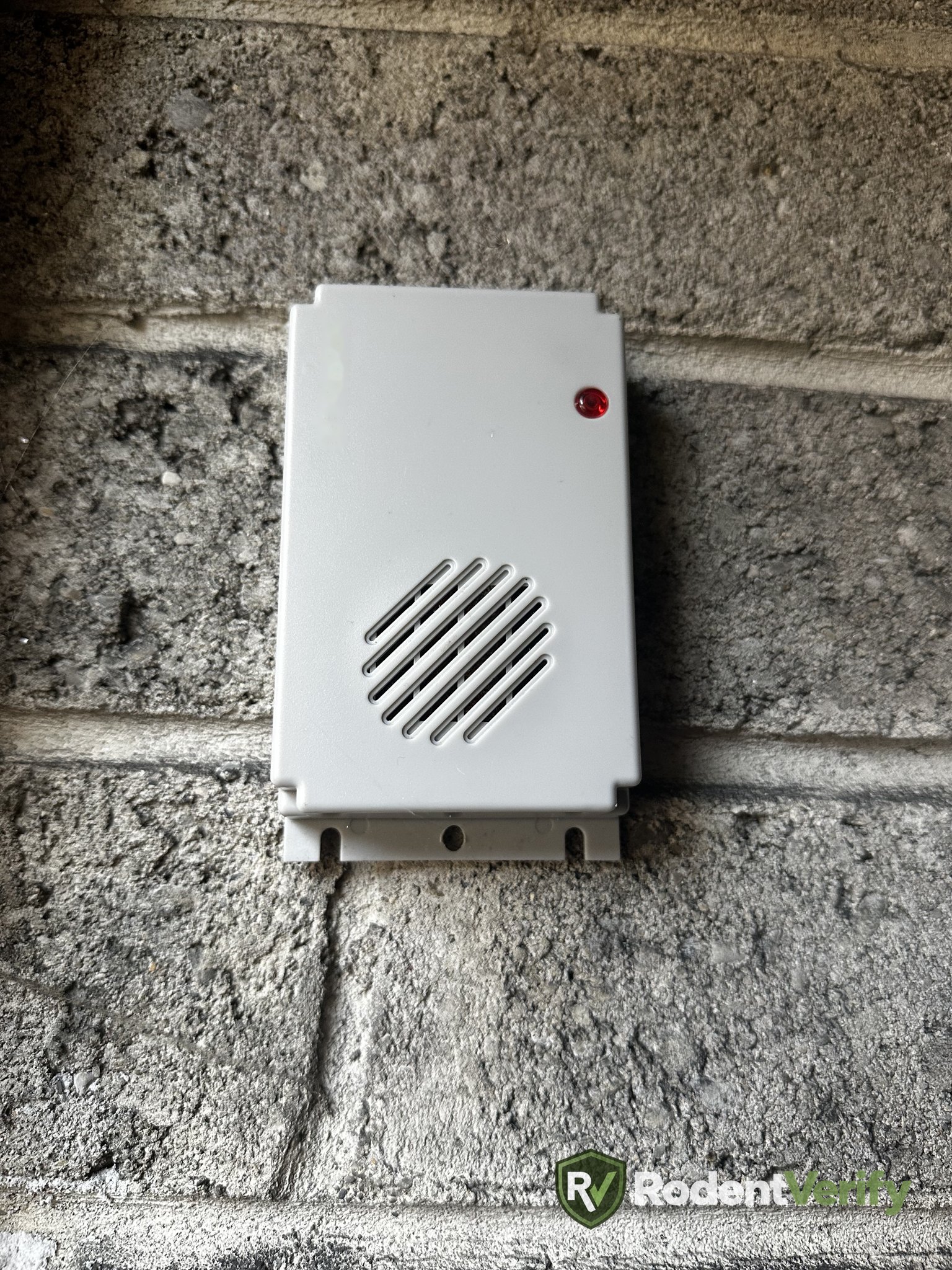
It worked for us. A rubbish bag we left overnight in our backyard outbuilding was badly chewed by the next morning, most likely by rodents. With a dog in the house, traps and poison were out, so we moved rubbish into containers with tight-fitting lids and put a battery-powered ultrasonic repeller on the outbuilding wall. That was several years ago. Since then we have seen no chewing, no droppings and no mice or rats there, and the dog never reacted to the device. We changed two things at once, though, and sealed food storage is exactly what CDC recommends, so we cannot say how much of the result is the device. One outbuilding is not proof, and the research on this page is why we would not rely on a repeller alone.
Why sound does not clear a house
Mice and rats hear sounds well above the range of human hearing (Lue et al., 2023), which is why these devices use ultrasound. But hearing a sound is not the same as leaving. The problems UC IPM describes are physical: ultrasound is directional, does not reach behind furniture, boxes and walls, and fades quickly with distance. Mice nesting inside a wall, under a cabinet or in stored boxes are exactly where the sound does not reach. And animals that hear the same sound over and over get used to it.
The sound also does nothing about why they came. A gap the width of a pencil, 1/4 inch, is enough for a mouse, according to CDC, and food left out keeps them coming back. If you are hearing animals in the walls, scratching in walls at night explains how to tell what it is.
What “EPA” on the box means, and what the FTC has done
EPA does not approve these devices. EPA classifies ultrasonic sound generators as pesticide devices, not pesticides. Its consumer guide says “FIFRA does not require devices to undergo premarket review and registration before being sold and distributed.” The EPA establishment number you may see on the package only identifies the factory: it “does NOT indicate that the product has been reviewed for safety or efficacy by EPA.” Devices still may not carry false or misleading claims, and some states require their own registration.
The FTC has challenged sellers for decades. In 2001 the FTC warned more than 60 manufacturers and retailers of ultrasonic pest-control devices that “claims about those products must be supported by scientific evidence,” noting six earlier cases between 1985 and 1997, each settled by consent order. Those earlier complaints alleged that any reaction by rodents would be “temporary at best” because they become accustomed to the sound.
In 2003 the FTC reached a consent order with Global Instruments over electromagnetic, ultrasonic and combination devices. The complaint challenged claims that the products would “repel, drive away, or eliminate mice, rats, and cockroaches from homes and other buildings in two to four weeks,” including by sending a signal through a home’s electrical wiring. Under the order, the company may not make such claims without competent and reliable scientific evidence. A consent order is a settlement, not a court ruling that every such product fails.
Private lawsuits continue. In Maroney v. Woodstream Corporation in federal court in New York, buyers allege that the Victor PestChaser “does not work as advertised.” Woodstream denies the allegations, and the case notice states that no court has decided who is right.
Are they safe for people and pets?
The best study on people is small. Researchers writing in the Journal of the Acoustical Society of America (2018) tested a repeller on 25 younger and 25 middle-aged adults. A short exposure “did not lead to significant adverse effects,” but the device also gave off “a faint but audible sound in the 4–5 kHz range,” younger listeners often heard it on the lower settings, and some found it disturbing. The authors called for better guidelines, especially for people most sensitive to sound. The study did not look at children or long-term exposure.
For pets, we found no official guidance from veterinary schools, the AVMA or the ASPCA on household ultrasonic repellers. That means there is no evidence either way, not that they are proven safe. If you keep hamsters, guinea pigs, pet rats or mice, or rabbits, ask your veterinarian before running one nearby.
What works instead
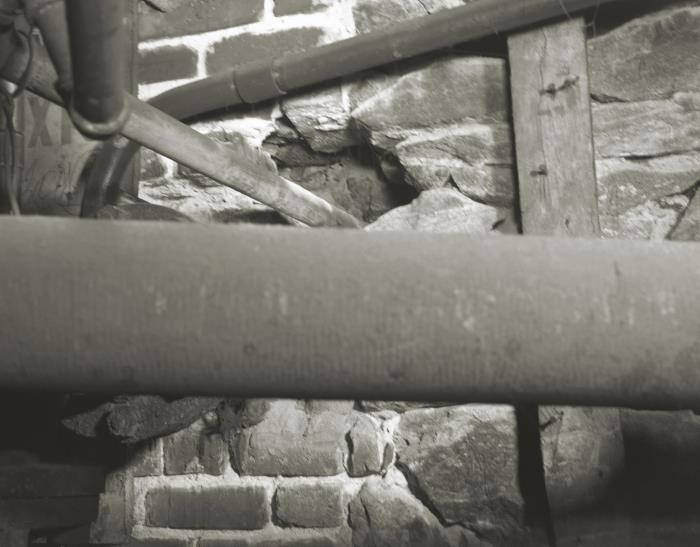
- Seal the gaps. CDC: fill small holes with steel wool held in place with caulk or spray foam, and use lath screen, metal, cement, hardware cloth or metal sheeting for larger ones. Details: how to seal mouse entry points.
- Remove food. Store food and rubbish in containers with tight-fitting lids and do not leave pet food out overnight.
- Trap. CDC recommends traditional snap traps, not glue traps or live traps, and says to keep traps out of reach of children and pets. Which trap and where: best mouse traps.
- Clean up safely without sweeping or vacuuming droppings: how to clean mouse droppings.
- Confirm they are gone: how to know if mice are gone.
Scents are no better than sound: see does peppermint oil repel mice?
Bottom line
University experts, the FTC and EPA all point the same way: an ultrasonic repeller is not a proven way to get rid of mice or rats, and the EPA number on the box is not an approval. One single-house study and our own outbuilding are encouraging stories, not evidence, and in both cases other measures were in place at the same time. If you already have rodents, seal the gaps, put food and rubbish in sealed containers, and set snap traps where children and pets cannot reach them.
Sources and verification
- UC IPM — Pest Notes: House Mouse (July 2025)High frequency electronic devices not effective; habituation; ultrasound directional, blocked by objects, fades with distance; little evidence for sound, magnetic or vibrational devices.
- UC IPM — Pest Notes: Rats (June 2025)Rats become accustomed to repeated sounds; high frequency and ultrasonic devices ineffective in homes and gardens.
- University of Arizona Cooperative Extension — Sonic Pest Repellents (az1639), Aflitto & DeGomez (revised October 2015)Residential sonic devices not shown effective; use not advised.
- University of Georgia Extension — Repellents and Wildlife Damage Control (C 1021) (reviewed July 2024)Plug-in ultrasonic repellents “almost completely useless.”
- Iowa State University Extension — Ultrasonic Pest Control: Buyer Beware, Donald Lewis (August 2001)No research supporting elimination claims.
- Whitford P.C. — TRANSONIC PRO Sonic/Ultrasonic Units Reduce Mouse Problems in Home, Proceedings of the 28th Vertebrate Pest Conference (2018), doi:10.5070/V42811056Single-house on/off comparison; 9 vs 91 mice caught; snap traps present throughout; white-footed deer mice.
- EPA — Pesticide Devices: A Guide for Consumers (September 2026)Ultrasonic generators are devices; no premarket review; establishment number is not a safety or efficacy review; no false or misleading claims; state registration.
- FTC — FTC Warns Manufacturers and Retailers of Ultrasonic Pest-control Devices (May 2001)Warning letters to more than 60 companies; six cases 1985–1997; rodent reaction alleged to be temporary.
- FTC — Global Instruments Ltd., analysis of proposed consent order (2003)Electromagnetic and ultrasonic devices; challenged two-to-four-week and wiring claims; substantiation required.
- Maroney et al. v. Woodstream Corporation, S.D.N.Y. No. 7:19-cv-08294 — class noticeAllegation that PestChaser does not work as advertised; defendant denies; no decision on the merits.
- van Wieringen A., Glorieux C. — Assessment of short-term exposure to an ultrasonic rodent repellent device, J. Acoust. Soc. Am. 144(4):2501–2510 (2018)50 adults; no significant short-term adverse effects; audible 4–5 kHz component; some found it disturbing.
- Lue P.-Y. et al. — Sheep as a large animal model for hearing research, Laboratory Animal Research 39:31 (2023)Mouse and rat hearing extending well into the ultrasonic range.
- CDC — How to Seal Up to Prevent Rodents (April 2024)The 1/4-inch hole; sealing materials; food storage.
- CDC — How to Trap Up to Remove Rodents (April 2024)Snap traps recommended; no glue or live traps; keep traps away from children and pets.