
Evidence and signs
Roof Rat vs Norway Rat: How to Tell Them Apart and Why It Changes What You Do
The United States has two introduced pest rats, and they behave differently enough that UC IPM says it is important to know which one you have before choosing how to control it. The body clues are reliable on an adult rat in hand; the signs around the house and yard only point one way or the other. Here is what university guides say about both, and what changes once you know.
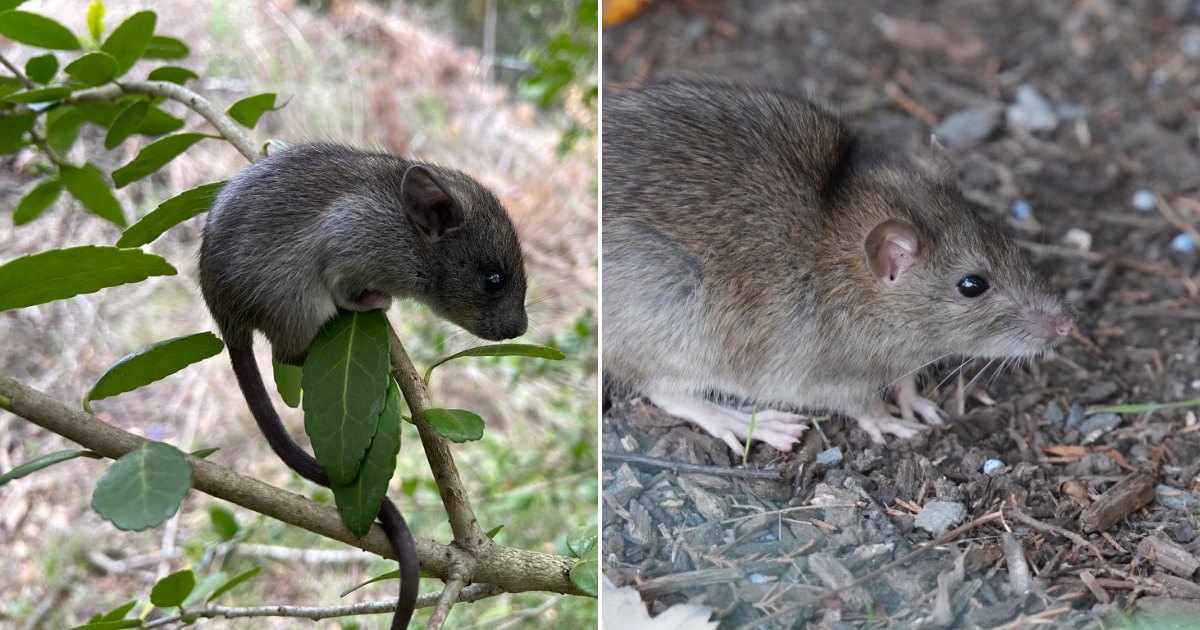
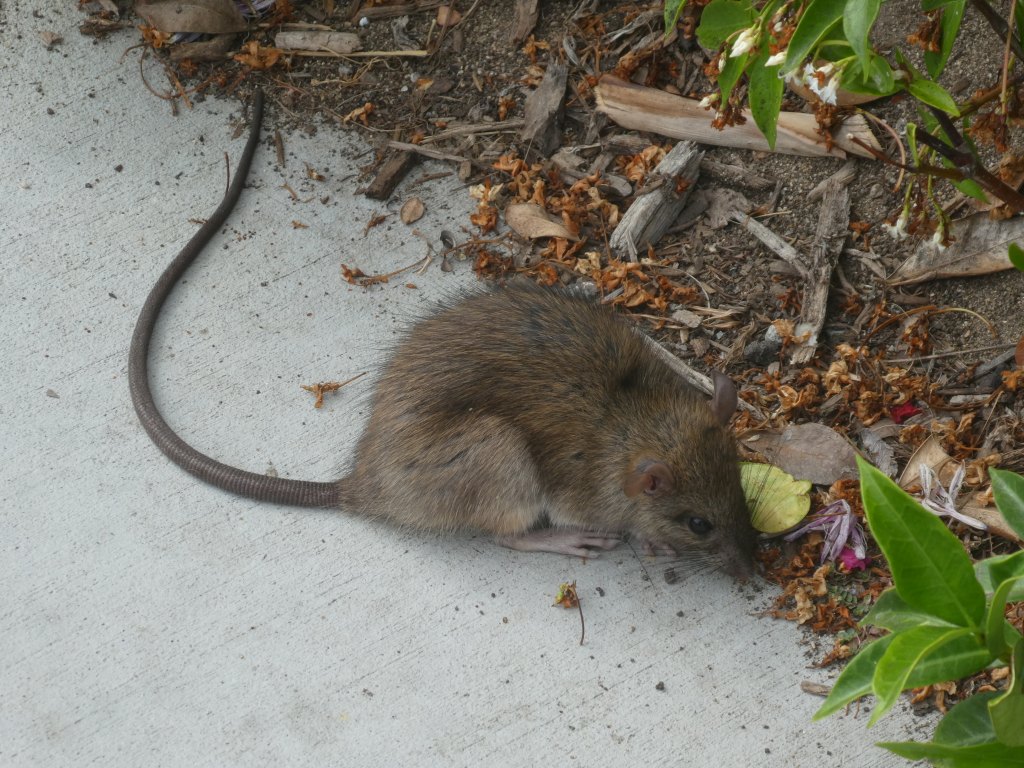
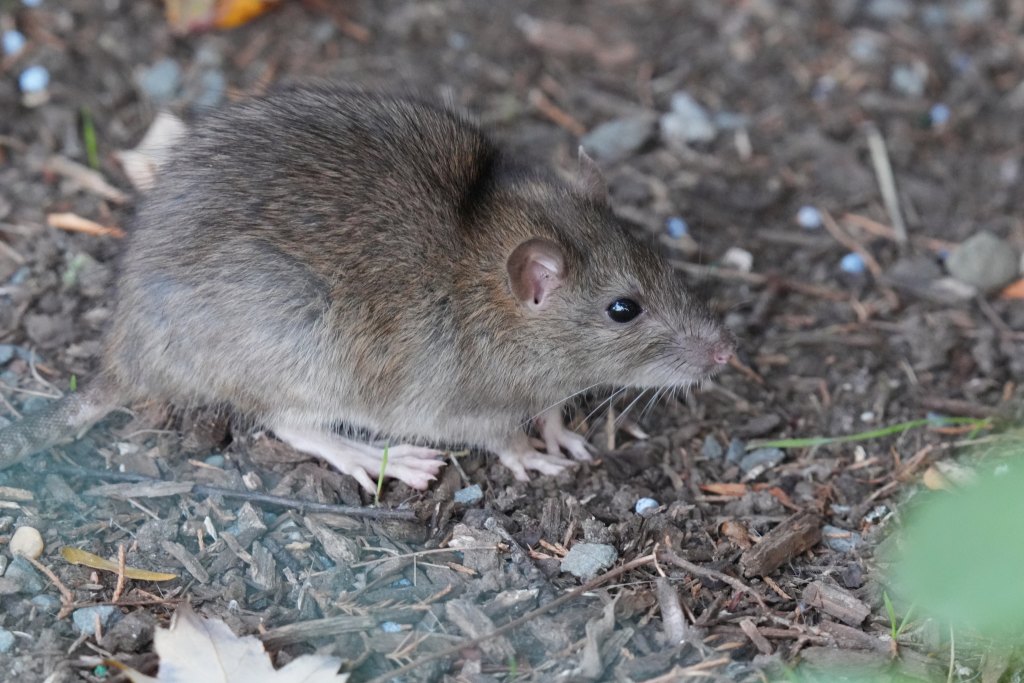
Short answer: a roof rat is sleek, with a pointed muzzle, large ears that reach the eyes when folded over, and a tail longer than its head and body. A Norway rat is large and stocky, with a blunt muzzle, small ears and a shorter tail (table). Roof rats climb and nest high, in trees, attics and walls; Norway rats burrow and stay low, along foundations and in basements, though both break that rule (where they live). Fur color is not a dependable clue. The difference matters for where you seal and where the traps go.
Roof rat vs Norway rat at a glance
UC IPM’s table of adult rats is the standard reference; ICWDM gives its own measurements, which are close but not identical. Where they differ, both are shown.
| Feature | Roof rat (Rattus rattus) | Norway rat (Rattus norvegicus) |
|---|---|---|
| Other names | Black rat, house rat, ship rat (UC IPM) | Brown rat, sewer rat, barn rat (UC IPM) |
| Build | Sleek, agile (UC IPM) | Large, robust (UC IPM) |
| Weight | 5 to 10 oz (UC IPM); about 5 to 9 oz, up to 12 oz (ICWDM) | 7 to 18 oz (UC IPM); average 12 to 16 oz (ICWDM) |
| Length | Body 6 to 8 in, tail 6 to 8 in (ICWDM) | Up to about 11 in, with a slightly shorter tail, about 16 in in all (Cornell) |
| Muzzle | Pointed (UC IPM) | Blunt (UC IPM) |
| Ears | Long enough to reach the eyes when folded over (UC IPM) | Do not reach the eyes when folded over (UC IPM) |
| Tail | Longer than head and body; uniformly dark, with fine scales (UC IPM) | Shorter than head and body; dark above and pale below, scaly (UC IPM) |
| Fur | Soft and smooth, brown with black intermixed; underside white, gray or black (ICWDM) | Coarse, usually brown or red-gray above, white-gray on the belly (ICWDM) |
| Droppings | About 1/2 in, pointed ends (ICWDM, Cornell) | Up to 3/4 in long and 1/4 in wide, blunt ends (ICWDM); 3/4 to 1 in (Cornell) |
| Lives | Above ground: trees, shrubs, ivy; indoors in attics, walls, ceilings and cabinets (UC IPM) | In burrows along foundations, under rubbish and woodpiles; indoors in basements and ground floors (UC IPM) |
| Best at | Climbing (UC IPM) | Swimming (UC IPM) |
The weights overlap, so a scale alone will not settle it. Neither will a single feature on a young rat: UC IPM’s table describes adults, and young rats of both species have large heads and feet for their size. If you are not yet sure it is a rat at all, start with mouse vs rat.
The tail test
UC IPM’s advice, if you are unsure which species you have, is to look at the tail against the head and body on a trapped rat. Pulled over the back toward the head, a roof rat’s tail reaches at least to the snout; a Norway rat’s reaches about the middle of the skull. Cornell describes the same field test for areas where both rats live: if the tail extends past the snout, it is a roof rat. Wear disposable gloves to handle a dead rat, as UC IPM advises, and see what to do with a dead mouse for the rest of the disposal steps, which are the same for rats.
Why fur color does not settle it
The name “black rat” misleads. ICWDM describes roof rat fur as brown with black intermixed and says three subspecies are generally told apart by their fur color; their bellies can be white, gray or black. The Norway rat is usually brown or red-gray. A brown rat in your yard can be either species, which is why the guides lean on the tail, ears and muzzle instead.
Which rat lives in your part of the U.S.
Norway rats are everywhere. ICWDM says they have spread throughout the contiguous 48 states, Alaska and Hawaii, generally at lower elevations but wherever people live.
Roof rats are regional. ICWDM places them along the lower half of the East Coast, through the Gulf States up into Arkansas, along the whole Pacific Coast, and in Hawaii. It says most interior states are free of roof rats, though isolated infestations, probably from infested cargo, can occur, and that the roof rat is more suited to warm climates. Cornell says roof rats are generally not found in New York. UC IPM adds that roof rats prefer warm, coastal areas but that their documented range is expanding, and that in some parts of California both species are present.
That means in most interior states a rat is very likely a Norway rat. Near the southern or western coasts, it could be either, and the body clues matter.
Up high or down low: where each one lives
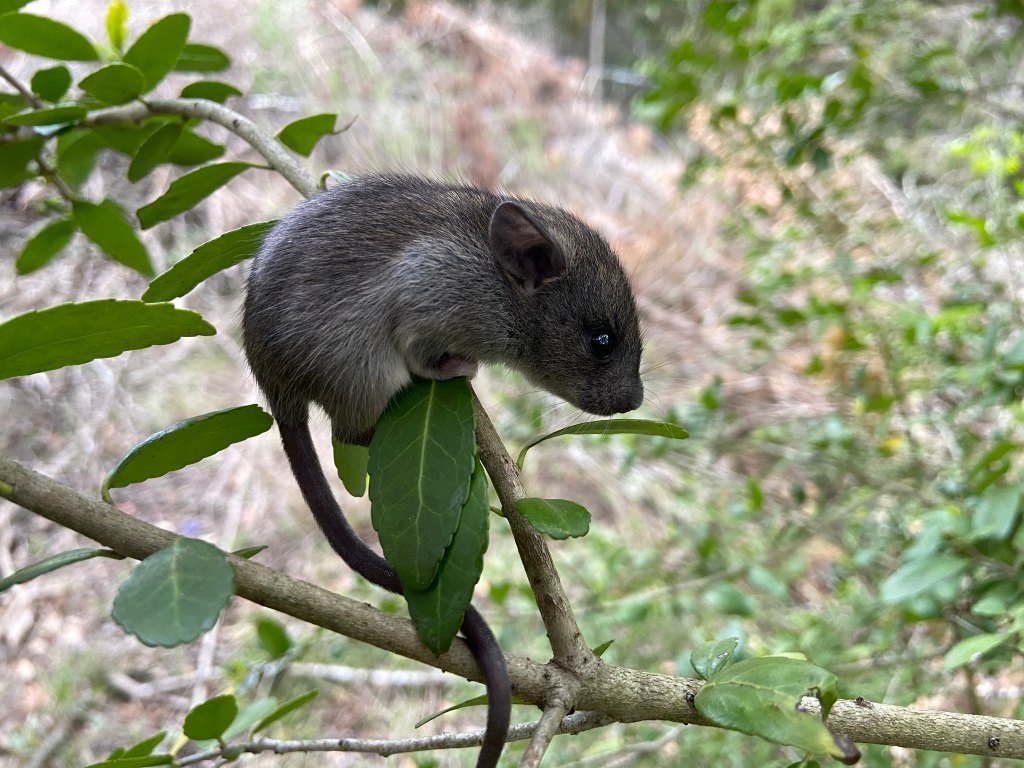
Roof rats are agile climbers that usually live and nest above ground in shrubs, trees or dense vegetation such as ivy, UC IPM says; mature landscaping makes good habitat. Indoors they nest in enclosed, elevated spaces: attics, wall voids, ceiling voids and cabinets. They are often seen at night running along utility lines or fence tops. ICWDM says sounds in the attic are often the first sign of roof rats in a house; rats or mice in the attic covers what to look for there.
Norway rats are burrowers. UC IPM finds their burrows along building foundations, beneath rubbish or woodpiles and around gardens; inside, they usually stay in the basement and ground floor. Cornell says they need standing water to drink every day.
Both break the pattern. UC IPM notes that roof rats will periodically burrow into soil and may even occupy sewers, especially when there is nowhere high to nest, and that Norway rat infestations in ceiling voids are not uncommon. When the two share a building, UC IPM says, Norway rats typically occupy the basement and ground floors and roof rats the upper floors. Where you find a rat is a clue, not proof.
Signs that point to one or the other
Often you never see the rat. These signs lean one way, according to the sources; none proves the species on its own.
| What you find | Leans toward | Why |
|---|---|---|
| Burrows along the foundation, under woodpiles, in garden beds | Norway rat | UC IPM: Norway rats build burrows in these places. ICWDM: active holes are 2 to 3 inches wide, clean of debris, often with rat hairs at the entrance. Roof rats burrow only occasionally. |
| Oranges hollowed out on the tree, rind left hanging | Roof rat | UC IPM and ICWDM both describe roof rats eating the pulp through a small hole and leaving the empty rind. UC IPM says they often eat lemon rinds and leave the flesh. |
| Noises in the attic, rats on wires or fence tops at night | Roof rat | ICWDM: attic sounds are often the first sign of roof rats. UC IPM: they run along utility lines and fences. |
| Activity in the basement or on the ground floor only | Norway rat | UC IPM: indoors, Norway rats usually stay low. |
| Rat-sized droppings with pointed ends, about 1/2 inch | Roof rat | ICWDM and Cornell. |
| Larger droppings with blunt ends, 3/4 inch or more | Norway rat | ICWDM; Cornell gives 3/4 to 1 inch. |
| Smudge marks on rafters, beams and pipes | Either | UC IPM lists rub marks on beams, rafters, pipes and walls as a sign of rats in general. |
Dropping sizes come from different guides and do not match exactly, so we treat droppings as one clue among several. Photos and actual-size comparisons are in mouse droppings vs rat droppings; for working out the animal from all the signs together, see do I have mice or rats?
How they behave differently
- Travel. UC IPM says roof rats routinely travel up to 300 feet or more for food and may live in one yard and feed on fruit trees in another; ICWDM gives 100 to 300 feet when necessary. Norway rats forage anywhere from 100 to 500 feet from the nest, depending on conditions, but stay as close to it as they can when food is near (UC IPM).
- Food. Roof rats prefer fruits, tree nuts, berries, slugs, snails, young birds and eggs, and eat avocados and citrus on the tree. Norway rats prefer cereal grains, meats, fish, nuts and some fruits, but take whatever is abundant, such as food waste (UC IPM).
- Eating. UC IPM says the two species do not feed together: roof rats commonly carry food away to eat elsewhere, while Norway rats often eat where they forage.
- Caution. Both rats avoid new objects and foods, often for days or weeks after a trap appears; UC IPM thinks this is more pronounced in roof rats.
- Nest sites. UC IPM says roof rats have very strong nest-site affinity and return if their nest sites are not removed during cleanup.
- Breeding. Roof rats average 3 to 5 litters of up to 8 young; the average female Norway rat has 4 to 6 litters a year and can wean 20 or more young annually (UC IPM).
- They do not mix. UC IPM and ICWDM both say the two species cannot interbreed.
What changes once you know which rat you have
The overall plan is the same for both: seal the way in, trap the rats inside, remove food and shelter. How to get rid of rats walks through it step by step. The species changes where you do each part.
Sealing
- Roof rats: openings above ground level must be plugged too, and UC IPM says rodent-proofing against roof rats usually takes more time to find the entry points, because of their climbing. Remove climbing plants from buildings and cut back tree limbs near the roof: UC IPM’s quick tips say limbs within 3 feet of a roof, its full Pest Note says within 6 feet. If roof rats are traveling on overhead utility wires, UC IPM says to contact a pest professional or the utility company.
- Norway rats: UC IPM’s general list covers the low entry points: cracks in the foundation, openings for pipes, wires and vents, and a tight cover for the crawl space. It also warns that Norway rat burrows can undermine foundations and slabs.
Materials and gap sizes for both are in how to seal entry points. If rats may already be inside a wall, read mice or rats in the walls before sealing.
Trapping
- Norway rats: close to walls, behind objects, in dark corners and where you found droppings, smudge marks or burrows, at a right angle to the wall (UC IPM).
- Roof rats: both on the ground and above it, on ledges, shelves, branches, fences, pipes and beams, fastened to the surface where possible (UC IPM).
Pre-baiting, numbers and spacing are in best rat traps.
Bait stations
UC IPM says to place stations for Norway rats near burrows, nest sites, walls and travel routes, and for roof rats in elevated spots such as the crotch of a tree, a fence top or high in a vine, securely fastened so they cannot fall where children or pets could reach them. It also notes recent research showing roof rats may not enter bait stations even on established runways. CDC recommends snap traps for homes; poison has risks for pets and wildlife, covered in mouse poison around dogs and cats.
The yard
For roof rats, UC IPM says to thin dense plantings, keep shrubs 2 feet or more from each other and from buildings, remove fallen fruit and nuts, and thin or remove climbing ivy, star jasmine and honeysuckle on fences and buildings. For Norway rats, look where UC IPM says they burrow: along foundations, under rubbish and woodpiles, beneath compost piles and garbage cans. UC IPM does not recommend smoke or gas cartridges in burrows around homes, because Norway rat burrows can run under a house.
If it is neither
- A young rat or a mouse. UC IPM says very young rats have large heads and feet for their bodies, unlike adult mice. See mouse vs rat.
- A pack rat (woodrat). UC IPM says these rats, some of them native to California, may be found in and around homes and also eat fruit and nuts. It says the easy check is the tail: woodrats have furry tails, while roof and Norway rats have scaly, mostly hairless tails.
- A squirrel. Running overhead in daylight fits a squirrel better than a rat; see scratching in walls at night for how the timing of sounds helps tell the animals apart.
Questions people ask
Are all roof rats black?
No. ICWDM describes roof rat fur as brown with black intermixed, and says the subspecies differ in color. Use the tail, ears and muzzle instead of color.
Which is bigger, a roof rat or a Norway rat?
The Norway rat: 7 to 18 ounces against 5 to 10 ounces for the roof rat, according to UC IPM. The ranges overlap, so weight alone does not identify the species.
Can Norway rats climb?
Yes. UC IPM says Norway rat infestations in ceiling voids are not uncommon, even though they usually stay in basements and on ground floors. Roof rats are the more agile climbers.
Can roof rats and Norway rats live in the same house?
Yes. UC IPM says that when both are in one building, Norway rats typically occupy the basement and ground floors and roof rats the upper floors. They do not feed together and cannot interbreed.
Do roof rats live in cold states?
Mostly not. ICWDM says most interior states are free of roof rats, apart from isolated infestations, and Cornell says they are generally not found in New York. UC IPM notes their documented range is expanding.
The bottom line
On an adult rat, the tail settles it: longer than the head and body, reaching at least to the snout when laid over the back, means a roof rat; shorter means a Norway rat. Large ears, a pointed muzzle and a slim build back up a roof rat; small ears, a blunt muzzle and a heavy body back up a Norway rat. Color does not. Without the animal, burrows and ground-floor activity lean toward Norway rats, and attic noise, hollowed citrus and rats on wires lean toward roof rats, but both species break the pattern. Outside the southern and western coasts, a rat is most likely a Norway rat. Once you know, seal and trap where that rat travels: low and along walls for Norway rats, high and fastened down for roof rats.
Sources and verification
- UC IPM — Pest Notes: Rats (June 2025)Importance of knowing the species; other names; table of adult characteristics (build, belly, weight, tail test, muzzle, ears); habitat, nesting and exceptions; range and preferred climate; both species in one building; food, citrus damage, travel distances and feeding behavior; neophobia; nest-site affinity; breeding; climbing and swimming; no interbreeding; young rats vs mice; pack rats; sealing, trapping and bait station placement by species; roof rats and bait stations; limbs within 3 feet (quick tips) and 6 feet (Pest Note); shrubs, climbing plants; smoke cartridges.
- ICWDM — Roof RatsBody and tail length; weight; fur and belly color; subspecies; droppings; U.S. range; warm-climate preference; isolated infestations.
- ICWDM — Roof Rats (damage prevention and control chapter)Travel 100 to 300 feet when necessary; hollowed oranges on the tree; attic sounds as the first sign; no crossing with Norway rats.
- ICWDM — Norway RatsWeight; fur; tail does not reach the nose; U.S. range; droppings; burrow holes.
- Cornell CALS (NYS IPM) — Mouse and Rat Biology and BehaviorNorway rat length and features; daily water; dropping sizes for both species; tail field test; roof rats generally not found in New York.
- CDC — How to Trap Up to Remove RodentsSnap traps recommended for homes.