
How mice and rats live
How Long Do Mice Live? In the Wild, in Your House and as Pets
A wild house mouse usually lives about a year. University and government guides put it at 9 to 18 months, depending on which one you read, and a pet mouse can live two years or more. That short life is the wrong reason to wait out mice in a house: they start breeding at about six weeks old, so the population lasts much longer than any one mouse. Here is what the sources say, why the figures differ, and what it means for you.
How long mice live, by source
The figures below are the ones each source actually gives. They are not identical, partly because some describe a typical life, some an average and some the longest lives recorded.
| Animal | How long it lives | Source |
|---|---|---|
| House mouse, wild | Usually 9 to 12 months; some have lived up to 3 years | UC IPM |
| 1 to 1½ years | NPIC | |
| Around 12 to 18 months on average; reaching the upper end is rare in the wild | NC State Extension | |
| Most do not live beyond 12 to 18 months | Animal Diversity Web | |
| House mouse, pet or captive | 1.5 to 2.5 years | Merck Veterinary Manual |
| About 2 years on average as a pet; wild-derived mice have lived up to 4 years in captivity, and some mutant or calorie-restricted captive mice up to 5 | Animal Diversity Web | |
| Deer mouse | Rarely more than 2 years in the wild | UC IPM |
| Vole (meadow mouse) | Seldom more than 12 months (UC IPM); 2 to 16 months (Penn State) | UC IPM; Penn State Extension |
| Norway rat / roof rat | Usually about 6 months / usually 9 to 12 months in the wild | National Park Service |
So for a house mouse in or around your home, “about a year” is a fair summary of all four sources, and “up to 3 years” is the rare exception UC IPM mentions. If you are not sure it is a house mouse, deer mouse vs house mouse, vole vs mouse and shrew vs mouse help tell them apart, and mouse vs rat covers young rats.
Why wild mice die young
A mouse can live two years or more when nothing kills it, which is why pet and laboratory figures are longer. In the wild, something usually does. NC State Extension says mice face predation by birds of prey, snakes and larger mammals and are extremely vulnerable to severe weather, food scarcity and human activity. Animal Diversity Web lists cats, foxes, weasels, snakes, hawks, falcons and owls among house mouse predators, and notes that mice make up for these losses by breeding fast.
Shelter matters too. UC IPM says house mice cannot survive in large numbers where they have few places to hide, rest, build nests or rear young. NC State points out that mice living indoors are away from common predators such as hawks and owls. None of the sources we checked gives a separate lifespan for mice living indoors, so we cannot tell you how much longer, if at all, a mouse in a house lives than one outside.
A house mouse’s life, from birth to breeding
The early weeks are short, and this is the part that matters for a house:
- Birth. Young are born 18 to 21 days after conception (UC IPM); ICWDM gives 19 to 21 days after mating.
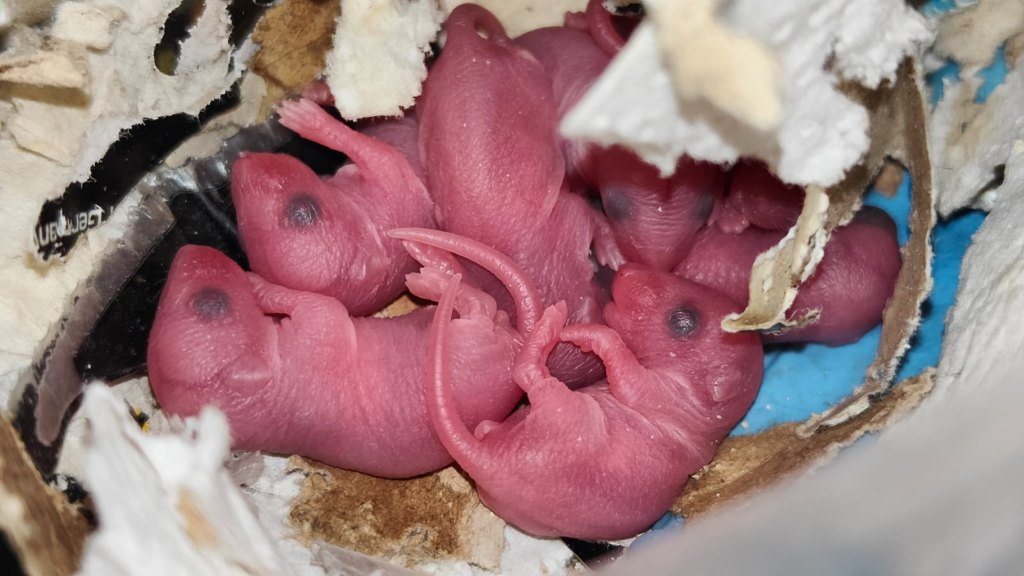
- First two to three weeks. ICWDM says the young are covered in hair with eyes and ears open after about 2 weeks, and start leaving the nest for short trips and eating solid food at 3 weeks.
- Breeding age. UC IPM says house mice are sexually mature 5 to 6 weeks after birth, although it can be delayed until as late as 12 weeks. ICWDM gives 6 to 10 weeks, NC State 6 to 8.
- The rest of the year. UC IPM counts 5 to 10 litters a year per female, usually 5 or 6 pups each, and notes that older females have bigger litters. NC State gives an average litter of 10 to 12. How baby mice grow, week by week, is in baby mice.
Put those together and a mouse spends most of its roughly one-year life able to breed. How fast numbers can grow, and what the signs say about how many you have, is covered in one mouse or an infestation.
Can you wait for mice in your house to die of old age?
No. A single mouse may not live long, but the group can. With steady food and shelter, UC IPM says, house mice breed in every season, and the dense populations that result can hold on for months or even years. A mouse that dies after a year has usually left young behind, and those young were breeding before it died.
Waiting also costs you something the whole time. Droppings and urine build up (are mouse droppings dangerous?), and mice keep chewing (rodent gnaw marks). The plan that works is the one in how to get rid of mice: trap the mice already inside, seal the openings, and take away food and nesting spots. How to know if mice are gone explains what counts as proof that the last one is gone.
Winter does not end it either. House mice do not hibernate, and indoors they keep breeding through the cold months (do mice hibernate?).
How long can a mouse live without food or water?
Water is the easy part for a mouse. House mice can manage without drinking at all, according to UC IPM, though they go looking for liquids when their food is too dry. ICWDM puts their need at about 0.4 ounces of water a day and says that, unlike rats, mice can get water from the food they eat; NC State says they can get by with little or no free water because they concentrate their urine strongly. NPIC makes the same point. So a dry house is not going to drive mice out (what attracts mice).
Food is different, but we did not find a source that says how many days a house mouse can go without eating. What UC IPM does say is that house mice can survive in very small areas with limited amounts of food, which is why a few crumbs and a bag of birdseed in the garage are enough to keep them going.
How long does a mouse live if you release it outside?
Often not long. UC IPM says that in a new environment, released house mice are likely to face aggression from other mice, be killed by a predator, or die from exposure if they cannot find shelter. It also notes that in California it is illegal to relocate live wildlife, including house mice, away from the property where they were caught without a permit from the state Department of Fish and Wildlife. Rules differ by state. CDC says not to use glue traps or live traps; best mouse traps covers what it does recommend.
More questions about how long mice live
How long do pet mice live?
The Merck Veterinary Manual gives 1.5 to 2.5 years for pet mice. Animal Diversity Web says about 2 years on average for a pet house mouse. This guide is about wild mice in houses; for a pet, ask a veterinarian.
Do mice die in the winter?
House mice are active all year and move indoors as it gets colder; we found no source that says how many survive a winter outdoors. See do mice hibernate?
Do mice live longer than rats?
Not clearly. The National Park Service’s rat manual gives about 6 months in the wild for Norway rats and 9 to 12 months for roof rats, which is in the same range as the 9 to 18 months given for house mice. These are different sources measuring different animals, so treat the comparison as rough. The rat figures, source by source, are in how long do rats live.
How long does a mouse live in a glue trap?
We did not find a source that gives a time. UC IPM says rodents caught on glue boards and other live-catch traps might not die quickly and will need to be euthanized, and CDC says not to use glue traps.
How long do deer mice live?
UC IPM says deer mice rarely survive more than two years in the wild. Deer mice matter more than their lifespan suggests because CDC says they spread the hantavirus that most often causes hantavirus pulmonary syndrome in the United States; see deer mouse vs house mouse.
In short
A wild house mouse lives about a year: 9 to 12 months by UC IPM, 1 to 1½ years by NPIC, 12 to 18 months by NC State and Animal Diversity Web, with rare mice reaching 3 years. Pet mice live longer, around 1.5 to 2.5 years. None of that helps much with mice in a house, because they can breed from about six weeks old and a population with food and shelter can last for months to years. Trap, seal and clean up rather than wait.
Sources and verification
- UC IPM — Pest Notes: House Mouse (July 2025)Life span usually 9 to 12 months, up to 3 years; populations lasting months to years with stable resources; 5 to 10 litters of about 5 or 6 pups, larger in older females; birth 18 to 21 days after conception; maturity at 5 to 6 weeks, up to 12; no need to drink water; surviving in small areas on limited food; shelter limiting numbers; fate of released mice and the California relocation rule; glue boards and live traps.
- NPIC — Mice (July 2026)Mice live 1 to 1½ years and reproduce quickly; may not need a water source if food is moist.
- NC State Extension — Biology and Behavior of Common Structure-Invading Mice (December 2024)Average life span around 12 to 18 months, the upper range rare in the wild; predators, weather, food scarcity and human activity; indoor living away from predators; gestation about 3 weeks; maturity at 6 to 8 weeks; 5 to 10 litters of 10 to 12; little or no free water needed.
- ICWDM — House Mouse BiologyLitters of 5 or 6 born 19 to 21 days after mating; hair, eyes and ears open at 2 weeks; solid food at 3 weeks; maturity within 6 to 10 weeks; 5 to 10 litters a year; water from food and about 0.4 ounces a day.
- Animal Diversity Web — Mus musculus (University of Michigan, 1999)Most wild mice do not live beyond 12 to 18 months; pets about 2 years; up to 4 years for wild-derived mice in captivity and 5 for some mutant or calorie-restricted captive mice; predators and fast recovery through breeding.
- Merck Veterinary Manual — Mice at a GlancePet mouse life span 1.5 to 2.5 years.
- UC IPM — Pest Notes: Deer Mouse (June 2012)Deer mice rarely survive more than two years in the wild.
- UC IPM — Pest Notes: Voles (April 2023) and Penn State Extension — VolesVole life spans: seldom more than 12 months (UC IPM); 2 to 16 months (Penn State).
- National Park Service — Integrated Pest Management Manual: Rats (archived copy, May 2010)Wild life span of Norway rats usually about 6 months and of roof rats usually 9 to 12 months.
- CDC — How to Trap Up to Remove Rodents and CDC — About HantavirusDo not use glue traps and live traps; the deer mouse as the main carrier of the hantavirus that causes HPS in the United States.