
Evidence and signs
Vole vs Mouse: How to Tell Them Apart and Why It Matters
Voles are often called “meadow mice” or “field mice,” but they are a different animal with a different problem attached. A house mouse is a pest of buildings; a vole is a pest of lawns, gardens and young trees, and university guides say it rarely comes indoors. Here is how to tell which one you have from the animal itself and from what it leaves behind, and what each answer means for what you do next.
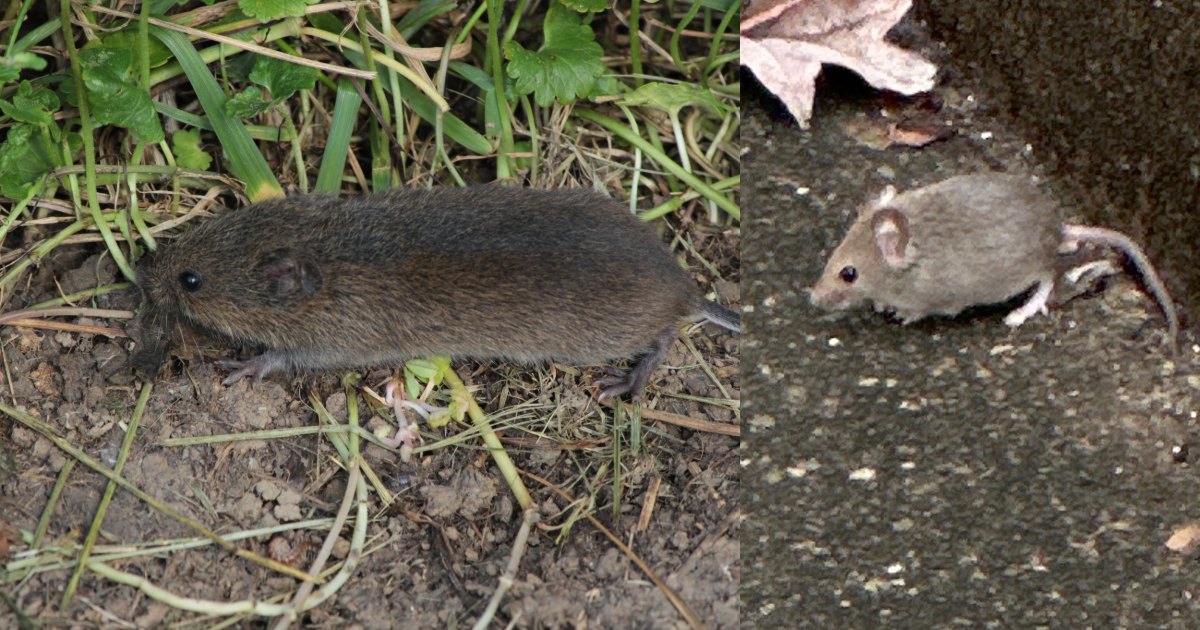
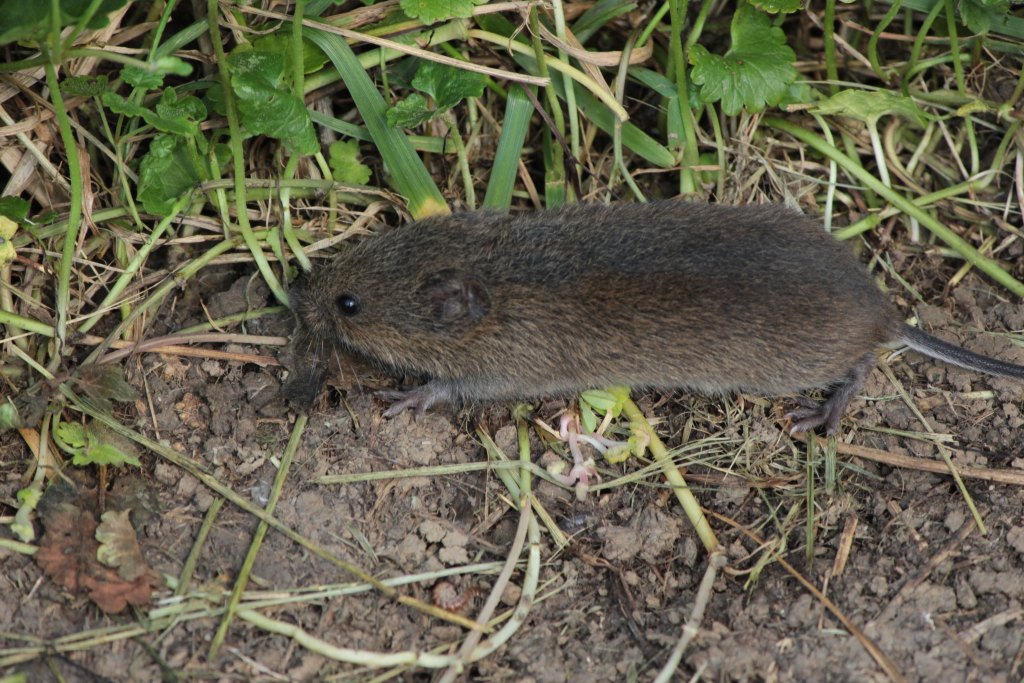
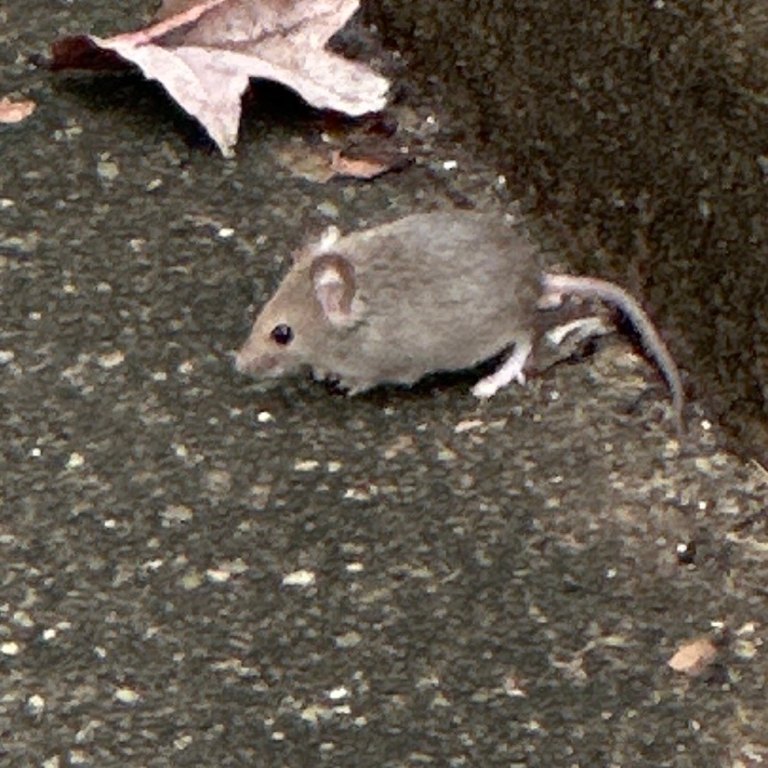
Short answer: look at the tail and the ears. A vole has a stocky body, a short tail and small ears that barely show through its fur. A house mouse has relatively large ears and a long, almost hairless tail that makes up about half its length (table). Where you found it is the next clue: voles live outdoors in dense grass and mulch and usually do not enter homes, while house mice often move indoors in autumn (indoors or outdoors). Surface runways in the grass, green droppings and bark chewed off near the ground point to voles (vole signs). The answer decides whether you protect the yard or deal with the house.
Vole vs mouse at a glance
The vole column describes the common Microtus voles. ICWDM counts 23 vole species in the U.S., 7 of which cause significant damage, and says the meadow vole is the most widely distributed. UC IPM and Penn State Extension give slightly different numbers; both are shown. The mouse column is the house mouse, the mouse most often found in homes. Deer mice and white-footed mice are covered separately in deer mouse vs house mouse.
| Feature | Vole (Microtus spp.) | House mouse (Mus musculus) |
|---|---|---|
| Other names | Meadow mice (UC IPM); field mice, meadow mice, ground moles, meadow moles (Penn State) | — |
| Build | Compact, heavy body and short legs (UC IPM); “stocky bodies, short legs, and short tails” (Penn State) | Small; about 1/2 ounce (UC IPM) |
| Length | 5 to 8 inches including the tail (UC IPM); 5 to 7 inches (Penn State) | 5 to 7 inches, including a 3- to 4-inch tail (UC IPM) |
| Tail | Short, with short fur (UC IPM) | Long, with almost no fur (UC IPM); nearly half the body length (Penn State) |
| Ears | Partly hidden (UC IPM); furred and “do not project much above the hair” (Penn State) | Relatively large (UC IPM) |
| Eyes | Small (UC IPM), black (Penn State) | Small and black (UC IPM) |
| Fur | Long and coarse, blackish brown to grayish brown (UC IPM) | Usually light brownish to gray (UC IPM) |
| Droppings | Greenish when fresh, about 3/16 inch, turning brown or gray with age (UC IPM); brown or green, shaped like rice grains (Penn State) | About 1/4 inch, pointed at the ends (see mouse droppings vs rat droppings) |
| Lives | Outdoors, in dense grass, mulch and ground cover, in shallow burrows linked by surface runways (UC IPM) | In and around buildings; nests of shredded paper or other fibers in sheltered places (UC IPM) |
| Comes indoors | Usually not (UC IPM); rarely (Penn State) | Often, especially in autumn (UC IPM) |
| Climbing | Poor climber (UC IPM) | Excellent climber; runs up rough vertical surfaces (UC IPM) |
| Food | Mostly plants: grasses, bulbs, tubers, bark and roots (UC IPM) | Omnivorous; eats whatever is available (UC IPM) |
| Active | Day and night, all year (UC IPM) | Mostly at night (UC IPM) |
| Lifespan | Seldom over 12 months (UC IPM); 2 to 16 months (Penn State) | Usually 9 to 12 months, rarely up to 3 years (UC IPM) |
Eye size does not help much: both have small, black eyes. The tail and the ears do the work.
The tail and ear check
Penn State Extension puts the quickest test in one line: “Mice have long tails that extend nearly half their body length, whereas voles have short tails.” UC IPM’s numbers say the same thing in inches: a house mouse is 5 to 7 inches long, and 3 to 4 inches of that is tail. A vole’s tail is short, so most of its 5 to 8 inches is body.
The ears are the second check. On a house mouse they stand out from the head; on a vole they are furred and sit almost flush with the fur. Both guides also describe a vole’s compact body and short legs, so it sits lower and rounder than a mouse.
If you only had a glimpse, the tail is what to try to remember. If you have a trapped animal, wear disposable gloves to handle it: UC IPM advises gloves for voles because they can carry pathogens or parasites, and the same applies to mice (what to do with a dead mouse).
Indoors or outdoors: the clue that usually decides it
UC IPM says voles “usually don’t enter homes or other buildings” and are poor climbers; they live in wildland, cropland or landscaped areas next to buildings, wherever there is protective cover such as dense vegetation, mulch or weed cloth. Penn State says voles “rarely invade houses.” House mice are the opposite: UC IPM says that where mice live outdoors, they frequently enter homes in autumn when nights turn colder.
So a small rodent running across the kitchen floor, droppings in a cabinet or chewing inside a wall fits a mouse far better than a vole. A short-tailed animal darting between holes in the lawn or under a mulched bed fits a vole. Neither rule is absolute, which is why the tail check matters when you do see the animal.
Signs of voles in the yard
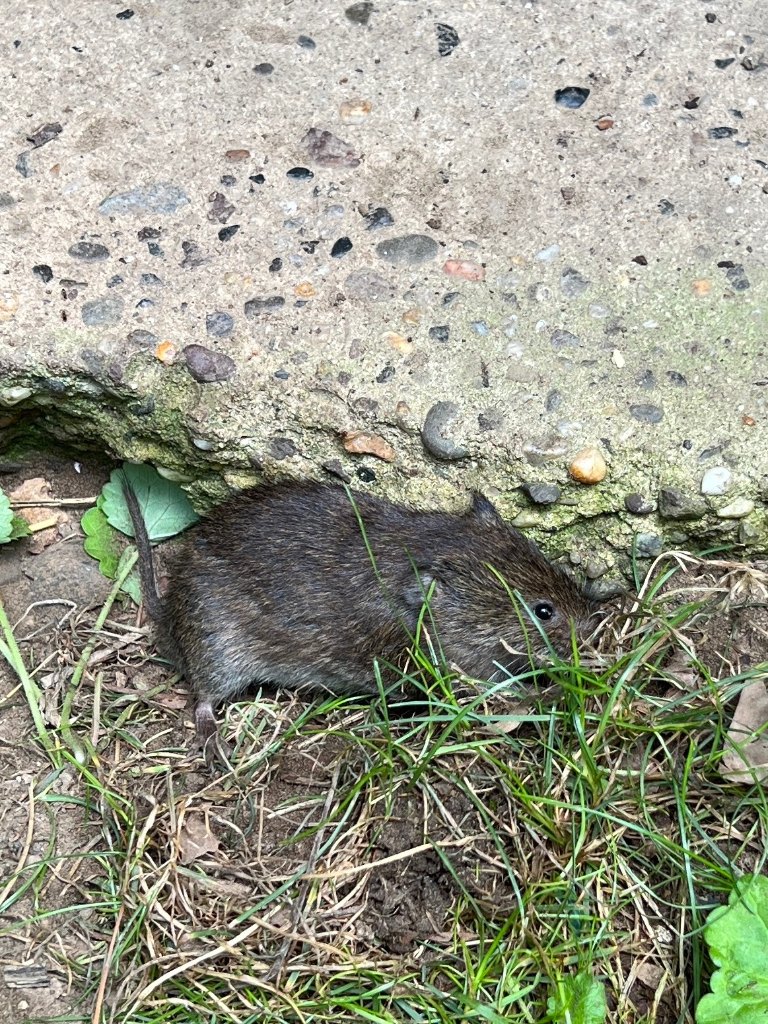
You may never see a vole, because UC IPM says they spend most of their time below ground. What they leave is distinctive:
- Runways. UC IPM calls well-traveled surface runways linking burrow openings the clearest sign of voles; they are usually hidden under grass or ground cover, so pull it back to look. Penn State says the travel lanes are about 1½ inches wide and are “reliable indicators” of meadow voles.
- Burrow openings. Many openings along the runways, each about 1½ to 2 inches across (UC IPM). Woodland (pine) voles leave small, conical piles of soil instead (Penn State).
- Clippings and droppings. Fresh clippings of green grass and greenish droppings about 3/16 inch long in the runways and near burrows (UC IPM).
- Bark gnawed near the ground. Gnaw marks about 1/8 inch wide and 3/8 inch long in irregular patches at various angles, usually from a few inches above to a few inches below the soil (UC IPM). Penn State adds that they are 1/16 inch or more deep and that rabbit gnaw marks are larger and more uniform. Where there is snow, damage can reach a foot or more up the trunk and often escapes notice until it is too late (UC IPM).
- Lawn trails after snow. Voles burrow in and through snow (UC IPM), and ICWDM notes that their tracks may be seen after a light snow. Penn State says runway damage in lawns is usually a temporary problem.
- Garden and line damage. UC IPM lists vegetables, bulbs, turf, fruit tree bark and even chewed irrigation lines.
House mice do not leave runway networks in the lawn. Their signs are indoors: droppings, gnaw marks, shredded-paper nests, a musky smell in long-term infestations and, less often, tracks (UC IPM). For those, see rodent gnaw marks, mouse nest signs and mouse urine smell.
If it is neither: shrews, gophers and deer mice
- Shrew. UC IPM’s house mouse guide says common voles have short tails, “whereas shrews have pointed snouts and tiny eyes.” A long, pointed nose is the giveaway.
- Pocket gopher. UC IPM says voles resemble pocket gophers, and both can girdle trees. Vole girdling is usually above ground and gopher girdling below ground, and voles leave open burrow entrances where gophers leave closed mounds.
- Deer mouse or white-footed mouse. These are true mice; UC IPM says the deer mouse has larger eyes than a house mouse and a white underside, and it matters for health reasons. See deer mouse vs house mouse.
- A young rat. If the animal looks like a mouse with oversized head and feet, check mouse vs rat.
What to do once you know
If it is a vole
The fix is in the yard, not the house. UC IPM’s approach:
- Remove cover. Weeds, heavy mulch and dense ground cover protect voles; mow and clear grassy edges next to gardens. Keep a vegetation-free circle about 4 feet across around young trees and vines, because voles prefer not to feed in the open.
- Fence the garden. Wire mesh or aluminum flashing with openings of 1/4 inch or smaller, at least 12 inches high, with the bottom edge buried 6 to 10 inches.
- Guard young trees. Cylinders of hardware cloth, sheet metal or heavy plastic around the trunk, buried 4 to 6 inches, tall enough to stay above the snow, and checked often.
- Trap along runways. Ordinary mouse snap traps work. Set them at right angles to the runway with the trigger end in it; they can be left unbaited, or baited with a peanut butter and oat mix or apple slices, covered so birds cannot reach the bait. For a small garden, UC IPM puts the minimum at about a dozen traps. Check daily, and move traps 15 to 20 feet once catches stop.
- Skip what does not work. UC IPM says gas cartridges are not effective because vole burrows are shallow with many openings, and that ultrasonic devices and flooding are ineffective. It calls repellents questionable. Predators such as owls and hawks eat voles but cannot be relied on to keep numbers down around a garden.
Poison is not a homeowner tool here. UC IPM says zinc phosphide, the toxicant it lists for voles, is a restricted-use product that requires a licensed or certified applicator and is available for non-residential lawns, ornamentals, golf courses and parks. Penn State says anyone using vole toxicants must be a certified pesticide applicator.
If a vole does get inside, Penn State says snap traps or live traps can handle it.
If it is a house mouse
The problem is the building: find and seal the gaps, trap the mice already inside, and remove what feeds them. How to get rid of mice walks through it step by step, with how mice get in and which traps work. Before cleaning droppings, read how to clean mouse droppings safely.
Questions people ask
Is a vole a type of mouse?
No. Both are rodents, and voles are often called meadow mice or field mice, but they belong to a different group (Microtus) from the house mouse (Mus musculus). UC IPM describes voles as “mouselike rodents” and says they should not be confused with the house mouse.
Do voles come into the house?
Rarely. UC IPM says they usually do not enter homes or other buildings, and Penn State says they rarely invade houses. By these guides, a small rodent living indoors is much more likely to be a mouse.
Can a mouse trap catch a vole?
Yes. UC IPM lists standard mouse snap traps as common vole traps; placement across the runway matters more than bait.
Are voles active in winter?
Yes. UC IPM says voles are active day and night, year-round, and burrow in and through snow. Much of their damage to tree bark happens in fall and winter, sometimes hidden under the snow.
How many voles can there be?
A lot, at times. UC IPM says some vole populations go through cycles, peaking every 3 to 6 years, and outbreaks can reach several thousand per acre. A female can mature in 35 to 40 days and have 5 to 10 litters a year (UC IPM); Penn State gives 1 to 5 litters a year, usually of 3 to 6 young.
The bottom line
Short tail, small hidden ears, a heavy body and life in the lawn or garden mean a vole. A long, nearly hairless tail, large ears and life indoors mean a house mouse. If you never see the animal, runways in the grass, green droppings and bark chewed near the ground point to voles; droppings, gnawing and nests inside the house point to mice. Voles are a yard problem handled by removing cover, fencing, tree guards and snap traps on the runways. Mice are a house problem handled by sealing, trapping and cleanup.
Sources and verification
- UC IPM — Pest Notes: Voles (Meadow Mice) (April 2023)Identification, size and fur; runways, burrow openings, clippings and droppings; activity, burrowing in snow, breeding, population cycles and lifespan; diet; poor climbers that usually do not enter buildings; damage and gnaw marks; vole vs pocket gopher girdling; habitat modification, fencing, tree guards, trapping, baiting restrictions, repellents, fumigants, ultrasonic devices and predators; handling with gloves.
- Penn State Extension — VolesCommon names; size, build, eyes and ears; tail of mice vs voles; runway width; woodland vole soil piles; droppings; gnaw mark size and rabbit comparison; lawn damage; litters, gestation and lifespan; voles rarely invade houses; trapping indoors; toxicants only for certified applicators.
- ICWDM — VolesNumber of U.S. species; meadow vole distribution; tracks after a light snow.
- UC IPM — Pest Notes: House Mouse (July 2025)House mouse size, weight, ears, eyes, fur and tail; confusion with voles and shrews; signs, nests and odor; activity; diet; breeding and lifespan; climbing; entering homes in autumn.