
Evidence and signs
Mouse Urine Smell: What It Means, How to Confirm It, and How to Get Rid of It
A musky, stale smell in a cupboard, drawer or closet is one of the recognised signs of house mice. It is also one of the weakest on its own: the smell does not tell you which animal left it, whether it is still there, or exactly where the source is. This guide covers what the smell can and cannot prove, how to confirm it, and how to remove it safely — by removing what causes it.
Before you go looking: do not sweep or vacuum anything you suspect is rodent urine, droppings or nesting material. CDC says this can put tiny virus-containing droplets into the air. Wet it with disinfectant, let it soak, and wipe it up with paper towels. The full cleanup procedure is here.
The short answer
A musky urine odor can point to mice, but it is a clue, not proof. UC IPM describes a characteristic musky odor that is common in large or long-term house mouse infestations, and Utah State University Extension lists the musky smell of urine from cupboards or drawers, together with droppings, as an indicator that mice are around.
Confirm it with physical evidence in the same area: droppings, fresh gnawing, nests, urine stains, rub marks, tracks or a sighting. A black light can help you find suspect stains, but it cannot tell you what they are. And the smell goes away only when its source is cleaned or removed — air fresheners and odor sprays do not deal with the contamination underneath.
What does mouse urine smell like?
Musky. That is the word the authoritative sources use, and it is the only description RodentVerify could verify. UC IPM, Utah State University Extension and Cornell Cooperative Extension all describe a musky odor with house mice. The National Park Service adds a detail that explains where you notice it: rodents mark their regular travel routes with body oils and urine, and those routes can smell musky from the concentration of bodily fluids. NPS also notes that nests may be smelled before they are seen, because of the urine and droppings concentrated in them.
That is why the smell tends to be strongest in closed spaces: a cupboard, a drawer, a pantry, a closet, a cabinet under the sink. The air there does not move much, and mice use these places repeatedly.
You will find much more specific descriptions online: sharp ammonia, cat pee, stale popcorn, damp wood, “fresh urine smells one way and old urine another.” None of the government or university sources behind this guide describes the smell that way, so we do not repeat those descriptions as fact. Smell is also personal — two people can describe the same odor differently, which is one more reason not to lean on it.
Is the smell enough to know you have mice?
No. A musky or urine-like smell is not specific to mice. Pet accidents, damp and moisture problems, plumbing or sewer issues, other animals, and spoiled food or waste can all produce strong, stale odors in a closed space. UC IPM and NPS both list odor alongside other signs — droppings, gnaw marks, tracks, nests, urine stains, rub marks, sightings — not as a test on its own.
What the smell does well is tell you where to look. What you find there is the evidence.
| What you have | What it supports | What it does not prove |
|---|---|---|
| A musky smell in a cupboard or drawer, nothing else found | A reason to inspect that space properly | That mice are the source, or that anything is living there now |
| The smell plus mouse-sized droppings | A much stronger case for mice | How many mice, or whether they are still active |
| The smell plus fresh gnawing or new droppings after cleaning | Current rodent activity in that area | Where the nest is |
| Spots that glow under a black light | Residue worth a closer look | That the residue is urine, or which animal left it |
| A smell that stays after trapping and cleanup | A missed source, contaminated material, a dead rodent, or continuing activity | That live mice are definitely still there |
| A strong smell from a wall after poison bait was used | A dead rodent is a plausible source | That no urine contamination is present as well |
Where to look when you smell it
Start where the smell is strongest and work outward. These are the places the sources point to:
- Cupboards, drawers and pantry shelves. Utah State Extension names cupboards and drawers specifically. Check back corners, shelf edges and the floor of the cabinet under the sink. If you find droppings among food, here is what to throw away and how to clean the cabinet.
- Along walls and edges. NPS notes that rodents urinate while walking or while perched on an edge, so urine can build up along a route rather than in one spot. Look along baseboards, behind appliances and behind stored items.
- Pipes, wiring and holes. Repeated travel leaves dark smear marks from body oils and urine on walls, around pipes and on wiring. How to recognise rub marks.
- Soft, absorbent materials. Fabric, cardboard, insulation and mineral-fiber ceiling tiles can hold urine and stain. NPS points out that stained ceiling tiles away from any water source are more likely to be rodent evidence than a leak.
- Nests. Shredded paper, fabric or insulation packed into a sheltered spot. What a mouse nest looks like.
Look for gnawing while you are there: fresh gnaw marks are one of the more useful signs because they can show recent activity. If what you find are droppings, compare them at actual size before deciding what you are dealing with.
Can a black light find mouse urine?
It can help you find it. It cannot tell you that what you found is mouse urine. Rodent urine does fluoresce under ultraviolet light, and NPS includes a UV flashlight in its rodent inspection kit. But NPS adds the limitation that matters: many substances fluoresce, so a UV flashlight is useful for confirmation when there are other signs of mouse activity in the area as well.
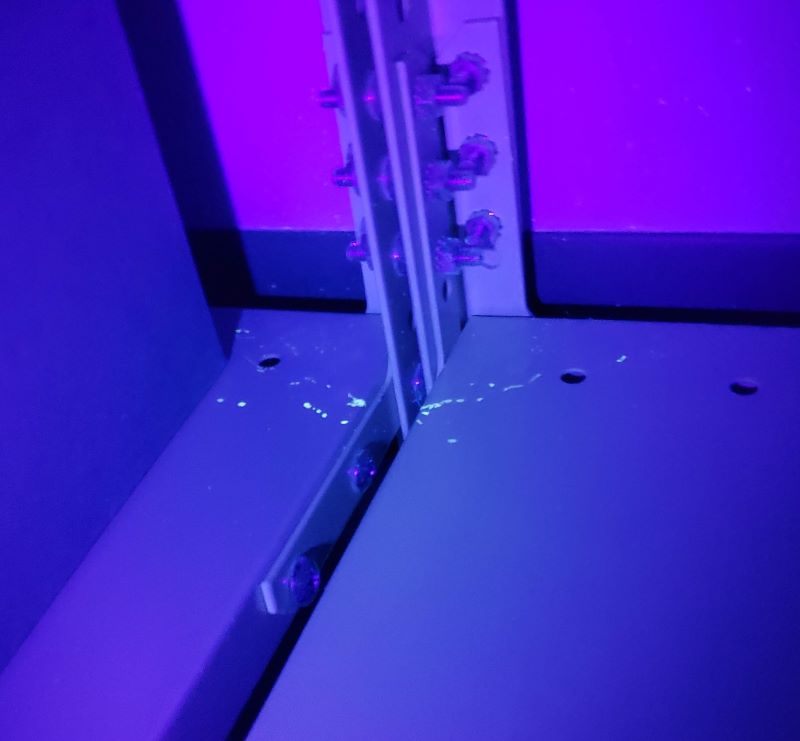
Used in the right order, a black light is a good tool:
- Find the likely area first — from the smell, droppings, gnawing or other signs.
- Search that area in normal light for droppings, rub marks, nesting material and tracks.
- Then use UV to see how far the staining extends along shelves, edges and routes.
- Treat anything that glows as suspect contamination, not as proof of mice. Clean it as if it were rodent urine.
What a black light cannot do: tell mouse urine from rat urine, from pet urine, or from the many other things that glow. No source we checked supports the claim that mouse urine glows a unique color or that fresh and old urine can be told apart by brightness.
Can you tell mouse urine from rat urine by smell?
No. You will read that rat urine smells stronger or “gamier” and mouse urine sharper. None of the government or university sources reviewed for this guide supports a smell-based way to separate the two. NPS describes musky odor and urine staining for mice and rats alike.
Use physical evidence instead: dropping size and shape, the size of gnaw marks and entry holes, tracks, and the animal itself if you see it. Our identification guide walks through each of these, and mouse vs rat covers the animals side by side.
Could the smell be a dead mouse instead?
Yes, especially if it started after poison bait was used. UC IPM notes that trapping lets you dispose of the mice and so avoids the dead mouse odors that may result when poisoning is done within buildings. Utah State Extension advises against using rodenticides in homes for the same reason: poisoned mice may die inside, and the odor of decay causes its own problems.
There is no reliable way to tell a decaying mouse from accumulated urine by smell alone, and both can be present at once. If the smell is coming from a wall or ceiling you cannot open, read what to do with a dead mouse — including one inside a wall.
Does a lingering smell mean mice are still there?
Not necessarily. A smell can outlast the mice that caused it, especially where urine has soaked into material that has not been cleaned or removed. It can equally mean the activity is continuing. The smell cannot tell you which.
The test is new evidence. CDC’s approach is to clean the area properly and then watch it: new droppings after cleaning indicate active rodent presence, and its trapping guidance treats new droppings, urine spots or gnawing as signs that activity is continuing. If nothing new appears in the cleaned areas but the smell stays, look for a missed source rather than assuming live mice. How to know if mice are gone sets out what counts as proof, and fresh vs old droppings explains why the clean-and-recheck method beats judging by appearance.
Is the smell of mouse urine dangerous?
The smell itself is not the hazard. The contaminated material is. Smelling an odor does not mean you have been exposed to a disease. What matters is how the urine, droppings and nesting material are handled. CDC says rodent-borne diseases are mainly spread to people when they breathe in contaminated air, which is why dry sweeping and vacuuming are ruled out.
Three CDC-documented infections are relevant here. LCMV is carried by the common house mouse and can be serious during pregnancy or with a weakened immune system. Hantavirus in the United States is linked mainly to the deer mouse, which can enter homes, especially rural ones; what the numbers actually say is covered separately. And leptospira bacteria are shed in the urine of infected animals, rodents included. You cannot tell by looking or smelling whether a rodent was infected, so treat all wild rodent urine the same way.
If you have been exposed to rodent urine, droppings or nesting material and feel unwell, contact a clinician and tell them about the exposure.
How to get rid of mouse urine smell
Remove the source, and the smell goes with it. Masking the odor leaves the contamination in place, and adding new urine on top of old will bring the smell back. So the order matters:
- Deal with the mice first. Cleaning a space that mice are still using only resets the problem. Trap where you found activity and close the way in: which traps to use and where, and how to seal entry points.
- Air the space. If you are cleaning a room or home with rodent signs, CDC says to open doors and windows for 30 minutes before cleaning and to leave the area while it airs out.
- Clean and disinfect by surface type, as below.
- Re-check the cleaned areas over the following days for new signs.
Hard surfaces: shelves, drawers, floors, counters
Put on rubber or plastic gloves. Spray the urine and any droppings until very wet with a product that says “disinfectant” on the label, or with CDC’s bleach solution: 1.5 cups of household bleach in 1 gallon of water (1 part bleach to 9 parts water), made fresh. Leave it wet for 5 minutes, or for the contact time on the disinfectant label. Wipe it up with paper towels and put them in a covered trash can. Then disinfect the whole surface — shelves, drawer interiors, nearby floor. Wash your gloved hands, remove the gloves, and wash your bare hands with soap and warm water.
Carpet, upholstery and washable fabrics
The spray-and-wipe method is for hard surfaces. For rugs and upholstered furniture, CDC’s instruction is to shampoo with a commercial disinfectant or use a commercial-grade steam cleaner or shampoo. Bedding, clothing and other washable items go through the washer in hot water with detergent and are dried on the highest heat the fabric allows. The full cleanup guide covers each surface in more detail.
Cardboard, insulation and anything you cannot clean
Some materials hold urine in a way no wipe will reach. CDC says to discard cardboard boxes contaminated with urine or droppings, and to place exposed insulation contaminated with urine and droppings into plastic bags for removal. Plastic, glass and metal containers can be disinfected. If the source is inside a wall, under a floor or in a large stretch of insulation, it is no longer a cleaning job you can finish from the room — see when to call a professional below.
What about enzyme cleaners, vinegar and odor sprays?
They do not replace disinfection. CDC’s procedure for rodent urine uses a disinfectant or the bleach solution above; it does not list enzyme cleaners, vinegar, baking soda or fragrance sprays as substitutes, and we do not recommend them for that step. If an odor remains on a surface after it has been properly disinfected, an odor product is a separate, later step: follow its label and use it only on surfaces it is made for.
Never mix bleach with other cleaners or disinfectants, including ammonia-based products and odor removers. CDC warns that mixing can release vapors that are dangerous to breathe. Use one product at a time, keep the area ventilated, and follow the label. See CDC bleach safety guidance.
When the smell is a job for a professional
Some situations are beyond a wipe-down. When to call an exterminator covers these in more depth:
- The smell comes through heating or cooling vents. CDC says to contact a professional rodent exterminating service when there is evidence rodents have accessed heating and cooling ventilation systems.
- The source is out of reach — inside walls, ceilings or subfloors.
- Contamination is extensive — large areas of soaked insulation, or a building with a heavy infestation. CDC calls for special precautions in those conditions, including protective equipment that most homeowners do not have.
- New signs keep appearing after you have trapped, sealed and cleaned.
Common questions
Does mouse urine smell like ammonia?
Many pest-control pages say so. The government and university sources behind this guide describe the odor as musky, not as ammonia. An ammonia-like smell in a house has plenty of other possible sources, so it is not a mouse sign on its own.
Can I vacuum dried mouse urine?
No — not before it has been wetted with disinfectant and wiped up. CDC rules out vacuuming and sweeping rodent urine, droppings and nesting material because it can put contaminated droplets into the air. That applies to dried material too.
Will the smell go away on its own?
None of the sources gives a timeline. If contaminated material stays in place, there is no reason to expect the smell to clear, and new activity will add to it. Clean or remove the source, then judge by what happens in the following days.
Does a stronger smell mean more mice?
UC IPM links the musky odor to large or long-term infestations, but there is no scale that converts smell into a number. One mouse or an infestation? explains what the evidence can and cannot tell you about scale.
The bottom line
A musky smell is a reason to look, not a conclusion. Use it to find the area, then confirm with physical evidence; use a black light to map stains only once you have that evidence. Treat suspect urine as contaminated, clean it wet and by surface type, and remove what cannot be cleaned. Then judge whether mice are still active by new evidence in the cleaned areas — not by whether you can still smell something.
Sources & verification
- CDC — How to Clean Up After RodentsNo sweeping or vacuuming; airing out for 30 minutes; gloves; disinfectant or 1.5 cups bleach per gallon (1:9), fresh; 5-minute or label contact time; carpets, upholstery, laundry, cardboard and insulation; professional help when rodents reach ventilation systems; special precautions for heavy infestation; diseases spread mainly through contaminated air.
- CDC — Controlling Wild Rodent InfestationsClean, then check for new droppings as the test for active presence.
- CDC — How to Trap Up to Remove RodentsNew droppings, urine spots or gnawing as signs that activity continues.
- CDC — Cleaning and Disinfecting with BleachNever mix bleach with other cleaners or disinfectants.
- CDC — About Lymphocytic ChoriomeningitisLCMV spread by the common house mouse; serious illness possible in pregnancy or with a weakened immune system.
- CDC — Hantavirus and CDC — LeptospirosisExposure through infected rodent urine, droppings and saliva; leptospira shed in the urine of infected animals.
- UC IPM — House Mouse (revised July 2025)Characteristic musky odor, common in large or long-term infestations; droppings, gnaw marks, tracks and nests as signs; trapping avoids dead-mouse odor from indoor poisoning.
- Utah State University Extension — Should You Worry About Mice?Droppings and the musky smell of urine from cupboards or drawers as indicators of mice; advice against rodenticides in homes because of decay odor.
- National Park Service — Conserve O Gram 3/12: Identifying Mouse and Rat DamageUrine fluorescing under UV and the warning that many substances fluoresce; urinating while walking or perched on edges; stained absorbent materials and ceiling tiles; rub marks; musky smell along routes and from nests.
- Cornell Cooperative Extension — MiceUrine stains on woodwork and a musky odor as signs of mice; poisoned rodents dying inside walls and causing odors.