
Rooms and places
Rats in the Chicken Coop: What They Do to Eggs and Chicks, the Signs, and How to Keep Rats and Mice Out
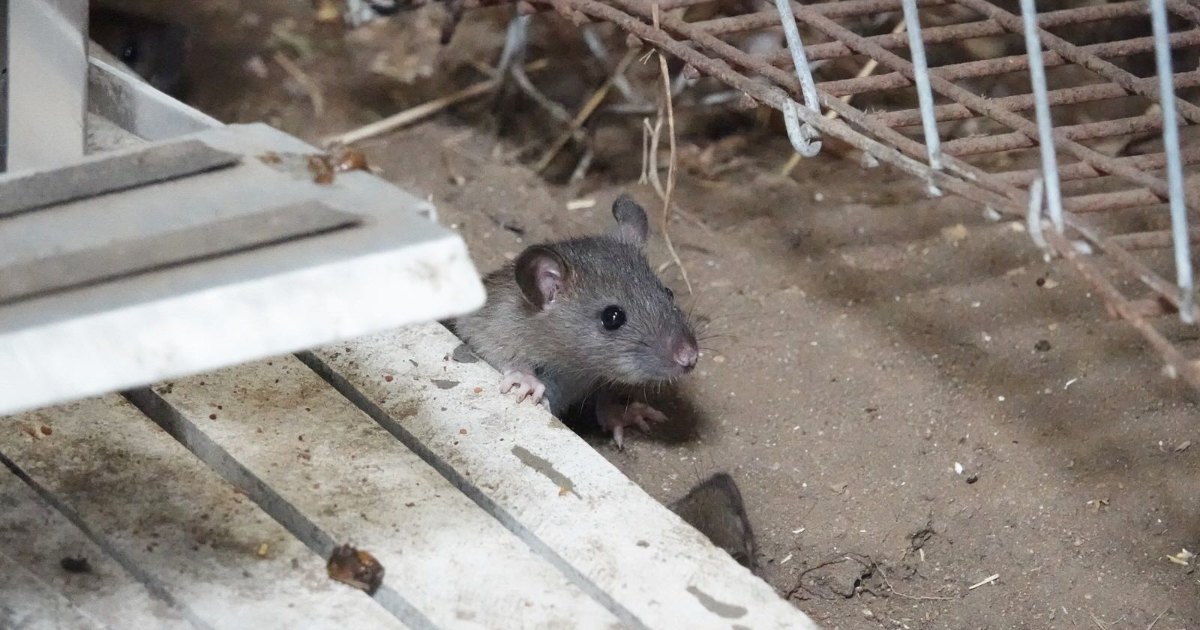
A chicken coop gives rats and mice almost everything they need: feed, water, warm bedding and places to hide. Extension specialists say rats usually go after eggs and chicks, and in bad infestations they can attack older birds at night. Mice mostly eat and soil the feed. Here is what university and public health sources say about the damage, how to tell rats are the problem, how to build and run a coop that keeps them out, and how to trap them without hurting your birds.
Short answer
- Rats take eggs and chicks. Utah State University Extension says rats generally prey on chicks and eggs, and that when an infestation is severe and food is short, they may raid a coop at night and attack young and adult birds.
- Feed is the draw. Take feeders and waterers in at night, clean up spills, and keep feed in metal containers with tight lids.
- Chicken wire does not stop rats. Use hardware cloth: Oklahoma State University Extension gives ½-inch mesh for rats and ¼-inch mesh for rats and mice. Cover the floor of the run, or bury the wire or add an apron, because rats dig.
- Trap where the birds cannot reach. Snap traps in boxes or behind barriers, set at night. If you use poison at all, only in tamper-resistant bait stations the birds cannot get into.
Why rats and mice come to a coop
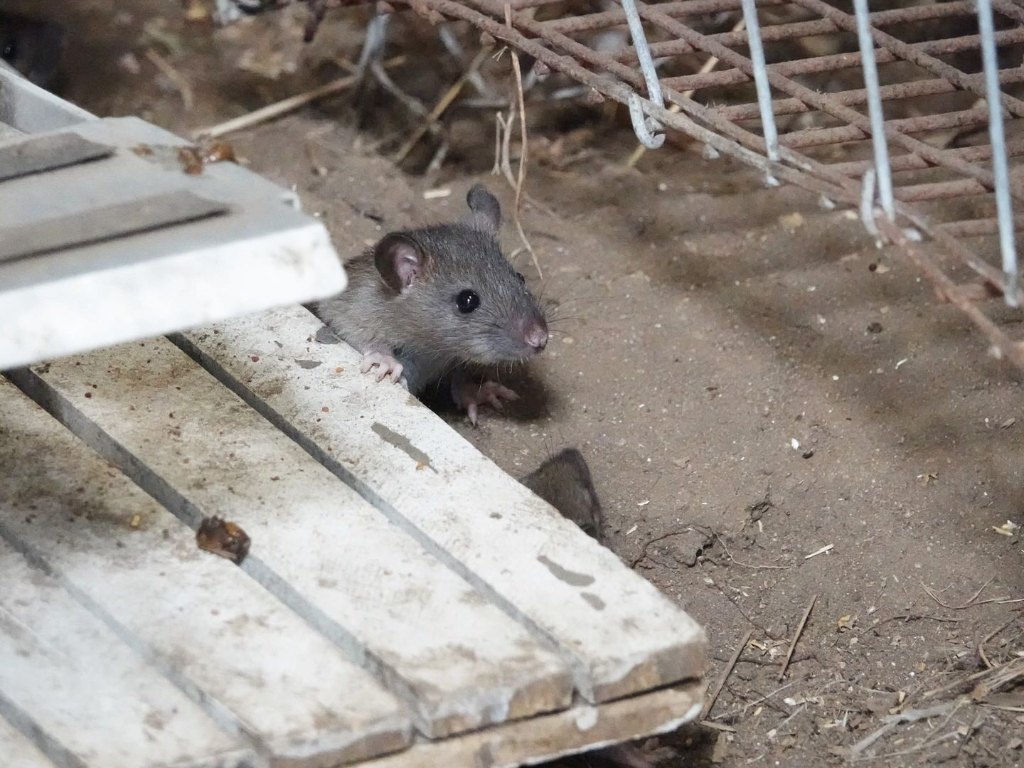
Rats need food, water and shelter, and a coop puts all three in one place. USU Extension wildlife specialist Terry Messmer says rats are prolific breeders that quickly exploit new sources of food, cover and water. Spilled feed, open feeders, waterers and the bedding in nest boxes are exactly that. UC IPM, the University of California’s integrated pest management program, notes that wherever animals are fed outdoors, their food becomes a steady supply for rats and mice nearby.
Do chickens bring rats? The rats are usually there first. An Oregon State University wildlife specialist, answering a resident in 2026, pointed out that rats reached the Pacific Northwest centuries before urban chickens and live far beyond towns. What changes is how much food is left out: poorly managed feed and water for chickens, pets and wild birds, fallen fruit and unharvested garden produce can all keep a rat population going. When Eugene, Oregon, allowed backyard flocks, residents and pest control firms reported more rats, according to a news report USU Extension cites, though there was no rise in rat-borne disease. Many cities that allow chickens now require rodent-proof coops and feed storage.
How little it takes: Mississippi State University Extension says an adult rat eats about 1 to 2 ounces of feed a day and a mouse about a tenth of an ounce. Oklahoma State estimates about 25 pounds of feed per rat per year, and says rodents waste and contaminate more than they eat. More on what draws rodents in general is in what attracts mice. For rats, see what attracts rats?
What rats and mice do to chickens and eggs
| Problem | Rats | Mice |
|---|---|---|
| Eggs | Break and eat eggs (Oklahoma State); Norway rats occasionally prey on chickens, ducks, pigeons and their eggs (ICWDM); roof rats prefer young birds and bird eggs among other foods (UC IPM) | No source we checked describes mice eating eggs |
| Chicks and young birds | Kill chicks (Oklahoma State); a problem for chicks and young birds, which go missing or are found partly eaten (University of Maryland) | No source we checked describes mice attacking birds |
| Adult birds | In a severe infestation with little food, may attack young and adult birds at night, biting the head or neck (USU) | — |
| Feed | Eat, carry off and contaminate it; damage feed containers (ICWDM, UC IPM) | Eat and contaminate it (Mississippi State) |
| Disease | Can carry disease to people, pets and poultry (UC IPM); salmonella and fowl cholera are the main concerns for poultry (Oklahoma State) | Same: Mississippi State lists salmonellosis among diseases linked to rats and mice in poultry |
| The coop itself | Gnaw wood and wire insulation, burrow under walls and floors (Oklahoma State, Mississippi State) | Gnaw and nest in bedding and insulation |
| Stress | Rodent movement and noise can frighten birds (Oklahoma State) | |
USU Extension adds that rats may drag the carcass of a bird into a burrow or another hidden spot to eat later, which is one reason losses can look like birds simply vanished.
Signs that rats are the problem
Rats are mostly active at night and wary of people, so you may never see one until there are many. The signs are what you go by:
- Missing eggs or chicks. On their own these do not point to rats. The Cooperative Extension poultry predator guide says missing chicks with no other disturbance could be a snake, rat, raccoon or house cat, and Virginia Tech lists rats among several predators that take eggs or chicks.
- Bites on the hocks of young birds. The same Cooperative Extension guide says bites on the hock joints of young birds often indicate rats.
- Partly eaten chicks (University of Maryland Extension), or birds bitten at the head or neck and dragged away (USU).
- Rat holes and burrows along the coop walls, under the run fence or beneath the floor. Rats are strong burrowers and can come in from below (USU). Mississippi State says Norway rat burrows usually run 8 to 18 inches deep; see what a rat nest looks like.
- Gnawed corners and edges of the coop and feed containers (USU); see rodent gnaw marks.
- Droppings near feeders and along walls. Rat droppings are much larger than mouse droppings; mouse droppings vs rat droppings shows both at actual size.
- Restless birds at night and rats seen in daylight. Oklahoma State lists unusual flock agitation as a sign, and says rats seen during the day usually mean a large population.
To check, the Cooperative Extension guide suggests spreading fine sand or talc where you suspect activity and looking for tracks the next morning, and Virginia Tech suggests a wildlife camera. If the losses look different (birds lined up dead with the back of the head eaten, a bird covered in slime, a whole bird gone with only wings or feet left), the University of Maryland guide points to a weasel or mink, a snake or an opossum instead. If you saw the animal and are not sure whether it was a rat or a young opossum, see opossum vs rat.
Step 1: take the food away
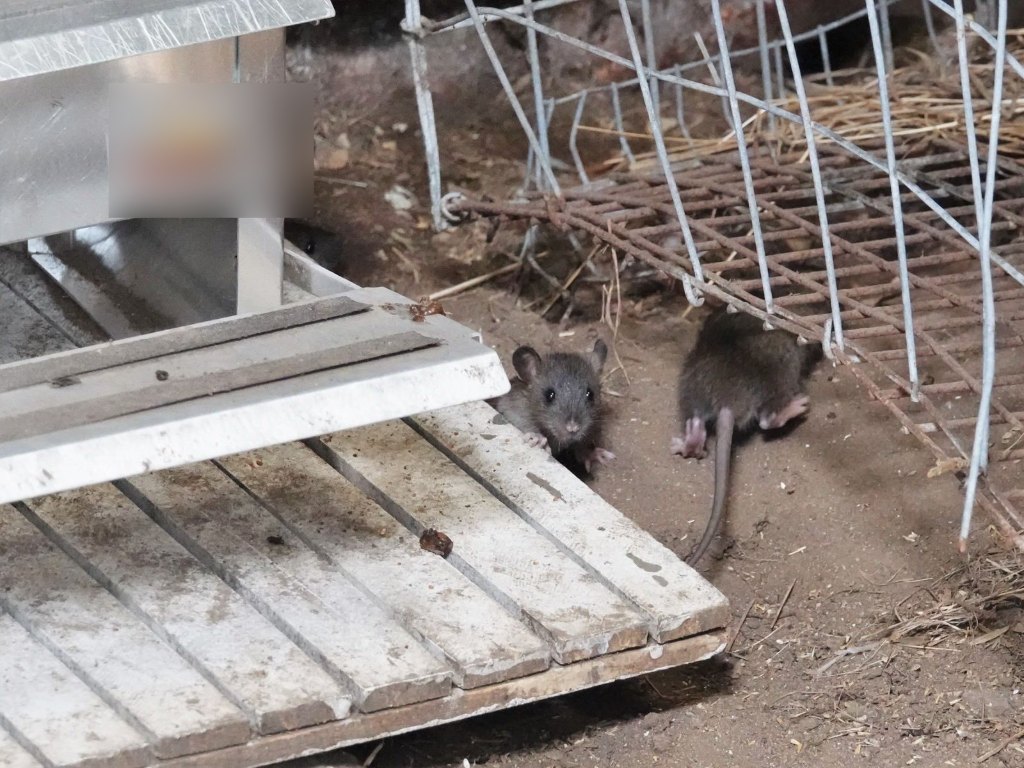
This is where the sources agree most, and it costs least.
- Take feeders and waterers in at night. USU Extension advises removing them every evening and putting them back in the morning: chickens do not eat or drink at night, but rats do.
- Store feed in metal. USU says rodents chew wood more readily than plastic, and plastic more readily than metal. CDC says to keep animal feed in thick plastic or metal containers with tight lids. A bin that is left open does not help; mice will live in it.
- Clean up spills inside the coop and outside it, and do not leave food in the run (Cooperative Extension poultry guide). Wild bird seed and pet food left out overnight count too (USU).
- Collect eggs often. CDC recommends it for egg safety, because eggs left in the nest can get dirty or break. Fewer eggs sitting in the nest also means less for rats; Virginia Tech advises locking up or removing feed, waste and eggs.
- Clear cover. Mississippi State recommends keeping a strip at least 3 feet wide around poultry buildings free of brush, trash and weeds so you can see burrows and trails. Remove junk, lumber piles and tall weeds near the coop (Oklahoma State).
Step 2: build the coop to keep them out
A mouse can get through a hole the size of a pencil and a rat through one the size of a dime, according to Oklahoma State. Mississippi State gives about ¼ inch for mice and ½ inch for rats.
| Part of the coop | What to use | Source |
|---|---|---|
| Walls and run | Hardware cloth: 19-gauge ½-inch mesh keeps out rats; 24-gauge ¼-inch mesh keeps out rats and mice. Not chicken wire | Oklahoma State; USU (¼ to ½ inch); UC IPM (never chicken wire) |
| Floor of the run | Wire the bottom of the run, or bury the bottom edge of the fence, or add an apron along the outside | USU |
| How deep to bury | At least 12 inches (Cooperative Extension guide); 1 foot, then bent outward 8 to 10 inches (University of Maryland); 1 to 2 feet or an outside skirt (Virginia Tech) | As listed |
| Top of the run | Enclose the top as well as the sides and bottom to exclude rats fully, since they climb | USU |
| Coop floor | Raise it, with open space underneath, so rodents have nowhere to hide below | USU |
| Gnawed spots and vents | Staple hardware cloth over gnawed areas; screen vents | USU; Oklahoma State |
| Chicks | Brood and raise them in pens with small wire openings | University of Maryland |
Why the bottom matters: Oklahoma State says rats can burrow 4 feet deep, and USU says they can come into a coop or run from below. They also climb wires, pipes and rough walls, so the top counts too; see can rats climb walls. Close the birds into the coop at night (Cooperative Extension guide). How to find and seal smaller gaps, and which materials hold, is in how to seal mouse entry points.
Step 3: trap rats and mice without catching chickens
Snap traps are what UC IPM calls the safest, most effective and most economical way to trap rats, and USU recommends wooden snap traps baited with peanut butter around coops. The catch with poultry is placement:
- Keep traps away from the birds. UC IPM says that where birds and other animals might reach a trap, set it inside a box or station, or behind a barrier. Oklahoma State says to put rat traps where birds cannot be caught.
- Set them at night. UC IPM says trapping at night reduces encounters with birds. Set traps after the flock is shut in and spring or remove them before the birds come out.
- Put them on the rats’ routes. Along walls, in dark corners, behind objects and near burrows, at right angles to the wall with the trigger end close to it (UC IPM). For roof rats, also on beams, ledges and pipes.
- Use enough. UC IPM suggests a dozen or more traps for a heavy infestation, about 10 to 20 feet apart, and leaving them baited but unset for a few nights so the rats get used to them. Rats avoid new objects at first.
- No glue traps outside. UC IPM says never to use glue boards outdoors, because other animals get stuck. CDC advises against glue and live traps for rodents in general.
Mice and very young rats often will not set off a rat trap (UC IPM), so if you have both, set mouse traps too. Trap types, baits and placement are covered in best rat traps and best mouse traps.
Rat poison around chickens
Mississippi State Extension says all rodenticides are poisonous at some level to poultry, livestock, wildlife and people. If you use bait anywhere near a flock:
- Only in tamper-resistant bait stations the birds cannot get into. USU says poison around coops must be in tamper-proof bait boxes so chickens, pets and people are not poisoned, and UC IPM says tamper-resistant stations must be used wherever birds may reach the bait.
- Only a product whose label allows that use. Oklahoma State says to use only baits approved for poultry houses and to follow the directions. The label is the law.
- Think about what eats the rat. UC IPM says a rat killed by an anticoagulant can contain several lethal doses, so pets and wildlife that eat the carcass can be poisoned. An Oregon State specialist notes that this can happen even when the product is used exactly as labeled.
We did not find official guidance on how long to wait before eating eggs if a hen may have eaten rat bait. If you think a bird has eaten poison or a poisoned rodent, call a veterinarian who treats poultry. For dogs and cats near the coop, see mouse poison around dogs and cats. Ultrasonic devices and scents are not a substitute; see do ultrasonic pest repellers work?
Eggs, droppings and cleanup
CDC says eggshells can pick up Salmonella and other germs from droppings and from where the eggs are laid. Its advice for backyard eggs applies with or without rodents: collect often, throw away cracked eggs, clean dirty eggs with fine sandpaper, a brush or a cloth rather than washing them in cold water, refrigerate them, and cook them until yolk and white are firm. Wash your hands after collecting eggs or handling feeders.
Rodent droppings and nests in a coop need the CDC rodent method, not sweeping: air out a closed coop or shed for 30 minutes, wear gloves, spray droppings and nesting material with disinfectant or a fresh bleach solution until soaked, then wipe up and bag it. CDC’s backyard poultry guidance adds: wear gloves when cleaning a coop, and clean equipment outdoors, never in the house. The full rodent cleanup is in how to clean mouse droppings, and the health risks in are mouse droppings dangerous.
More questions about rats and chickens
Will a rat kill a full-grown chicken?
It can, but it is not the usual case. USU Extension says rats generally take chicks and eggs, and attack young and adult birds at night mainly in severe infestations when food is scarce.
Do mice hurt chickens?
None of the sources we checked describes mice attacking chickens or eating eggs. The harm from mice is to the feed, which they eat and contaminate, and the disease risk that comes with their droppings.
Can chickens catch rats or mice?
We found no source that recommends relying on chickens for rodent control. Plan as if they will not.
Will a cat keep rats away from the coop?
Oklahoma State mentions cats as part of a poultry-house program, but UC IPM says predators cannot significantly control rats, and food left out for outdoor cats feeds rats too. Keep cats away from any bait stations.
How do I know the rats are gone?
No new droppings, burrows that stay closed after you fill them, untouched trap bait and no new losses for a week or more. How to get rid of rats covers the full plan and how to tell when it has worked.
In short
Rats come to coops for the feed. They take eggs and chicks and, when there are many, attack older birds at night; mice mostly eat and foul the feed. Take feeders and water in at night, keep feed in closed metal containers, collect eggs often and clean up spills. Build with ½-inch or ¼-inch hardware cloth instead of chicken wire, and protect the bottom of the run against digging. Trap at night with snap traps the birds cannot reach, and use poison only in tamper-resistant stations under a label that allows it, or not at all.
Sources and verification
- Utah State University Extension — Is There a Correlation Between Rodents and Backyard Chickens? (August 2018) and Ask an Expert – Backyard Chicken Ranching, Rodents and COVID-19 (January 2021), Terry MessmerRats exploit new food, cover and water; Eugene, Oregon reports; rats prey on chicks and eggs and, in severe infestations, attack young and adult birds at night by biting the head or neck; carcasses dragged away; gnawing and burrowing as signs; feeders and waterers removed at night; feed in rodent-proof containers, metal over plastic over wood; chicken wire not a barrier; hardware cloth ¼ to ½ inch; run floor, buried fence or apron; enclosing top, bottom and sides; raised floors; wooden snap traps with peanut butter; poison only in tamper-proof bait boxes; city ordinances.
- Oklahoma State University Extension — Rodent Control in the Poultry HouseRats kill chicks and break and eat eggs; about 25 pounds of feed per rat a year; salmonella and fowl cholera; birds frightened by rodents; signs including flock agitation; daytime sightings and population size; pencil-size and dime-size holes; burrowing 4 feet deep; hardware cloth 19-gauge ½-inch and 24-gauge ¼-inch; traps placed where birds cannot be caught; baits approved for poultry houses; cats; removing cover.
- Mississippi State University Extension — Controlling Rodents on the Poultry Farm (Publication 2824; Tabler and others)Openings of about ¼ inch for mice and ½ inch for rats; 1 to 2 ounces of feed a day for a rat and about 0.1 ounce for a mouse; Norway rat burrows 8 to 18 inches deep; diseases linked to rats and mice in poultry including salmonellosis; 3-foot clear strip; all rodenticides poisonous at some level to poultry and people; label directions.
- University of Maryland Extension — Identifying and Preventing Poultry Predators in the Mid-Atlantic Region (FS-1132, July 2020)Rats as a problem for chicks and young birds, missing or partly eaten; small-mesh pens for chicks; burying fencing 1 foot and bending it out 8 to 10 inches; signs of weasels, snakes, raccoons and opossums; spilled feed attracting rats.
- Cooperative Extension (poultry.extension.org) — Predator Management for Small and Backyard Poultry FlocksBites on the hocks of young birds often indicating rats; missing chicks or eggs not specific to one predator; sand or talc to read tracks; hardware cloth buried at least 12 inches; birds locked in at night; no food left in the run.
- Virginia Cooperative Extension — Predators for Free-Ranging Poultry (APSC-192P, Leonie Jacobs, 2023)Rats among nocturnal predators taking eggs or chicks; locking up feed, waste and eggs; removing debris; wire buried 1 to 2 feet or a skirt; wildlife cameras.
- UC IPM — Pest Notes: Rats (June 2025)Roof rats preferring young birds and bird eggs among other foods; rats eating and contaminating animal feed; disease risk to poultry; ½-inch mesh and never chicken wire; snap traps; traps in boxes or behind barriers where birds may reach them; trapping at night; trap placement, number and spacing; prebaiting; no glue boards outdoors; mice not triggering rat traps; tamper-resistant bait stations where birds may reach bait; secondary poisoning; predators unable to control rats; food for outdoor animals attracting rodents.
- ICWDM — Norway Rat Damage IdentificationNorway rats occasionally preying on chickens, ducks, racing pigeons and their eggs; eating and contaminating livestock feed; damage to feed containers.
- CDC — Backyard Poultry (July 2025)Coops that protect against rodents; handwashing after collecting eggs and handling feeders; collecting eggs often; discarding cracked eggs; cleaning eggs without cold water; refrigerating; cooking to 160 °F; gloves and outdoor cleaning.
- CDC — How to Seal Up to Prevent Rodents, Trap Up and Clean UpAnimal feed in thick plastic or metal containers with tight lids; no glue or live traps; airing out closed buildings for 30 minutes, gloves, soaking droppings with disinfectant, no sweeping.
- Ask Extension — answer by Dana Sanchez, Oregon State University (April 2026)Rats present long before urban chickens; poorly managed feed and water sustaining rats; secondary poisoning of wildlife possible even with labeled use.