
Rooms and places
Mice in Garage: What to Do, Where to Set Traps, and How to Keep Them Out
A garage gives mice almost everything they look for: big doors that rarely seal tightly, stored boxes to nest in, and often pet food, birdseed or grass seed on the shelves. Confirm the signs, check whether the garage connects to the house, set mouse-size snap traps along the walls, close the gaps, and clean up wet. These steps overlap; you do not have to finish one before starting the next.
Before you move boxes or sweep the floor: do not sweep or vacuum droppings, urine or nesting material. CDC warns that this can put tiny virus-containing droplets into the air. Wet it with disinfectant first, then wipe it up. Garage cleanup steps are below.
What to do if you find mice in your garage
- Confirm the signs. Droppings, chewed bags, shredded nesting material or the animal itself.
- Check the way into the house if the garage is attached: the door, the shared wall, and where pipes and wires pass through.
- Put food and nesting material out of reach. Pet food, birdseed and grass seed in sealed containers; cardboard off the floor.
- Set mouse-size snap traps along the walls where the signs are, out of reach of children and pets.
- Close the gaps at the doors, corners, foundation and utility lines with materials mice cannot chew through.
- Clean wet, following CDC’s steps.
- Watch the cleaned spots for new signs before you call it finished.
CDC’s own order is to check inside and outside for how rodents got in, seal those openings, and set traps for any still inside. UC IPM adds that for a small number of house mice, trapping is the preferred method in homes, garages and other structures.
Signs of mice in a garage
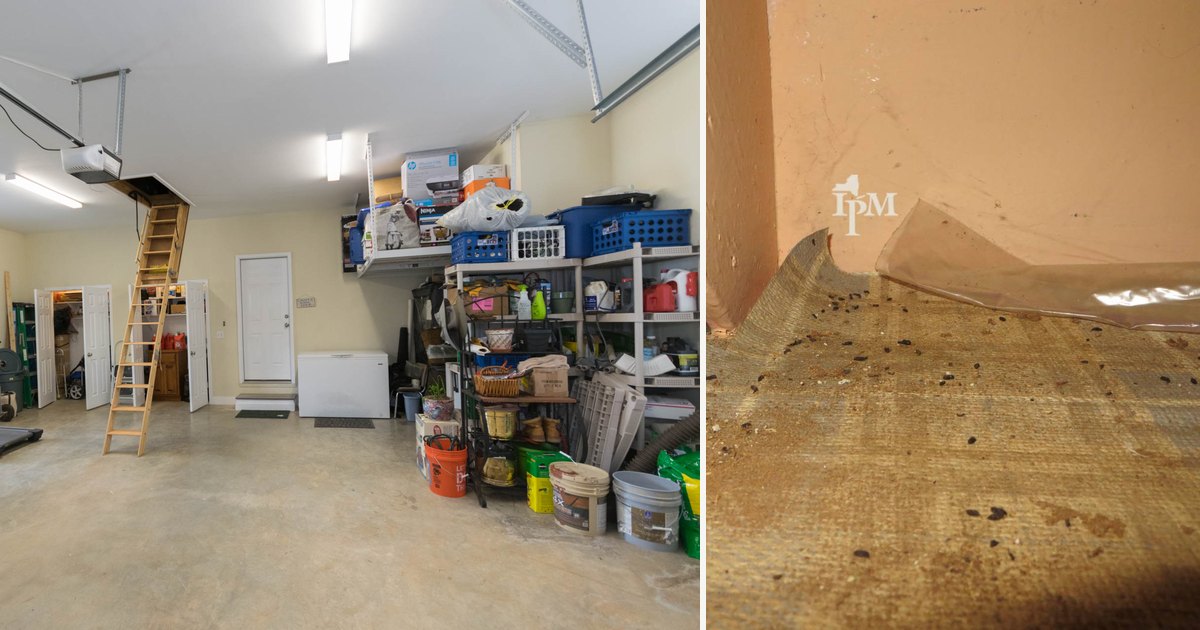
Physical evidence, in the places mice can hide and eat. UC IPM lists droppings, fresh gnaw marks and tracks as the signs that show where house mice are active, and tells you to search for nests behind boxes, in drawers, in garages and around woodpiles. EPA adds chewed food packaging and nesting material such as shredded paper or fabric.
In a garage, look first at:
- bags of pet food, birdseed or grass seed, especially at the bottom corners;
- the floor along the walls, behind shelving and under workbenches;
- stored cardboard boxes, old clothes, rags and camping gear;
- the bottom corners of the garage door and the side door;
- anywhere pipes, wires or vents pass through a wall.
Use more than one sign before you decide what you have. A sound, a smell or one dropping on its own is a reason to look, not a confirmation. How to read gnaw marks helps with chewed edges, and what a mouse nest looks like covers shredded material in boxes.
Mouse or rat?
The trap has to match the animal: CDC notes there are different snap traps for mice and rats. UC IPM notes that Norway rats, indoors, usually stay in basements and on ground floors, so in a garage don’t assume. Start with dropping size or a clear look at the animal: compare droppings by size and shape, or work through the other signs that separate mice from rats. In rural areas, a mouse with a sharply white belly and a two-tone tail may be a deer mouse, which changes the health risk of the droppings.
Mice in the garage but not the house: can they get inside?
Finding mice in the garage does not prove they are in the house. It does mean you should check the routes between the two before assuming they aren’t. Mice can fit through a hole the width of a pencil, 1/4 inch, according to CDC.
- Detached garage: the garage is a separate building to inspect and seal. CDC says to seal outbuildings and garages as well as the home.
- Attached garage: check the door into the house (does it close tightly, is there daylight under it?), the bottom of the shared wall, and every place a pipe, wire, duct or vent passes from the garage into the house.
Then look for evidence on the house side of those routes: in the laundry room, a utility closet, under the kitchen sink, or in the basement if the garage sits next to it. If you find nothing there, keep checking for a few weeks rather than treating it as settled.
A note on the wall between garage and house. RodentVerify’s editorial view: the wall and door between an attached garage and the living space may be built to fire-safety requirements. If you need to seal around pipes or wiring that pass through it, use a method a qualified contractor confirms is suitable for that wall, rather than whatever is at hand.
Best mouse traps for a garage
A mouse-size snap trap, set along the wall, is the default choice. This section compares trap types for garage conditions. It is not a test of brands: RodentVerify has not lab-tested these traps.
| Trap type | For a garage | Why |
|---|---|---|
| Mouse-size snap trap | Default choice | CDC recommends traditional snap traps; UC IPM calls trapping the preferred method for a few mice in garages. Mechanical, with no batteries or electronics for cold or damp to affect. |
| Snap trap with a covered bait area | Good option | Keeps bait from being stolen. A covered bait area is not the same as a trap a child or pet cannot reach. |
| Electronic trap | Only if the manufacturer allows those conditions | Some models are indoor-only and not for freezing or damp spaces. Check the instructions for the exact model. |
| Glue board | Not recommended | CDC advises against glue traps; a scared rodent may urinate, which raises your exposure. |
| Live-catch trap | Not recommended | CDC advises against live traps for the same reason. EPA notes a released rodent may find its way back if the gaps are still open. |
| Poison bait station | Not a first step | CDC reserves poison for infestations that persist. See poison and bait stations below. |
The full mouse trap comparison covers each type in more detail. This page stays with what changes in a garage.
Mouse-size snap traps: the default
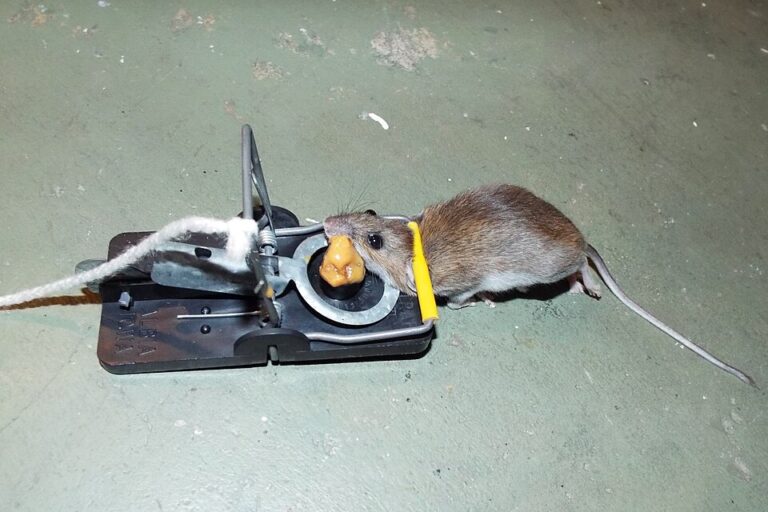
CDC says traditional snap traps are recommended, and that you should choose the right trap for the rodent: mouse traps for mice. A mechanical trap does not depend on batteries or electronics, which is why it is the easiest choice for a garage that is cold in winter or damp.
Some manufacturers name garages directly. Victor, for example, lists garages among the places its Quick-Kill mouse trap (CM140B) is meant for and describes it as usable indoors and outdoors, with a covered bait trough. That is the manufacturer’s description, given here as an example of what to look for on the label, not a RodentVerify test result.
Where to place traps, and how many
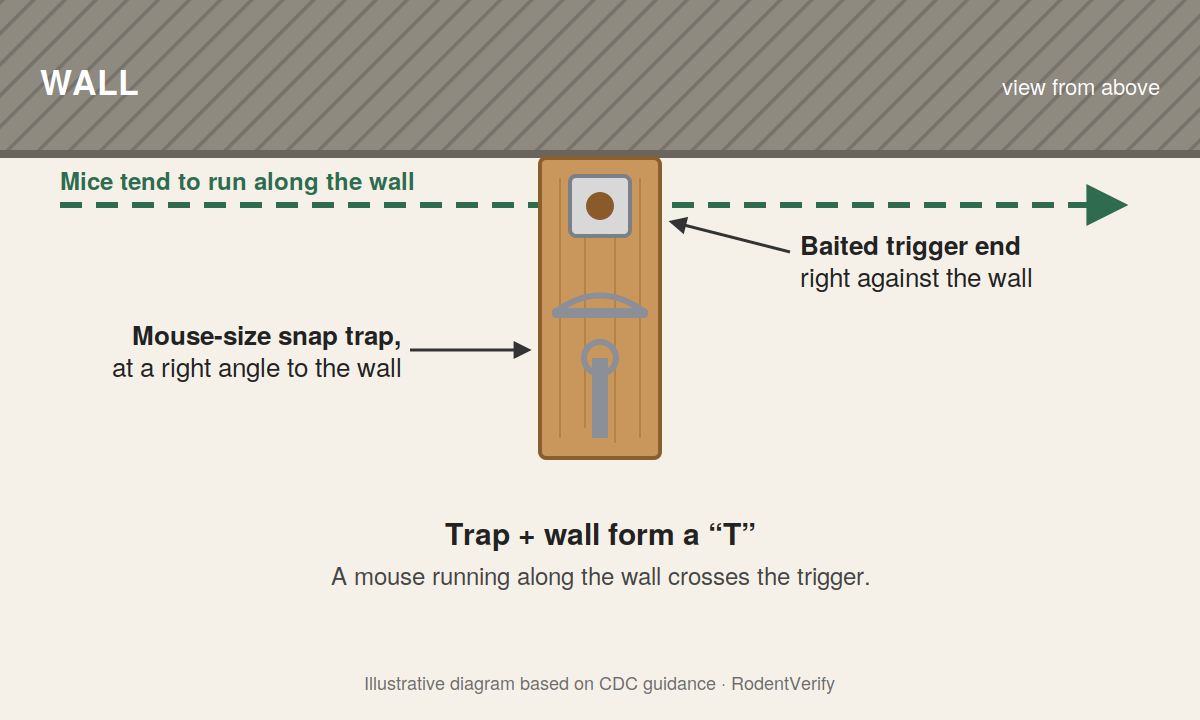
- Against the wall, as a “T”. CDC says to place the trap on the floor against the wall with the baited end next to it, because rodents run along walls.
- Where the signs are. CDC says to put traps where you have seen mice, nesting material, droppings, urine, nibbled food or gnaw marks, and also in outbuildings and other places that could shelter rodents.
- Behind things. UC IPM adds behind objects and in dark corners: behind shelving, under the workbench, next to stored boxes.
- Spacing, not floor area. UC IPM suggests traps no more than about 10 feet apart in areas where mice are active, and notes that pairs set 1 to 2 inches apart can catch mice that jump over obstacles. There is no fixed number per garage; it depends on how many active routes you find.
- Bait lightly. CDC suggests a small amount of chunky peanut butter. UC IPM notes that too much bait lets a mouse take it without setting off the trap, and that a small ball of cotton or dental floss can also work.
- Check every day. CDC says to check traps daily and dispose of dead rodents right away.
One trap by the big door is rarely enough. Mice run along the walls, so a trap in the middle of the floor, or one in a corner far from any sign, will often catch nothing.
Electronic traps in a cold or damp garage
Electronic traps vary by model, and the manufacturer’s instructions decide where they can go. As one example, Victor says its Multi-Kill electronic mouse trap (M260) cannot be used outdoors, should not be placed where temperatures are extreme, particularly below freezing, and may not work in damp or wet areas. If your garage is unheated or damp, check those limits before buying an electronic trap for it.
Traps around children, pets and the car
CDC says to keep baits and traps out of reach of children and pets. Some product pages say a trap can be used around children and pets “when used as directed.” RodentVerify follows CDC: put the trap where children and pets cannot get to it, or use a box or cover designed for that trap. In a garage, behind shelving or inside a closed cabinet usually works. Keep traps out of the path of the car and the garage door.
Where mice get into a garage
Through gaps you probably walk past every day. CDC puts the size at 1/4 inch. In a garage, check:
- The bottom of the garage door, especially the two bottom corners, where the door meets the floor and the side of the opening. Look for daylight with the door closed.
- The side door, along the bottom edge and the threshold.
- Where the walls meet the floor and the foundation, including cracks in the slab.
- Every pipe, wire, cable and vent where it passes through a wall. CDC lists holes for electrical, plumbing, cable and gas lines among the outside entry points to check.
- The attic or ceiling space above the garage, if you can reach it safely. CDC includes the roof among the rafters, gables, eaves and soffits.
Inspect the garage door only while it is closed and not moving. RodentVerify’s editorial view: do not take apart, adjust or block the door’s springs, tracks, opener or safety sensors to close a gap; if the gap comes from the door itself, ask a garage door technician.
How to mouse-proof a garage
Take away food and nesting material
- Food in hard containers. CDC advises keeping food sealed in thick plastic, metal or glass containers with tight lids. That includes pet food, birdseed and grass seed stored in the garage; a paper sack on the floor is food and bedding at once.
- Pet food. CDC says to put pet food away after use and not to leave bowls out overnight. UC IPM suggests feeding pets only what they will eat at one feeding.
- Trash. CDC advises keeping garbage in thick plastic or metal containers with tight lids.
- Less shelter. UC IPM says that if house mice have few places to hide, rest and nest, they cannot survive in large numbers. Get cardboard boxes, rags and old fabric off the floor, and store what you keep in plastic bins with lids.
Cleaning up helps, but UC IPM is clear that good sanitation will seldom completely control house mice. It limits how many the garage can support; traps and sealing do the rest.
Seal with materials mice cannot chew
UC IPM calls exclusion the most successful and permanent form of house mouse control, and says to close gaps and openings larger than 1/4 inch.
- Small holes: CDC says to fill them with steel wool and hold it in place with caulk or spray foam. UC IPM notes steel wool is a good temporary plug but may rust.
- Larger holes: CDC lists lath screen or metal, cement, hardware cloth or metal sheeting, cut to fit around pipes.
- Foundation cracks and utility openings: UC IPM recommends metal or concrete.
- Doors: UC IPM says doors should fit tightly, and that it may be necessary to cover the edges of doors with metal to prevent gnawing.
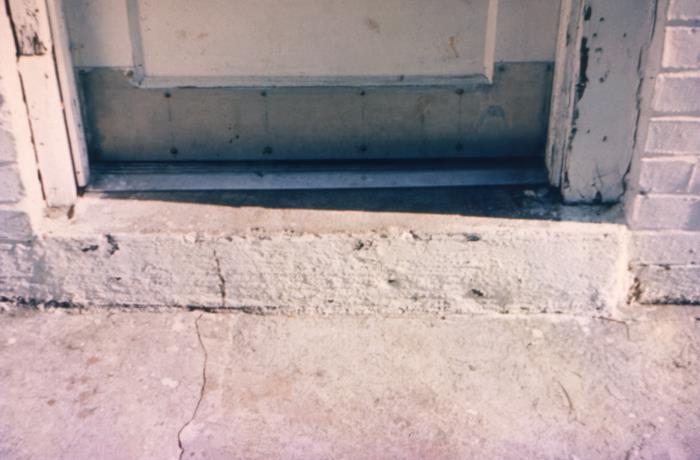
A rubber garage door seal is not a rodent barrier on its own. UC IPM lists rubber, vinyl, plastic screening, expanding foam and wood as ineffective for plugging holes mice use, because mice can gnaw through them. A rubber seal can close a draft; where mice are chewing at the door edge, metal is what holds.
The full sealing guide goes through each type of opening and the materials that hold.
Mice in the garage in winter
UC IPM notes that house mice frequently enter homes in autumn, when nighttime temperatures drop. A garage is often the first sheltered space they reach. How mice get into a building, and how to find the opening they use, is in how do mice get in your house. That makes autumn a good time to inspect the doors and gaps, before you see signs.
It does not mean mice only come in cold weather, or that they will leave in spring. Mice that have shelter and food in a garage can stay there all year, which is why sealing and storage matter more than the season. What draws them, from birdseed to cardboard, is in what attracts mice.
Scratching in garage walls or ceiling
A sound in the wall or ceiling tells you something is moving there, not what it is. Look for droppings, gnawing or nesting material along the bottom of that wall, on top of shelving, and in any ceiling space you can reach safely. What scratching in walls can and cannot tell you covers how to narrow it down without opening anything up.
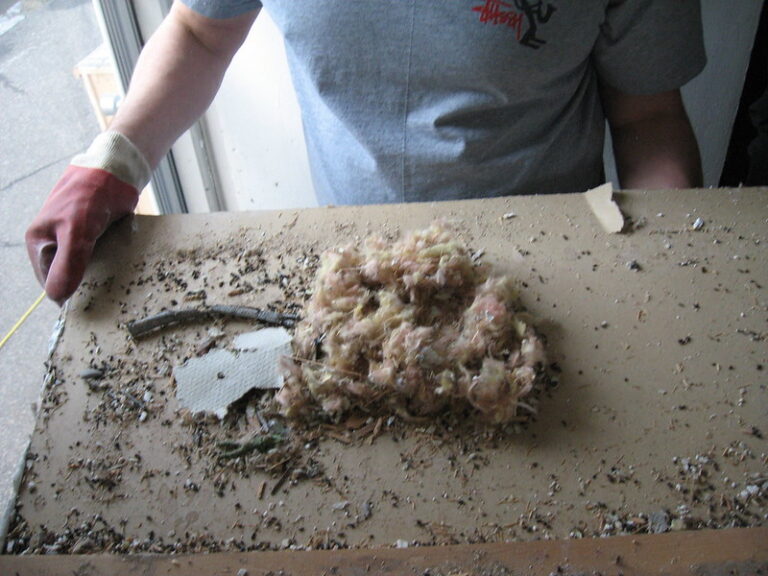
Do not open finished walls or ceilings, or pull out insulation, to look for a nest. UC IPM notes that house mice can chew on wires in walls, and CDC calls for extra care with contaminated insulation. Activity inside a wall or ceiling you cannot reach is a reason to call a professional.
Could mice be in a car stored in the garage?
Yes, especially in a car that sits unused. CDC has a separate procedure for vehicles. In brief: open the hood, doors and trunk and let the car air out for 20 minutes; inspect the air intakes and filters before starting the engine; remove the battery cables before inspecting the engine compartment; and consult a qualified mechanic for parts you cannot safely reach. Mouse nest signs covers what CDC says about nesting material in a vehicle’s air intake. Mice in your car goes through the signs, chewed wiring and cleanup step by step.
How to clean droppings and nesting material safely
CDC’s steps for homes and outbuildings such as cabins, sheds and barns apply to a garage:
- Air it out. Open all doors and windows for 30 minutes before cleaning, and leave the area while it airs out. In a garage, that means the big door too.
- Put on rubber or plastic gloves.
- Do not sweep or vacuum. Spray droppings, urine and nesting material with a disinfectant or a fresh bleach solution of 1.5 cups of household bleach in 1 gallon of water until very wet.
- Let it soak for 5 minutes, or as the disinfectant label directs.
- Wipe it up with paper towels and put them in a covered garbage can.
- Clean the floor: mop or sponge hard floors with disinfectant.
- Wash your gloved hands, remove the gloves, then wash your bare hands with soap and warm water.
Stored boxes. CDC says to move storage boxes with possibly contaminated contents outside to a well-ventilated area. Contaminated cardboard should be thrown away; plastic, glass and metal containers can be disinfected.
Heavy contamination is a different job. CDC calls for special precautions in buildings with heavy rodent infestation, including coveralls, boots or shoe covers, gloves, goggles and a respirator with HEPA filters. A garage with droppings across stored belongings and insulation may be that situation. The complete cleanup guide covers nests, a dead mouse and when the heavier protocol applies.
Poison and bait stations
CDC says to use poison or bait stations only for infestations that persist, and to follow the label exactly. In a garage, where pets, children and wildlife may pass through, that matters more.
EPA groups household bait stations into tiers. Only Tier 1 stations, which are resistant to tampering by young children and dogs and also weather-resistant, can be used outdoors, within 50 feet of buildings. The other tiers are indoor-only, and the lower tiers only where children or pets have no access. EPA’s tier guide explains which is which. UC IPM adds the practical problem: rodenticide often means mice dying inside the structure, which in a garage can mean inside a wall.
Plug-in sound devices are not a substitute. UC IPM says high-frequency electronic devices aren’t effective and that mice quickly get used to regularly repeated sounds (do ultrasonic pest repellers work?). Traps and sealing are what the sources support.
How to tell whether the garage mice are gone
Watch the spots you cleaned. Once the floor along a wall or a shelf has been cleaned, anything that appears there afterwards is new.
- CDC says to check traps daily, and to check the bait every week and refill or move it as needed for at least 15 days.
- Keep traps set until activity stops. No new captures is encouraging, but judge it together with the cleaned spots: no new droppings, no new gnawing, no new nesting material.
- Recheck the seals at the door corners and around pipes for fresh gnawing.
- CDC says that if new droppings, urine spots or gnawing persist after a week, you may be dealing with rats, which sends you back to the species check.
How to know if mice are gone has the full checklist.
When to call a professional
Reasonable triggers: signs keep appearing after trapping and sealing; activity is inside walls, the ceiling or insulation you cannot reach; you find gnawed wiring; the contamination is heavy; you cannot find the way in, or it is part of the garage door itself; or the evidence points to rats. CDC suggests contacting a pest control specialist when rodents have got into areas that cannot be reached to clean, and your local or state health department if you are concerned about an infestation. When to call an exterminator goes through each of these.
The bottom line
Mice in a garage come for shelter and whatever food is stored there, and get in through gaps at the doors, corners and utility lines. Confirm the signs, check the route into the house, set mouse-size snap traps along the walls, store food and seed in hard containers, and close the gaps with metal or concrete rather than rubber or foam. Clean wet, and judge the result by what turns up on the surfaces you have already cleaned.
Sources and verification
- CDC — How to Seal Up to Prevent RodentsThe 1/4-inch mouse opening; outside entry points including utility lines and the roofline; sealing garages and outbuildings; steel wool with caulk or spray foam, and metal, cement or hardware cloth for larger holes; food, pet food and garbage storage; when to contact a health department or pest control specialist.
- CDC — How to Trap Up to Remove RodentsChecking, sealing and trapping together; snap traps over glue and live traps; mouse versus rat traps; T-placement; trap locations including outbuildings; bait; children and pets; daily checks; the 15-day bait check; persisting signs after a week pointing to rats; poison only for persistent infestations.
- CDC — How to Clean Up After RodentsNo sweeping or vacuuming; 30-minute airing for homes and outbuildings; bleach solution and soak time; floors; storage boxes and cardboard; vehicle inspection; special precautions for heavy infestation.
- UC IPM — Pest Notes: House MouseTrapping as the preferred method for a few mice in homes, garages and other structures; signs and where to search for nests; autumn entry; shelter and sanitation; exclusion as the most permanent control; ineffective materials; metal or concrete for cracks and openings; metal on door edges; trap placement, 10-foot spacing, paired traps and bait; rodenticide and mice dying inside structures; ultrasonic devices; chewing on wires; telling a house mouse from a deer mouse.
- UC IPM — Pest Notes: RatsNorway rats indoors usually staying in basements and on ground floors.
- EPA — Options for Dealing With Rodent InfestationsReleased rodents finding their way back unless entry points are sealed.
- EPA — Choosing a Bait Station Product for Household UseTier 1 to Tier 4 bait stations, where each may be used, and following the label.
- EPA — Identify and Prevent Rodent InfestationsSigns of infestation, including chewed packaging and nesting material.
- Manufacturer pages, cited as examples only:Victor Quick-Kill CM140B (garages listed, indoor and outdoor use, covered bait trough) and Victor M260 FAQ (indoor only, not for extreme or freezing temperatures or damp areas). RodentVerify has not tested these products.