
Evidence and signs
Deer Mouse vs House Mouse: How to Tell Them Apart and Why It Matters
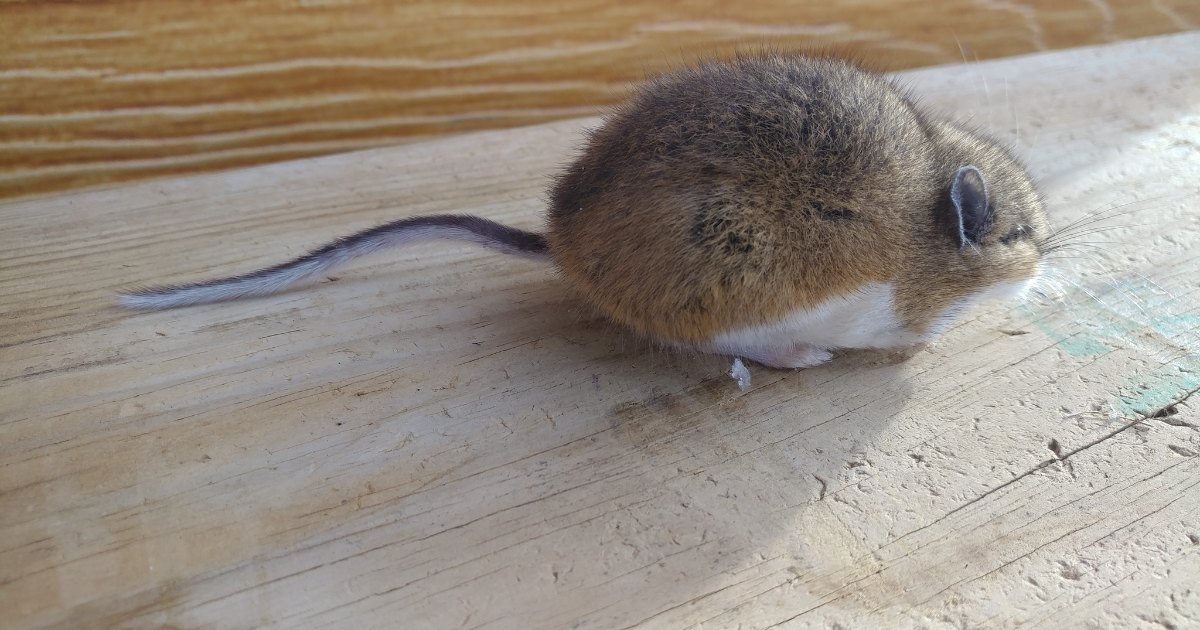
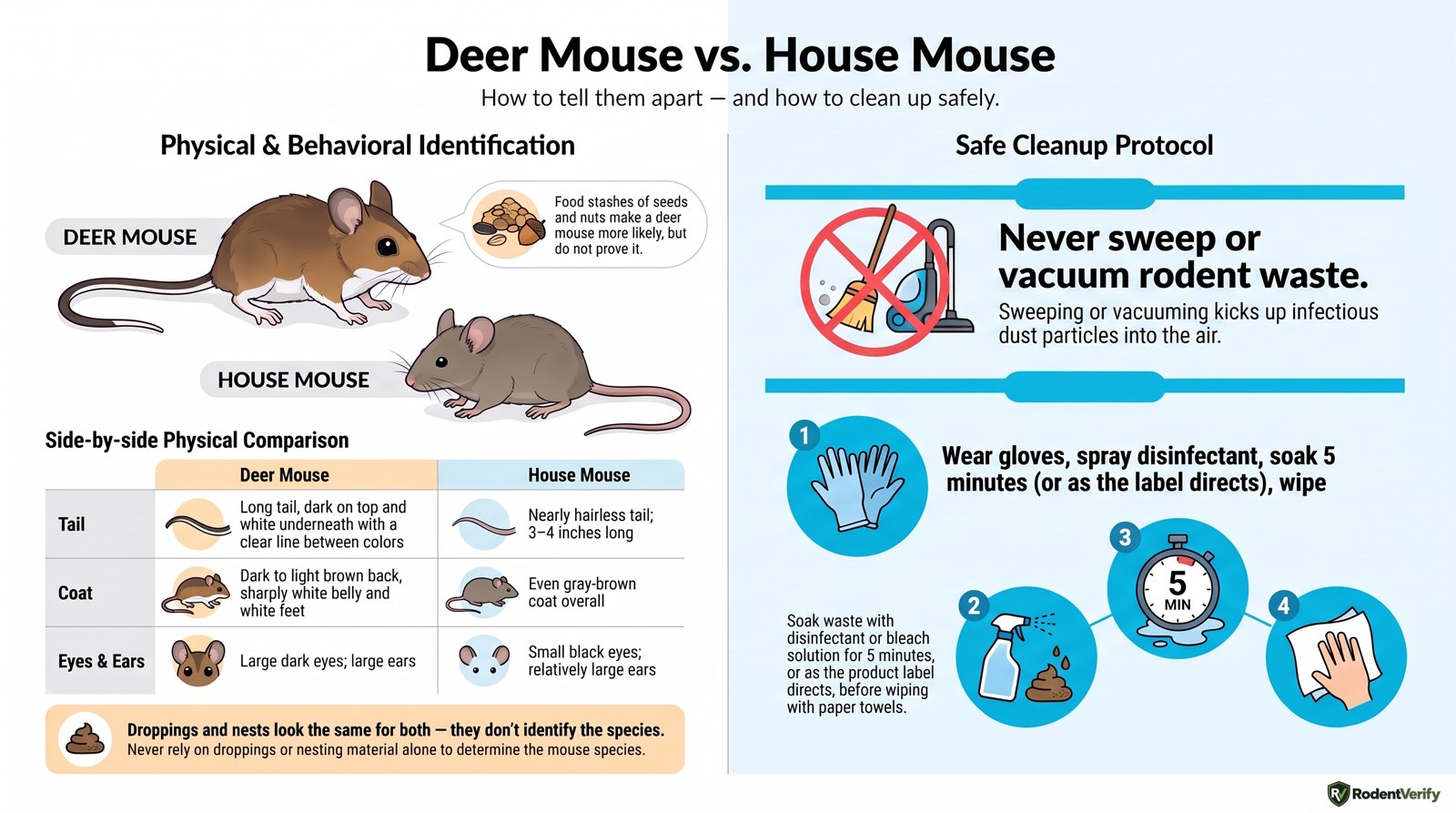
Look at the tail first. A deer mouse has a furred tail that is sharply two-toned, dark on top and white underneath, plus a white belly and white feet. A house mouse is an overall gray-brown animal with an almost hairless tail. The difference matters because the deer mouse spreads the most common hantavirus that causes hantavirus pulmonary syndrome in the United States. Droppings and nests will not tell you which one you have.
If you think it could be a deer mouse: do not sweep or vacuum droppings, urine or nesting material. CDC says to wear rubber or plastic gloves and soak the waste with disinfectant or a bleach solution first. The same rules apply to house mouse waste, because you cannot tell by looking whether a mouse is infected. What to do differently is mostly about where you are cleaning, not which mouse it was.
The fastest check: the tail
UC IPM says the deer mouse’s bicolored tail, “white on the bottom and the darker color on top,” is “the easiest feature to use to distinguish them from house mice.” The same page describes house mice as having “almost furless tails and an overall gray-brown coat.”
The second check is the belly. Deer mice have white undersides, legs and feet, and ICWDM notes a distinct separation between the brownish back and the white belly. A house mouse is usually light brownish to gray, without that sharp line.
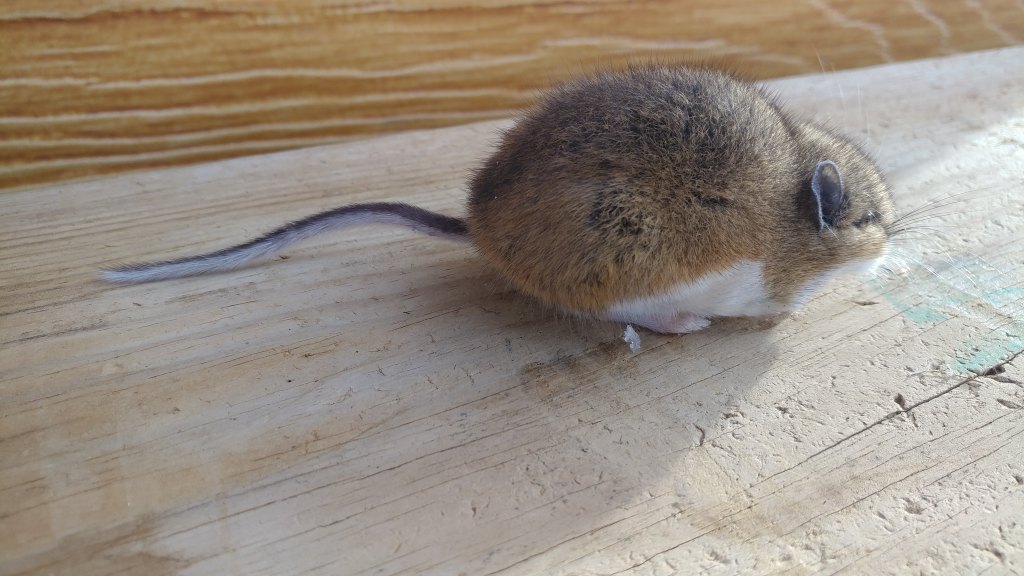
Deer mouse and house mouse side by side
| Feature | Deer mouse | House mouse |
|---|---|---|
| Tail | Sharply bicolored, dark on top and white below; relatively long, sometimes as long as the head and body | Almost no fur on it; 3–4 in long |
| Coat | Dark to light brown back; white underside, legs and feet, with a clear line between back and belly | Light brownish to gray overall |
| Eyes and ears | Larger eyes and ears than a house mouse | Relatively large ears, small black eyes |
| Size | About 3–4 in long, not counting the tail | About 5–7 in long including the tail; about ½ oz |
| Smell | No characteristic mousy odor | Musky odor, common in large or long-term infestations |
| Where it lives | Most of North America; often enters vacated homes and cabins | Near people: homes, schools, commercial buildings |
| Droppings and nests | Similar for both — they do not identify the species | |
Sources for the table: UC IPM Deer Mouse, UC IPM House Mouse and ICWDM. Neither source gives a weight or an exact tail length in inches for the deer mouse, so we do not either.
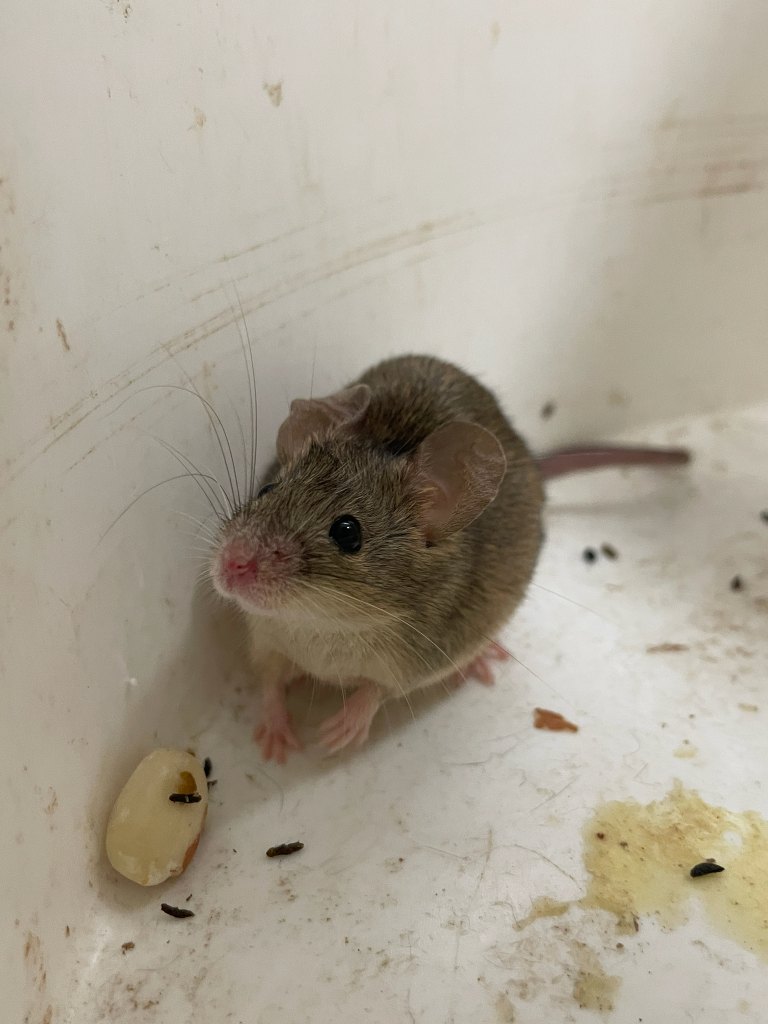
Eyes and ears are a supporting clue rather than a test on their own. UC IPM separates the two by the deer mouse’s larger eyes and white underside, and ICWDM says deer and white-footed mice have larger eyes and ears than house mice.
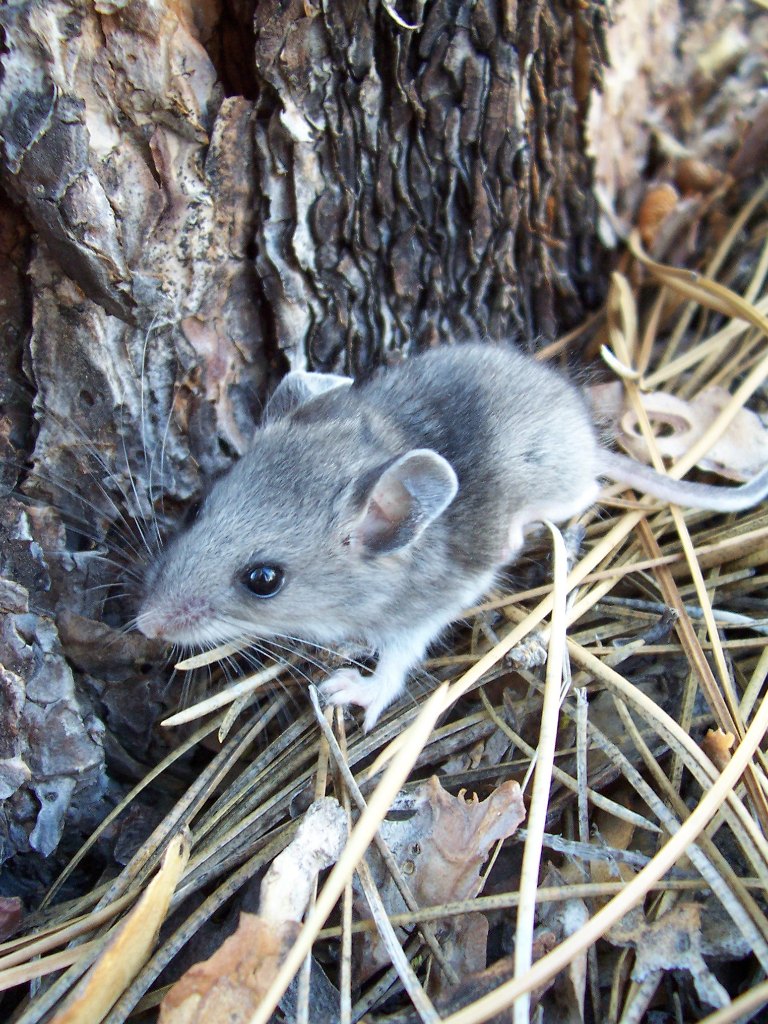
Can you tell from droppings or a nest?
No. UC IPM says plainly: “Nests, droppings, and other signs left by deer mice are similar to those of house mice.” We found no authoritative source that gives a dropping size or shape that separates the two.
There is one clue worth noting. UC IPM says deer mice “have a much greater tendency to cache food supplies such as acorns, seeds, or nuts than do house mice.” A stash of acorns or seeds next to a nest, especially in a cabin, shed or rural home, makes a deer mouse more likely. It does not prove it.
What droppings can tell you is whether you have mice or rats and whether the activity is recent: mouse vs rat droppings at actual size, fresh vs old droppings and what a mouse nest looks like. If you are not sure it is a mouse at all, start with mouse vs rat.
White-footed mice, “field mice” and voles
White-footed mouse
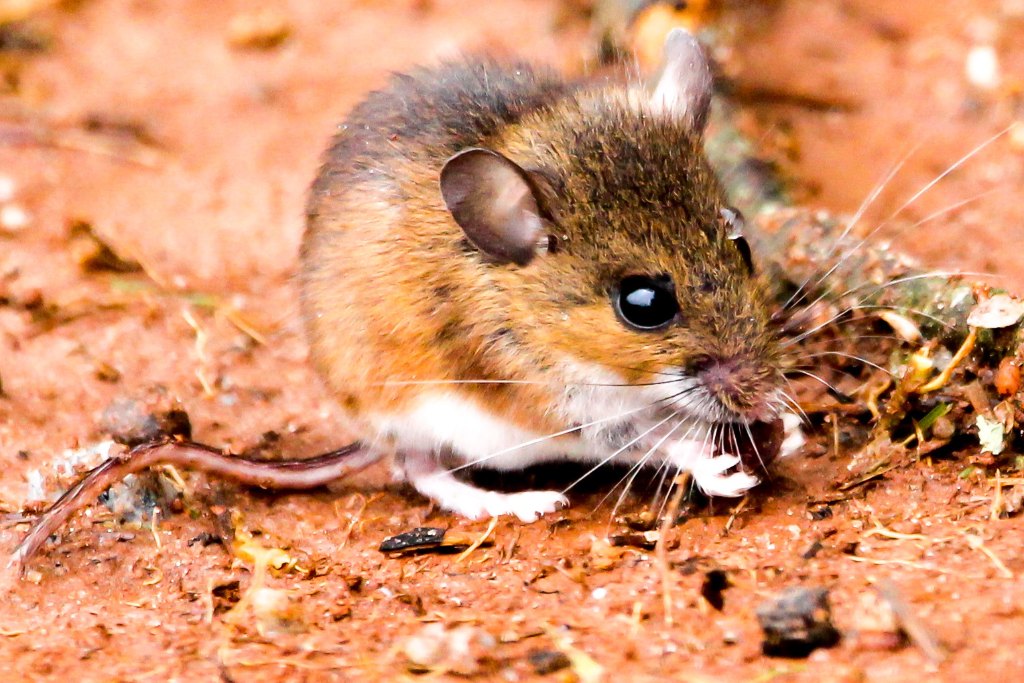
The white-footed mouse (Peromyscus leucopus) is a close relative of the deer mouse and looks very similar: brown back, white belly and white feet. ICWDM gives it about 3.5 to 4 inches of body length, not counting the tail, and says it is found “throughout the US east of the Rocky Mountains except in parts of the Southeast,” while the deer mouse is found “throughout most of North America.”
Do not expect to separate the two yourself. ICWDM says: “It is difficult even for an expert to tell all of the species apart.” For a homeowner, the practical answer is the same either way: ICWDM says all Peromyscus species “cause similar problems and require similar solutions,” and the white-footed mouse is also on CDC’s list of North American rodents that spread hantaviruses causing HPS (which rodents carry what).
“Field mouse” is not one species
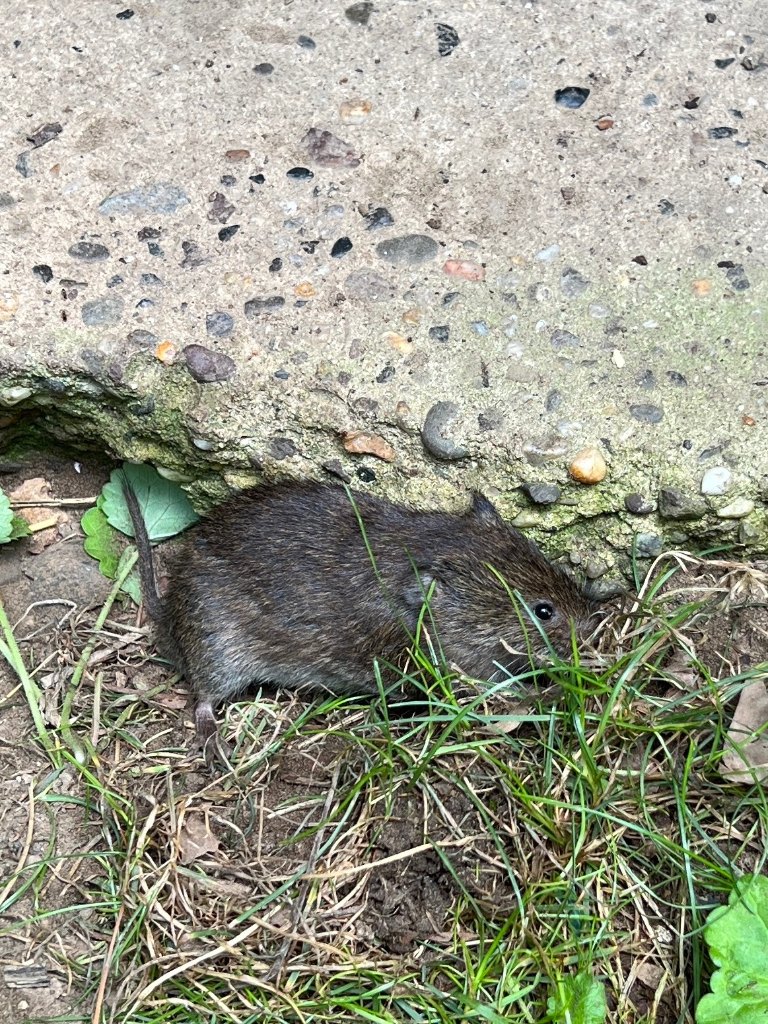
“Field mouse” is an everyday name, not a species. Penn State Extension lists “field mice” among the common names for voles, along with meadow mice, ground moles and meadow moles. If someone tells you they saw a “field mouse,” the name alone does not tell you which animal it was.
Voles are easy to separate from both mice. Penn State describes them as 5 to 7 inches long with “stocky bodies, short legs, and short tails,” small black eyes, and furred ears that “do not project much above the hair.” Tail length is the quickest check: a mouse’s tail is long, a vole’s is short.
Where you are likely to meet each one
The house mouse lives with people. UC IPM notes it is native to Central Asia, reached North America on ships with European settlers, and is found in and around homes, schools and commercial buildings. In a city kitchen, a house mouse is the likeliest answer.
The deer mouse is a wild animal that comes indoors. UC IPM says deer mice “often enter vacated homes, cabins,” and that they “aren’t common in urban and residential areas.”
The sources do not fully agree on how rare they are in town. A study published in CDC’s journal Emerging Infectious Diseases found 35 deer mice in 25 urban and suburban homes in southwestern Montana, and seven of those mice (20%) carried antibodies to Sin Nombre virus. That was one region, in one study, but it means “I live in town” does not rule out a deer mouse.
Deer mice do not hibernate. UC IPM says they may become dormant in especially severe weather and nest in family groups through the winter. For rooms where you are likely to find them, see mice in the garage and mice in a car.
Why the difference matters: hantavirus and LCM
CDC says: “The most common hantavirus that causes HPS in the United States is spread by the deer mouse.” UC IPM calls deer mice “the principal reservoir” of that virus, Sin Nombre virus, and says people can be exposed by breathing contaminated dust. HPS is rare: CDC reports 890 cases of hantavirus disease in the United States from 1993, when surveillance began, through the end of 2023.
The house mouse is not harmless either. UC IPM says house mice carry diseases including leptospirosis, salmonella and lymphocytic choriomeningitis (LCM), and that LCM is contracted from exposure to fresh urine, droppings or saliva.
So the species changes the risk, but not the precautions: you cannot tell by looking whether any wild rodent is infected. How dangerous mouse droppings really are covers the numbers in detail. If you get sick after cleaning up after rodents, see a clinician and tell them about the exposure.
What to do differently if it is a deer mouse
Cleanup: the place matters more than the species
CDC’s cleanup steps are the same for any mouse, and they are the ones to follow for deer mice:
- Do not vacuum or sweep rodent urine, droppings or nesting materials.
- Wear rubber or plastic gloves.
- Soak the waste with a disinfectant or a fresh bleach solution of 1.5 cups of household bleach in 1 gallon of water, and let it soak for 5 minutes or as the disinfectant label directs.
- Wipe it up with paper towels, throw them away, and wash your hands after removing the gloves.
What changes is the setting. For a cabin, shed, barn or other outbuilding that has been closed up, CDC says to open all doors and windows for 30 minutes before cleaning and to leave the space while it airs out. Cabins are among the places UC IPM says deer mice move into. For a heavy infestation, CDC adds coveralls, rubber boots or shoe covers, goggles and respiratory protection, and UC IPM says only an approved respirator with HEPA filters gives full protection when cleaning up after deer mice. If rodents have got into heating or cooling ducts, CDC says to call a professional. The step-by-step guide is in how to clean mouse droppings safely.
UC IPM’s deer mouse page (2012) says to let bleach soak for 10 minutes. CDC’s current guidance (2024) says 5 minutes or the label directions. We follow CDC and the product label.
Traps
CDC recommends traditional snap traps and says not to use glue traps or live traps, because frightened rodents urinate and that raises your exposure. UC IPM agrees for deer mice: snap traps and electrocution traps can be used, glue boards should be avoided, and multiple-catch traps are not recommended “because of the greater potential for exposure to hantavirus.” UC IPM suggests peanut butter, alone or mixed with cereal or rolled oats, as bait, and traps no more than about 10 feet apart where you see activity. More in best mouse traps.
Keeping them out
The rule is the same for both mice. UC IPM says to seal openings larger than 1/4 inch, because mice gnaw to enlarge them, and that steel wool “makes a good temporary plug” while plastic, rubber, foam and wood are unsuitable. UC IPM also says the most effective way to avoid hantavirus from deer mice is to keep them out of houses. See how to seal mouse entry points, and when to call an exterminator if the problem keeps coming back.
Bottom line
A sharply two-toned, furred tail with a white belly and white feet means a deer mouse or one of its close relatives; an even gray-brown mouse with a nearly bare tail is a house mouse. You cannot tell them apart by droppings or nests, and you will not reliably tell a deer mouse from a white-footed mouse at all. Treat any mouse waste with the same care: no sweeping or vacuuming, gloves, a disinfectant soak. If the mouse looked like a deer mouse, or you are cleaning a closed-up cabin, shed or outbuilding, air it out first and take the heavier precautions seriously.
Sources and verification
- UC IPM — Pest Notes: Deer Mouse (June 2012)The bicolored tail as the easiest way to tell deer mice from house mice; white undersides, legs and feet; similar nests and droppings; food caching; vacated homes and cabins; not common in urban areas; winter behavior; principal reservoir of Sin Nombre virus; snap, electrocution, glue and multiple-catch traps; bait and spacing; 1/4-inch openings and steel wool; HEPA respirator; the 10-minute soak.
- UC IPM — Pest Notes: House Mouse (July 2025)House mouse size, weight, color, ears, eyes and nearly hairless tail; how it differs from the deer mouse; native range; where it lives; musky odor; leptospirosis, salmonella and LCM.
- Internet Center for Wildlife Damage Management — Deer and White-footed MiceBody length of deer and white-footed mice; tail length; the back-belly line and bicolored tail; larger eyes and ears and no mousy odor; ranges; difficulty telling the species apart; similar problems and solutions.
- CDC — About Hantavirus (May 2024)The deer mouse as the spreader of the most common U.S. hantavirus causing HPS.
- CDC — Reported Cases of Hantavirus Disease (April 2026)890 U.S. cases of hantavirus disease from 1993 through the end of 2023.
- Emerging Infectious Diseases — Sin Nombre Virus in Deer Mice Captured Inside Homes, Southwestern Montana (August 2000)Deer mice in 25 urban and suburban homes; 20% seropositive.
- CDC — How to Clean Up After Rodents (April 2024)No sweeping or vacuuming; gloves; bleach solution and 5-minute or label soak; airing cabins, sheds and barns for 30 minutes; PPE for heavy infestation; professionals for air ducts.
- CDC — How to Trap Up to Remove Rodents (April 2024)Snap traps recommended; no glue traps or live traps, and why.
- Penn State Extension — Voles (January 2007)“Field mice” as a common name for voles; vole size, body, eyes, ears and short tail; tail length as the way to tell voles from mice.