
How mice and rats live
Can Rats Climb Walls? Pipes, Wires, Trees and the Ways Up to Your Roof
Yes. Rats can climb almost any rough wall, including brick, wood and concrete, and they run along wires and fences to reach a roof. Roof rats are the expert climbers, but Norway rats climb too. The useful question is not whether they can, but which routes on your house they can use, and which ones you can take away. Here is what the wildlife-damage handbooks and UC IPM say rats can do, with the numbers.
What rats can climb, by the numbers
The clearest list comes from the chapter on rodent-proof construction in the Prevention and Control of Wildlife Damage handbook (Baker, Bodman and Timm, 1994), written for people who design buildings to keep rodents out.
| What | Rats | House mice, for comparison |
|---|---|---|
| Walls | Almost any rough vertical surface: wood, brick, concrete, weathered sheet metal, many plastics | The same list applies to mice |
| Wires, fences, plants | Run along or climb electrical wires, pipes, fences, poles, ropes, cables, vines, shrubs and trees to get into a building | Same |
| Outside of a pipe | Vertical pipes and conduits up to 3 inches across; larger pipes on a building by bracing between the pipe and the wall | Not given |
| Inside of a pipe or gap | Vertical pipes, wall voids and seams 1½ to 4 inches across | Not given |
| Jump | Up to 36 inches straight up from a flat surface; up to 48 inches across | Up to 18 inches from the floor onto a raised surface |
| Fall | Drop 50 feet without serious injury | Not given |
| Reach | As high or wide as 13 inches | Not given |
| Gaps | Any opening higher or wider than 1/2 inch | Openings larger than 1/4 inch |
Two things the handbook does not say. It gives no maximum height a rat can climb up a wall, and it describes rough surfaces, not smooth ones. We did not find a source that says how well rats climb glass, glazed tile or smooth painted metal, so we are not going to guess. How mice compare in more detail is in can mice climb walls?
Roof rats and Norway rats: both climb, one lives up there
UC IPM puts it simply: Norway rats are the more powerful swimmers, but roof rats are more agile and better climbers. The roof rat chapter of the same handbook (Marsh, 1994) says roof rats use their tails for balance on overhead utility lines and have an excellent sense of balance, and that they often enter buildings from the roof or near those lines. At night they can be spotted racing along wires and the tops of fences.
Norway rats climb as well. The handbook’s Norway rat chapter (Timm, 1994) says that although they can climb, they tend to live on the lower floors of buildings, and UC IPM adds that Norway rats in ceiling voids are not a rare find. So a rat in the attic is more likely a roof rat, but not certainly one. How to tell the two species apart, and where each one lives, is in roof rat vs Norway rat.

How rats climb into a house
Put the abilities together and the usual routes up a house are easy to list. Each one comes from the handbook or UC IPM:
- Overhead wires. The handbook calls power lines a favorite travel route for rats, especially roof rats. When rats are using overhead utility lines, UC IPM’s advice is to bring in a pest professional or call the utility, not to work on the lines yourself.
- Trees and climbing plants. UC IPM says to remove climbing plants from buildings and to prune tree limbs near the roof: the quick tips give 3 feet from the roof, the full pest note 6 feet, to keep both rats and tree squirrels off the roof. It singles out ivy, star jasmine and honeysuckle growing on walls and fences as roof rat routes.
- Pipes and downspouts on the wall. Rats climb the outside of pipes up to 3 inches across, brace against the wall to climb bigger ones, and climb inside pipes and gaps 1½ to 4 inches across (handbook).
- Rough walls themselves. Brick, wood siding, concrete and weathered metal are all climbable, so the handbook tells inspectors to check roof joints and flashing whenever rats can reach the roof by wire, pipe, plants or a rough wall.
- Garage and overhead doors. The handbook describes rats and mice climbing the space between a door and the wall or track to the top, then climbing down inside. All the ways in, and how to find the one your rats use, are in how do rats get in your house?
- From below. Rats also come up through sewer lines, toilets and broken drains (UC IPM; handbook). That is swimming more than climbing; how to get rid of rats covers it, and can rats swim? explains how they get through the water in a drain trap.
Signs that rats are climbing
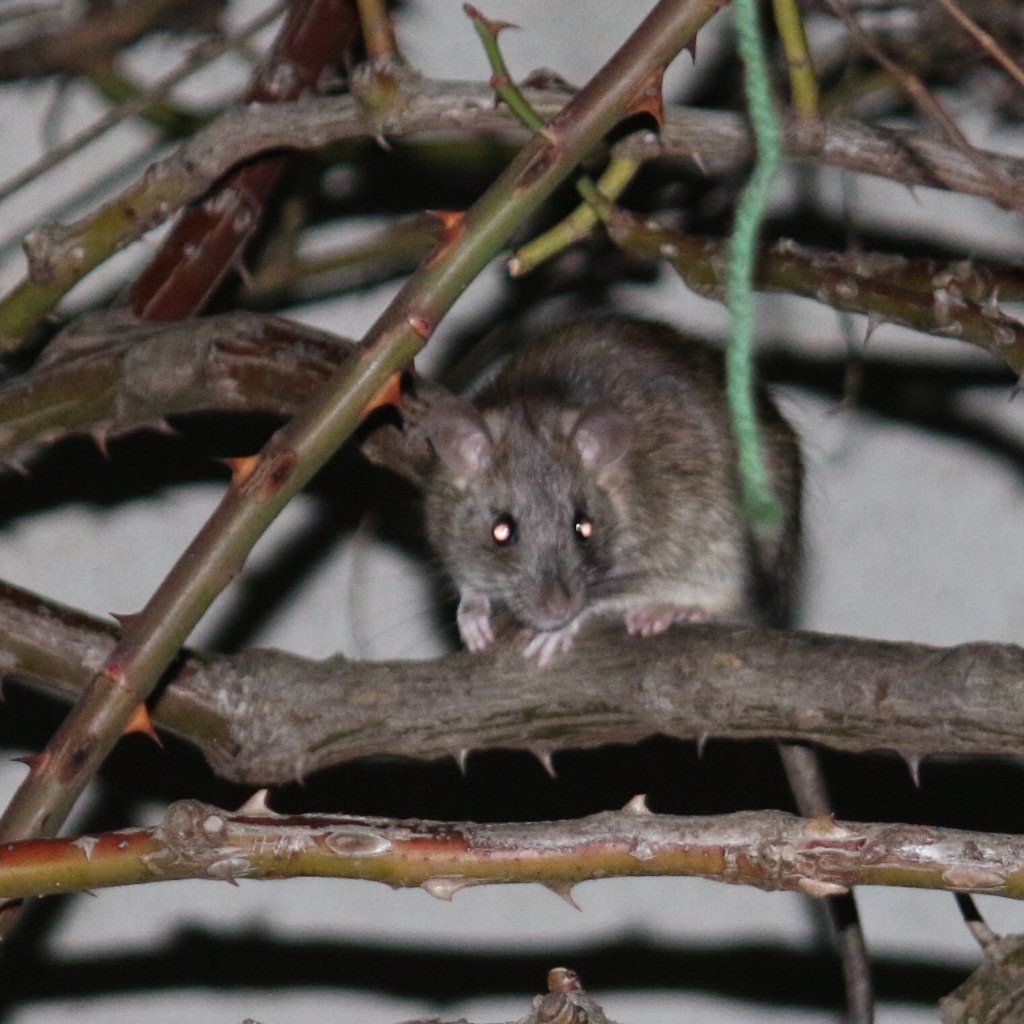
- Noises overhead. UC IPM lists noises from the attic or drop ceilings among the signs of rats, and the roof rat chapter says that in a home, noise in the attic is often how people first notice roof rats. Scratching in walls at night helps separate rats from mice, squirrels and bats.
- Rub marks up high. UC IPM describes dark smudges where rats rub their fur along the same beams, rafters, pipes and walls night after night.
- Rats on wires or fences at dusk. UC IPM names this as a sign of a rat problem in the yard. What to do about rats in the yard is in rats in the yard.
- Little sign on the floor. The roof rat chapter notes that roof rats living overhead may leave few droppings or tracks on the floor because they live between floors, above false ceilings or in utility spaces and come down only to feed. A clean floor does not rule out rats in the attic (rats or mice in the attic).
How to stop rats from climbing in
You cannot make a brick wall unclimbable, so the work is in cutting off the routes and closing the openings at the top.
- Cut the plant routes. Prune limbs away from the roof (3 to 6 feet, as above), take climbing ivy and vines off walls and fences, and keep shrubs at least 2 feet from each other and from the house (UC IPM).
- Seal high as well as low. Because roof rats climb so well, UC IPM says the openings above ground need plugging as well, and finding them usually takes longer than with Norway rats. Look at the roofline, eaves, vents and where pipes and wires enter. Rats need only a 1/2-inch gap (handbook).
- Screen vents properly. UC IPM gives 1/2-inch galvanized metal mesh for vent covers, screens over rooftop plumbing vents more than 2 inches across, and warns never to use lightweight chicken wire. The handbook adds that neoprene seals and spray foam are not rodent-proof. Materials and methods are in how to seal entry points.
- Leave the wires to the utility. The roof rat chapter mentions rat guards for overhead lines but warns they can fray insulation and cause short circuits; UC IPM’s advice is to call in a professional or the utility.
- Trap where they travel. For roof rats, UC IPM says traps often need to go off the ground as well as on it, on ledges, shelves, branches, fences, pipes or beams, and the handbook says to nail or wire them in place. Best rat traps covers types and spacing.
Do not seal a hole while rats may still be inside behind it; trap first, then close it. Mice or rats in the walls explains why.
Climbing questions people ask
Can rats climb brick walls?
Yes. Brick is on the handbook’s list of rough surfaces rats can climb, along with wood, concrete, weathered sheet metal and many plastics.
Can rats climb into a second-floor window or onto the roof?
They can reach both if there is a route: a rough wall, a pipe, a vine, a tree limb or a wire. That is why UC IPM tells you to plug openings above ground level and prune limbs back from the roof.
Can rats climb smooth walls?
We did not find a source that answers this. The handbook describes rats climbing rough surfaces; it does not give results for glass, glazed tile or smooth metal.
Can Norway rats climb?
Yes, though less than roof rats. The handbook says they can climb but tend to stay on lower floors, and UC IPM notes they turn up in ceiling voids more often than people expect.
How far can a rat jump?
Up to 36 inches straight up from a flat surface and up to 48 inches across, according to the handbook. A rat can also drop 50 feet without serious injury.
What it comes down to
Rats climb rough walls, pipes up to 3 inches across, wires, fences, vines and trees, jump 3 feet up and 4 feet across, and fit through a 1/2-inch gap. Roof rats do it best and live up high; Norway rats climb too but usually stay low. To keep them out, take away the routes (limbs, vines, crowded shrubs), seal openings at the roofline as carefully as at the foundation, screen vents with metal mesh, leave overhead wires to the utility, and set traps where the rats actually travel.
Sources and verification
- Baker, R. O., Bodman, G. R. and Timm, R. M. — Rodent-Proof Construction and Exclusion Methods, Prevention and Control of Wildlife Damage handbook (University of Nebraska–Lincoln, 1994)Rats and mice climbing wires, pipes, fences, poles, cables, vines, shrubs and trees and almost any rough vertical surface; rats climbing the outside of pipes up to 3 inches, larger pipes by bracing, and the inside of pipes and seams 1½ to 4 inches; jumping 36 inches up and 48 inches across; dropping 50 feet; reaching 13 inches; 1/2-inch and 1/4-inch openings; mice jumping 18 inches; power lines as a favorite route; checking roof joints and flashing; climbing beside overhead doors; toilets, drains and sewers; neoprene and spray foam not rodent-proof.
- Marsh, R. E. — Roof Rats, Prevention and Control of Wildlife Damage handbook (1994) (also at ICWDM)Entry from the roof and near overhead utility lines; running along lines and fences at night; tails for balance; agile climbers; little floor sign when living overhead; attic sounds as the first sign; more time needed to find entry points; vines and overhanging limbs; rat guards and their risks; traps nailed or wired on beams and pipes.
- Timm, R. M. — Norway Rats, Prevention and Control of Wildlife Damage handbook (1994)Norway rats can climb but tend to inhabit lower floors.
- UC IPM — Pest Notes: Rats (June 2025)Roof rats more agile and better climbers, Norway rats stronger swimmers; Norway rats in ceiling voids; entry by gnawing, climbing, jumping and through toilets and drains; removing climbing plants; pruning limbs within 3 feet (quick tips) and 6 feet (pest note) of the roof; 2-foot shrub spacing; ivy, star jasmine and honeysuckle; plugging openings above ground; utility wires; vent screening and no chicken wire; smudge marks; attic noises; rats on wires and fences at dusk; elevated trap placement.