
Traps and materials
Are Ultrasonic Pest Repellers Safe for Dogs, Cats and Other Pets? What the Frequencies Mean
The box usually says “pet friendly” and “inaudible to humans.” Neither claim is something a regulator has checked. What can be checked is the frequency printed on the box against what each animal can hear. Here is that comparison for dogs, cats, small pets and people, what one manufacturer says about pet rodents, and what buyers report.
Short answer: nobody has shown that they are safe, and nobody has shown that they harm dogs or cats. We found no study that tested household ultrasonic repellers on pets and no guidance from veterinary organizations. What is known is that dogs hear up to about 45 kHz and cats up to about 64 kHz, so they can hear much of what these devices put out (table). Pet rats, mice, gerbils, hamsters and guinea pigs are the animals these devices are aimed at, and one manufacturer says its repeller will affect them. Some devices, including ours, start at 12 kHz, a pitch many people can hear, especially children. If you use one, keep it away from rodent pets, watch how your dog or cat reacts, and switch it off if their behavior changes. Whether the devices work at all is a separate question, covered in do ultrasonic pest repellers work?
Who can hear an ultrasonic repeller?
Hearing ranges are measured by training an animal to respond to tones and finding the softest sound it detects at each pitch, so the published limits are approximate and depend on how loud the test tone was. The figures below come from a table compiled by George Strain at Louisiana State University from two standard references, with his caution that “too much value should not be placed on comparing species.”
| Animal | Approximate hearing range | Can it hear a 12–24 kHz device? | Can it hear 25–65 kHz? |
|---|---|---|---|
| People | 64 Hz to 23 kHz | The lower part, yes, for many people | No |
| Dog | 67 Hz to 45 kHz | Yes | Up to about 45 kHz |
| Cat | 45 Hz to 64 kHz | Yes | Almost all of it |
| Rabbit | 360 Hz to 42 kHz | Yes | Up to about 42 kHz |
| Ferret | 16 Hz to 44 kHz | Yes | Up to about 44 kHz |
| Guinea pig | 54 Hz to 50 kHz | Yes | Up to about 50 kHz |
| Gerbil | 100 Hz to 60 kHz | Yes | Most of it |
| Rat | 200 Hz to 76 kHz | Yes | Yes |
| Mouse | 1 kHz to 91 kHz | Yes | Yes |
| Chinchilla | 90 Hz to 22.8 kHz | The lower part | No |
| Canary, parakeet, cockatiel | About 200–250 Hz to 8–8.5 kHz | No | No |
| Goldfish | 20 Hz to 3 kHz | No | No |
The last two columns are our reading of the hearing ranges against the frequencies printed on devices; they say whether a sound is within range, not how loud it seems to the animal or whether it bothers it. Hamsters are not in the table we used, so we have no figure for them. Strain also notes that in the dog studies three dogs heard a tone at 46 kHz, but only when it was loud, at 64 to 73 dB.
What frequencies the devices actually use
Frequencies are printed on the box or listed by the seller, and they vary a lot. Examples from listings we checked on Amazon UK in November 2026 (we do not name brands):
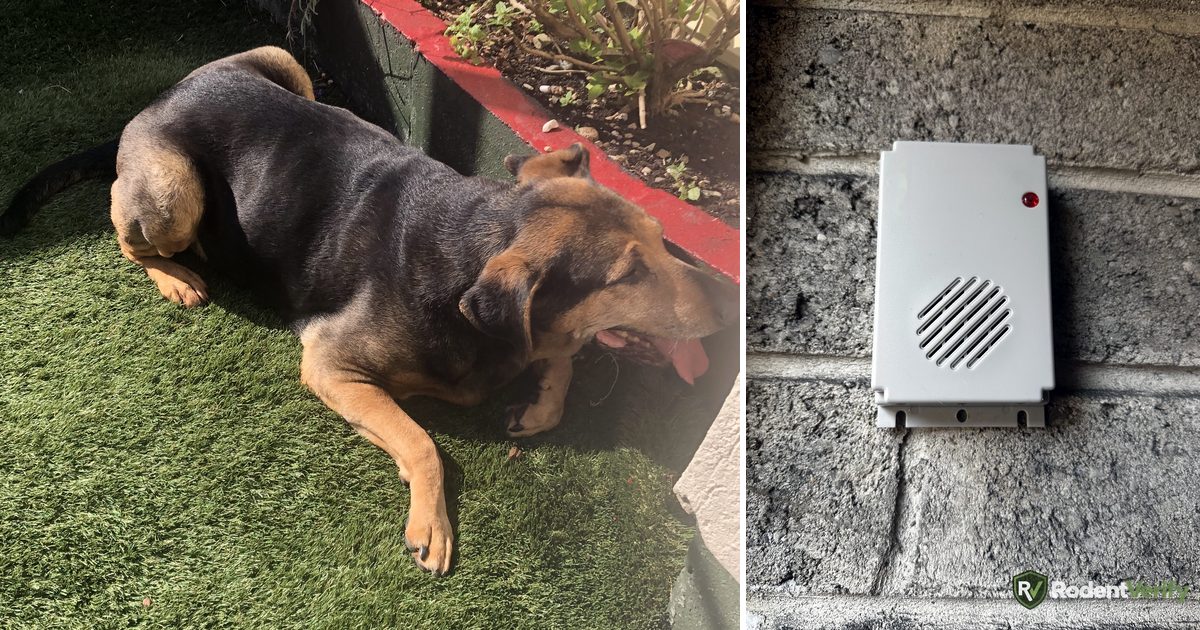
- 12–24 kHz, switching on for about 5 seconds and off for about 25: the battery device in the photo above. Its listing says “These frequencies are inaudible to humans.”
- 12–24, 5–110 and 20–70 kHz as selectable modes, with a volume control, on a newer model from the same line.
- 25–65 kHz on several plug-in models.
- “1–20 kHz” described as a mode that works “without a single sound you can hear.”
The last claim cannot be right: 1 to 20 kHz is ordinary audible sound for most people. The same goes for the low end of the 12–24 kHz devices. Acoustics researcher Timothy Leighton of the University of Southampton uses “very high frequency” for 12 to 20 kHz and reserves “ultrasound” for sound above 20 kHz. A device that starts at 12 kHz, or offers a 5 kHz mode, is partly an audible device.
Can people hear them?
Many can, at least sometimes. Upper hearing limits drop with age: age-related hearing loss “starts with problems hearing high-pitched sounds,” according to HealthLink BC, so a teenager may hear a device that an adult in the same room does not. In his 2016 review of public exposure to airborne ultrasound, Leighton cites a report that 5% of people aged 5 to 19 have a measurable hearing threshold at 20 kHz, and expects children to make up a greater share of the people who can hear such sound.
Buyer reviews of the 12–24 kHz device on Amazon UK match that picture. One reviewer heard “a high pitch noise” every 30 seconds and returned it; others say they hear nothing; one family wrote that the adults heard nothing while the children heard a whistle they found unpleasant. Reviews are not tested evidence, but they show that “inaudible to humans” is not true for everyone.
Is it harmful to people? The evidence is thin. Leighton writes that early studies reported hearing threshold shifts, nausea, headache, fatigue, migraine and tinnitus, but that there has been too little research on human subjects to say what risk current exposures carry, and that “it is not possible to prove or disprove public health risk or discomfort.” He also notes that some manufacturers of ultrasonic pest deterrents warn in their instruction manuals of subjective adverse reactions. A 2018 laboratory study with 50 adults is summarized in do ultrasonic pest repellers work?
Dogs
A dog can hear a 12–24 kHz device and much of a 25–65 kHz one. We found no study of whether that distresses dogs or damages their hearing, and no veterinary organization guidance on household repellers. Being able to hear a sound is not the same as being harmed by it, and the absence of studies is not proof of safety.
Our own experience is one dog: we ran a battery-powered repeller on the wall of a backyard outbuilding for several years, and the dog never reacted to it (our own experience). That is one animal and one device, not a test.

Cats
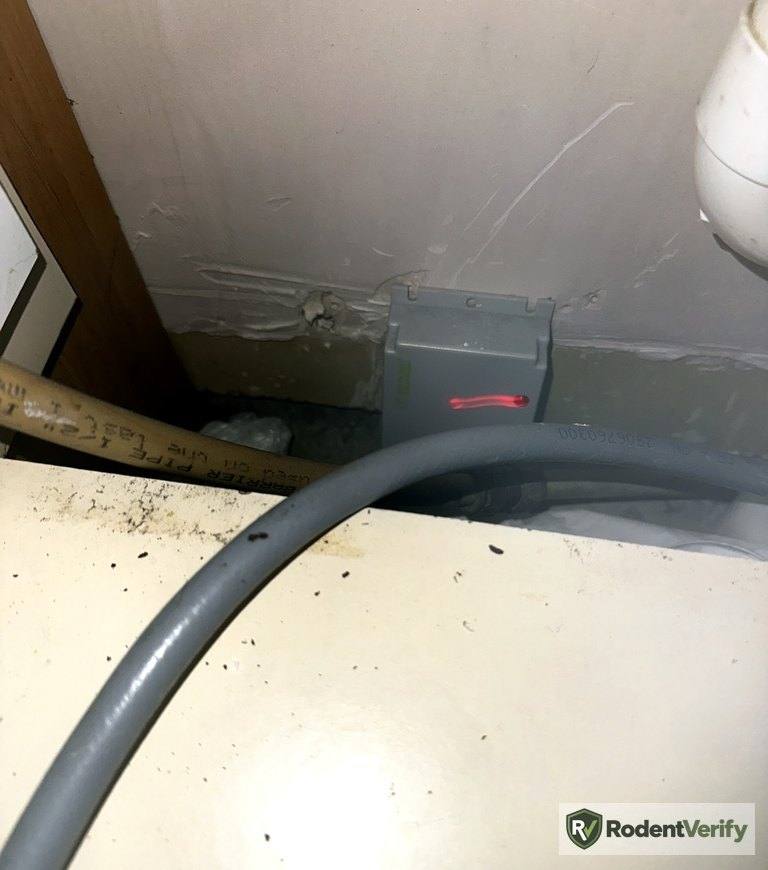
Cats hear higher than dogs, up to about 64 kHz, so they can hear almost every frequency these devices list. One Amazon UK reviewer wrote that the device was sold as pet friendly, but “my cat can hear it”: the cat stopped going upstairs while the repeller ran in the loft and seemed unsettled even downstairs, so the owner switched it off. That is a single report, not a study, but it is the kind of change to watch for.
Hamsters, guinea pigs, gerbils, pet rats and mice, rabbits
This is where the risk is most obvious, because a rodent repeller is designed to bother rodents. Pet rats, mice and gerbils hear well into the ultrasonic range, and guinea pigs up to about 50 kHz. The manufacturer of one widely sold repeller line says plainly that its device “will affect any rodent including rats, mice, gerbils, guinea pigs, chinchillas, or hamsters,” and that owners of those pets should keep them in a different room away from the repellent.
Rabbits and ferrets are not rodents, but they hear up to about 42 and 44 kHz, inside the range of most devices. We found no studies on how these devices affect them. Our view: do not run a repeller in a room with small pets, and if you keep them anywhere in the house, ask your veterinarian first.
Birds and fish are a different case. The table puts pet birds’ upper limit around 8 kHz and goldfish at 3 kHz, below what most repellers emit, although that says nothing about a device’s audible modes or clicks.
What “pet friendly” on the box means
It is the seller’s claim. EPA treats ultrasonic sound generators as pesticide devices that do not go through premarket review, and the FTC has challenged sellers of these devices for unsupported claims; details are in what “EPA” on the box means. We found no requirement that a “pet friendly” claim be tested before it is printed.
If you have pets and rodents
- Keep repellers away from rodent and small pets. Not in the same room, as the manufacturer quoted above advises.
- Watch dogs and cats for a few days. Our advice, not a source rule: if a pet starts avoiding the room, seems restless, or stops using a space it used before, switch the device off.
- Check the frequency on the box. Anything that starts below 20 kHz, or has a low “audible” mode, may also be heard by people in the house, especially children.
- Rely on the methods that work. Seal the openings (how to seal mouse entry points), set snap traps where pets cannot reach them (best mouse traps), and be careful with poison around pets (mouse poison around dogs and cats). The full plan is in how to get rid of mice.
Questions people ask
Can dogs hear ultrasonic pest repellers?
Yes. Dogs hear up to about 45 kHz, so they can hear a 12–24 kHz device and part of a 25–65 kHz one. Whether it bothers them seems to vary; we found no study that measured it.
Can cats hear ultrasonic pest repellers?
Yes. Cats hear up to about 64 kHz, which covers nearly every frequency printed on these devices.
Can ultrasonic repellers hurt a dog’s ears?
We found no study showing that household repellers damage dogs’ hearing, and none showing they are harmless. There is simply no data.
Are ultrasonic repellers safe for hamsters and guinea pigs?
Assume not. They are rodents, they hear these frequencies, and at least one manufacturer says its device will affect them and should be kept in a different room.
Why can I hear my “ultrasonic” repeller?
Because many devices work partly below 20 kHz, the usual upper limit of human hearing, and some have modes as low as 5 kHz. Children and younger adults are more likely to hear them.
The bottom line
Ultrasonic pest repellers have not been shown to be safe or unsafe for pets; we found no study that tested it. Dogs and cats can hear most of what these devices emit, and rodent pets are exactly what they are designed to bother. Some devices are also audible to people, especially children. If you use one, keep it away from small pets, watch your dog or cat, and switch it off if they react. For getting rid of mice or rats, sealing and snap traps are what CDC and university guides recommend.
Sources and verification
- George M. Strain, Louisiana State University — Frequency Hearing Ranges in Dogs and Other Species (April 2017; archived copy, the page is no longer on lsu.edu)Approximate hearing ranges compiled from Fay (1988) and Warfield (1973); dog audiograms from Heffner (1983), three dogs hearing 46 kHz at 64–73 dB; caution about comparing species.
- T.G. Leighton — Are some people suffering as a result of increasing mass exposure of the public to ultrasound in air? Proceedings of the Royal Society A (2016)12–20 kHz as very high frequency sound and ultrasound above 20 kHz; spread of ultrasonic pest deterrents; manufacturers’ manual warnings; 5% of 5–19 year olds with a 20 kHz hearing threshold; early reports of nausea, headache, fatigue, migraine and tinnitus; insufficient research to prove or disprove risk.
- HealthLink BC — Age-related hearing loss (presbycusis) (March 2023)Starts with problems hearing high-pitched sounds.
- Victor — Answers from the Pros: PestChasersManufacturer statement that its ultrasonic device will affect pet rodents and that those pets should be kept in a different room.
- Amazon UK product listings and buyer reviews (checked November 4, 2026)Frequencies printed by sellers (12–24 kHz; 12–24, 5–110 and 20–70 kHz; 25–65 kHz; “1–20 kHz”); reviews describing an audible noise, children hearing a whistle, and a cat avoiding the loft. Brands not named; reviews are unverified reports.
- RodentVerify — Do ultrasonic pest repellers work?UC IPM, EPA and FTC sources on effectiveness and regulation; the 2018 study with 50 adults; our outbuilding experience.