

Evidence and signs
How to Know If Mice Are Gone: What Counts as Proof and What Doesn’t
No single sign proves a house is mouse-free — not a quiet week, not an empty trap, not one clean drawer. What you can do is set a clean starting point, keep traps working where mice were active, and watch whether new evidence stops appearing. Here is how to read what you find.
Do not sweep or vacuum old droppings to “start fresh.” CDC advises against sweeping or vacuuming rodent urine, droppings or nesting material, because it can put tiny droplets containing viruses into the air. Wet them with disinfectant and wipe them up instead. The full cleanup procedure is here.
How do you know if mice are gone?
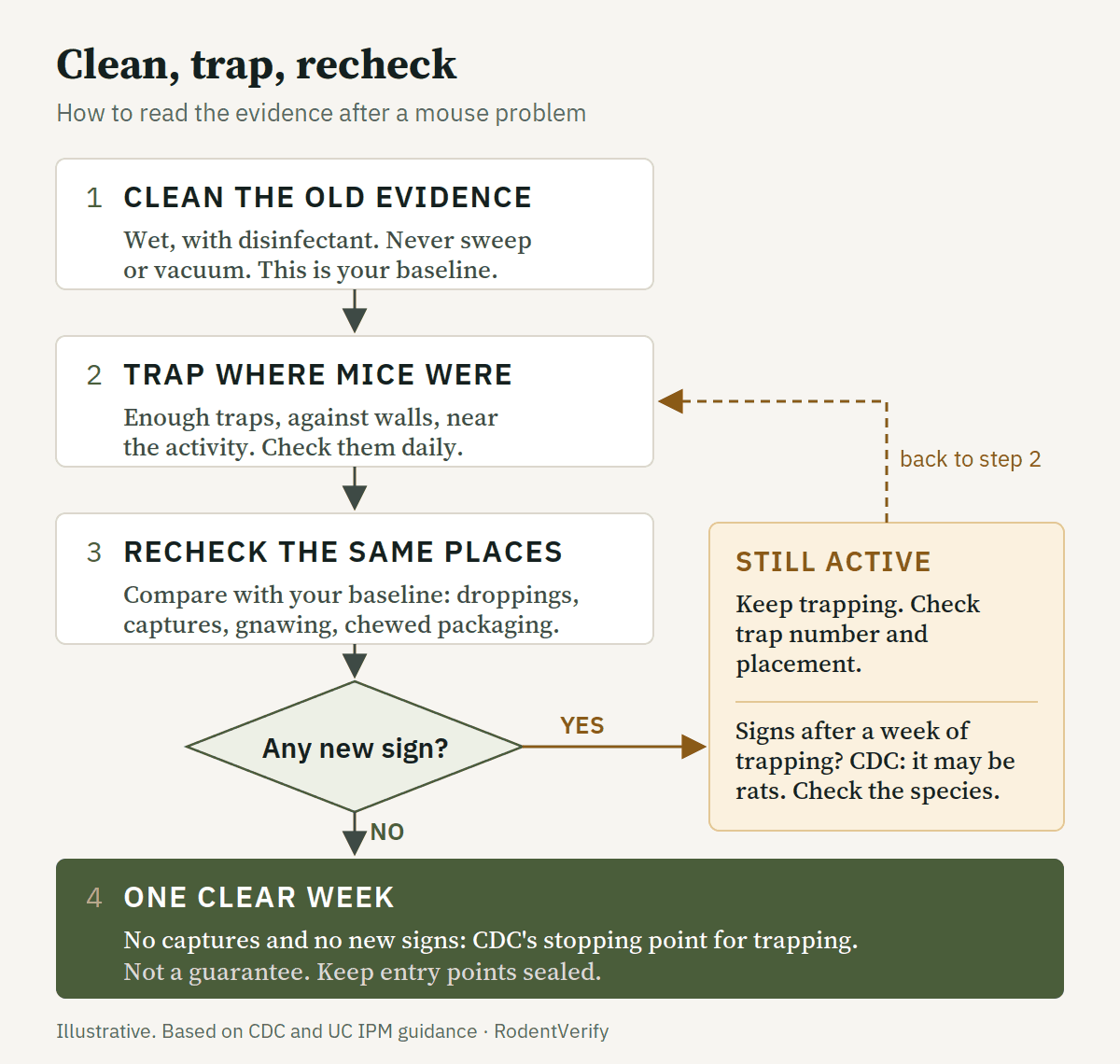
You know by what stops appearing, not by one sign. Clean up the old droppings safely, keep correctly placed traps set, and recheck the same places. If traps stop catching and no new droppings, gnawing or other signs appear, the control is working. CDC’s trapping guidance treats a week with no captures and no new signs as the point where trapping has done its job.
That is the strongest practical answer public-health guidance gives. It is a benchmark, not a guarantee: it cannot tell you that no mouse will ever get in again. That part depends on whether the way in is closed.
What counts as evidence mice are still there?
The distinction that matters is between old evidence and new evidence. CDC notes that gnaw marks alone may only mean rodents were active in the area at some point, and that it can be hard to tell whether rodents are active just by examining droppings. Old signs tell you where mice have been. Only new signs, appearing after you know the area was clean, tell you they are still there.
| What you see | What it supports | What it does not prove |
|---|---|---|
| New droppings after a safe cleanup | Active rodent presence (CDC) | How many mice, or that it is a mouse and not a rat |
| A mouse in a trap | A mouse was active on that route | How many are left |
| New gnawing on something intact at your baseline | Recent activity in that spot | When exactly, or how many |
| Freshly chewed food packaging | Recent feeding activity | Where the mouse is now |
| Tracks in dust | Activity along that route (UC IPM) | The size of the problem |
| Old droppings, old gnaw marks, an old nest | Rodents were there at some point | That they are there now |
| An empty trap | Nothing was caught there | That no mice are present |
| One spot that stays clean | No new droppings in that spot | Anything about the rest of the house |
| Quiet nights | Supporting evidence, at most | A mouse-free house |
| A musky odor | Associated with house mice (UC IPM) | Whether they are still active, or when they left |
| Sealed repairs still intact | The repair is holding | That no mouse is left inside |
| A week with no captures and no new signs | CDC’s endpoint for trapping | That mice can never get back in |
Step 1: Clean the old evidence to create a baseline
This is the core of the method, and it comes straight from CDC: one way to be sure whether rodents are active is to safely clean the area; if droppings are present after cleaning, that indicates an active rodent presence. CDC says the same cleanup approach can help determine whether gnawing is current.
Old droppings left in place cannot tell you when they were deposited, and their color or shine is not a reliable clock. Why appearance can’t date droppings goes through that in detail. Do not crush, press or break droppings to check them — handle them only as part of the wet cleanup.
Clean every place where you found evidence, not just the room that bothered you first. Then write down or photograph what those places look like now. That record is your baseline.
Step 2: Keep traps set where mice were active
Traps are a monitoring tool as well as a control tool. NC State Extension describes snap traps as providing simultaneous monitoring and control, and UC IPM notes that trapping lets you see your own success.
But an empty trap only means something if the trapping was done properly. UC IPM says trapping works best when enough traps are placed in strategic locations near rodent activity, set against walls, and spaced no more than about 10 feet apart where mice are active. Too few traps, or traps in the wrong places, can stay empty while mice keep moving a few feet away. Which traps to use and where to put them covers the setup.
Check traps daily. Both CDC and NC State advise daily checks, and every capture is information: it tells you mice were still active on that route.
Step 3: Recheck the same places
Go back to the spots you cleaned and compare them against your baseline. The places worth checking are the ones where activity was already shown, and the places CDC lists for trap placement: behind the stove and refrigerator, the backs of cabinets and drawers, and attics, basements and crawlspaces.
What you are looking for is anything new since the baseline:
- New droppings on a surface you cleaned.
- New gnawing on wood, packaging or wiring that was intact before. How to read gnaw marks.
- Freshly chewed food packaging. NC State Extension describes mice chewing through packaging and taking small tastes before moving on.
- Tracks in dusty areas like a garage, attic or basement.
- Captures in the traps.
The strongest conclusion comes from several signals agreeing. Clean surfaces, empty traps and intact repairs together say much more than any one of them alone.
How long should you keep checking?
CDC’s answer is: keep trapping until activity stops, then use a clear week as the stopping point. Its trapping guidance says to reset traps until rodent activity has stopped, to keep checking and refreshing bait for at least 15 days, and to leave baited traps out longer if you still have mice. It also uses a week with no captures and no new signs of rodents as the endpoint.
One detail in the source is worth knowing. CDC’s page covers rodents in general, but the sentence after the one-week condition literally says “the rats are gone.” Read it for what it is: a practical stopping point for a trapping program, not a scientific proof that a house is mouse-free.
You will see other timers online — “48 hours with no droppings,” “two weeks and you can be sure.” None of the sources behind this guide give them, so RodentVerify does not use them.
Which signs are too weak to use on their own?
These can support a conclusion. None of them can carry it alone.
- Silence. Scratching in walls is one of the signs NC State Extension lists, but when it stops, that does not prove the mice have gone, and wall noise can come from other animals entirely. What the sounds in your walls can and can’t tell you
- Not seeing a mouse. UC IPM notes house mice are active mostly at night. Not seeing one during the day says little.
- A fading smell. UC IPM associates a musky odor with house mice, especially in large or long-term infestations. None of the sources here gives a timeline for how fast it should fade, so a weaker smell is not evidence of anything by itself. A smell that lingers is not proof of live mice either: what a lingering mouse urine smell does and does not mean
- One clean room. It tells you about that room. UC IPM notes house mice seldom range more than 30 feet from their nest and food, so activity elsewhere in the house may never show up in the spot you are watching.
- An empty trap. Covered above: it proves nothing unless the trapping was set up to catch.
- A pet that has lost interest. UC IPM warns that predators can make rodents more secretive, giving the false impression that the population has been reduced.
What if new droppings appear after cleaning?
Rodents are still active in that area. That is exactly what CDC’s clean-and-recheck method is designed to show. Keep trapping, and check the placement and number of traps against the guidance above.
New droppings confirm activity. They do not tell you how many mice there are, and one new sign does not by itself mean a large infestation. One mouse or an infestation? covers what the evidence supports.
If new droppings, urine spots or gnawing keep appearing after a week of trapping, CDC’s trapping page raises a specific possibility: you may be dealing with rats. Rats are more cautious about new objects, and NC State Extension notes that mouse snap traps are not an effective tool for rats. Check what you actually have: how to tell mice from rats and how the droppings compare.
What if the traps stay empty but signs keep appearing?
The mice are not gone; the traps are not reaching them. New evidence after a clean baseline outranks an empty trap. The likely reasons are the ones UC IPM names: not enough traps, traps too far from where the activity is, or traps not set against walls where mice pass over the trigger. The other possibility is the one above — the animal may not be a mouse. Trap placement and troubleshooting
Check the repairs, not just the rooms
“Gone” and “can’t get back in” are two separate questions. Trapping removes the mice that were inside. Exclusion stops new ones replacing them. UC IPM calls exclusion the most successful and permanent form of house mouse control.
While you are monitoring, look at the places you sealed. New gnawing around a repair, or packing material that has been pushed out of a gap, means something is still working at that opening. NC State Extension notes that rodents can push mesh aside, which is why it recommends caulking over it. How to seal entry points
A clear trapping period without exclusion is not a lasting fix. NC State Extension recommends doing exclusion regularly, even when there is no sign of mice.
A verification checklist
The closest you can get to “yes, they’re gone” is when all of these are true at once:
- The old droppings, urine and nesting material were cleaned up safely, wet, not swept or vacuumed.
- No new droppings have appeared on the surfaces you cleaned.
- Traps placed near the old activity, in enough numbers, have stopped catching.
- No new gnawing, chewed packaging or tracks have appeared since your baseline.
- Your entry-point repairs are intact, with no new gnawing around them.
- CDC’s trapping benchmark has been met: a week with no captures and no new signs.
Any single new sign — a dropping, a capture, fresh gnawing — resets the check for that area. After that, the job becomes prevention: food in sealed containers, garbage covered, openings closed, and an occasional look at the places mice used before.
When to get professional help
CDC says that if trapping does not resolve the infestation, you could consider a bait station or professional help. It also advises contacting a professional service when there is evidence rodents have accessed heating and cooling ducts. Help is also worth considering when signs keep appearing despite correct trapping and sealing, when activity is in walls or ceilings you cannot reach, when you are not sure what animal you have, or when you cannot safely inspect, clean or trap yourself. Where the line between DIY and professional help sits.
The bottom line
You cannot prove mice are gone from silence or from one clean spot. You can build confidence: clean the old evidence safely, keep properly placed traps working, recheck the same places, and look for agreement across droppings, captures, gnawing, tracks and your repairs. When all of them stay quiet through CDC’s clear week, the trapping has done its job. Keeping the openings closed is what keeps it that way. The whole plan, step by step, is in how to get rid of mice.
Sources & verification
- CDC — Controlling Wild Rodent InfestationsThe clean-and-recheck method: droppings present after safe cleaning indicate active presence; gnaw marks alone may reflect past activity.
- CDC — How to Trap Up to Remove RodentsReset traps until activity stops; daily checks; bait checked for at least 15 days; the one-week no-capture, no-new-sign endpoint; persisting signs may point to rats; professional help if trapping does not resolve it.
- CDC — How to Clean Up After RodentsNo sweeping or vacuuming; wet cleanup with disinfectant; professional service when rodents have reached ventilation systems.
- UC IPM — House Mouse (Pest Notes, updated July 2025)Fresh gnaw marks and tracks as activity signs; musky odor; nocturnal activity; 30-foot range; enough traps, near activity, about 10 feet apart; trapping to verify success; predators giving a false impression; exclusion as the most permanent control.
- NC State Extension — Surveillance and Management of Common Structure-Invading Mice (2024)Signs of infestation including chewed packaging and wall noises; snap traps as monitoring and control; daily checks; mouse traps not effective for rats; mesh can be pushed aside; exclusion done regularly.