

Traps and materials
Do Cats Keep Mice Away? What the Studies and Pest Guides Actually Show
A cat will catch some mice, and its presence can make mice more careful. But university pest guides agree that a cat rarely gets rid of mice that are already living in a house, and studies of cats and rats point the same way. Where a cat can help is afterward: once the mice are gone, a good hunter may stop new ones from settling in. Here is what the guides say, what the research found, whether the smell of a cat does anything, and what hunting costs the cat.
Short answer
- Cats catch mice, but rarely control them. UC IPM says there are few situations in which cats or dogs control rodent numbers, and ICWDM says pets generally do not control large populations.
- Fewer sightings do not mean fewer mice. UC IPM warns that predators can make rodents more cryptic, which gives a false impression that the population is down.
- A cat may help after the mice are gone. ICWDM says a cat may not eliminate existing mice but in some situations may prevent re-infestation.
- Cat smell alone is not a repellent. In lab tests, cat odor changed the behavior of some mice for a short time; no guide recommends it for control. Other smells are compared in what smells do mice hate.
What university pest guides say
Two of the main U.S. references on house mice say much the same thing. UC IPM, the University of California’s integrated pest management program, says some dogs and cats will catch and kill house mice and rats, but that there are few situations in which they control the population. The reason is practical: around most buildings, house mice can find many places to hide and raise their young where a predator cannot reach them.
ICWDM, the Internet Center for Wildlife Damage Management, adds that in towns and suburbs mice often live close to cats and dogs and feed on their food, and that mice frequently live under dog houses and come out to eat when the dog is away or asleep. Its conclusion for house mice is that a cat may not eliminate an existing population but in some situations may prevent re-infestation. It says the same about rats: cats cannot eliminate large existing rat populations, but a good hunter may stop rats from moving back in after they have been controlled.
Both guides make one more point that matters if you are judging a cat by results. UC IPM says the presence of predators can make rodents more cryptic, so you see fewer of them without there being fewer. The same warning appears in our guides on how to know if mice are gone and one mouse or an infestation.

What studies of cats and rodents found
Most research on cats as rodent control looks at rats or at farms, not at mice in a house. The studies are small, but they agree with the pest guides more than with the folk wisdom.
| Study | What it tested | What it found |
|---|---|---|
| Parsons and others, 2018 (Frontiers in Ecology and Evolution) | Feral cats and a colony of more than 100 tagged rats at a New York City waste recycling center, filmed over 79 days | 20 stalking events, 3 kill attempts and 2 kills. When cats were around, rats spent less time in the open and fewer were seen, but they hid rather than died |
| Mahlaba and others, 2017 (PLOS ONE) | Rodent activity at 40 rural homesteads in Swaziland with cats only, dogs only, both, or neither | Homesteads with both cats and dogs had less rodent foraging. Cats or dogs on their own usually did not reduce pest rodents |
| Adduci and others, 2021 (PLOS ONE) | Laboratory house mice and Norway rats given a choice of boxes with cat urine, cat body odor, a fox odor or water | Female mice visited the cat-odor boxes less; male mice did not. Neither species spent less time in the odor boxes, which the authors read as the aversion fading |
| Ferrero and others, 2011 (PNAS) | Which chemical in carnivore urine rats and mice avoid | A compound called 2-phenylethylamine, found at high levels in the urine of 18 of 19 carnivore species tested, triggers an inborn avoidance in rats and mice |
The New York study is the clearest test of a cat as a rat catcher. Adult rats there averaged about 337 grams, more than ten times a typical mouse, and the cats mostly watched them. The authors conclude that people see fewer rats and assume the cats killed them, when the rats have simply moved out of sight. For more on cats and rats, see how long do rats live and how to get rid of rats.
Mice are smaller and easier prey, so a cat has a better chance with them. Still, none of these studies shows cats clearing an established population of mice from a building, and the pest guides above explain why: the mice live in wall voids, under appliances and in stored boxes the cat cannot reach.
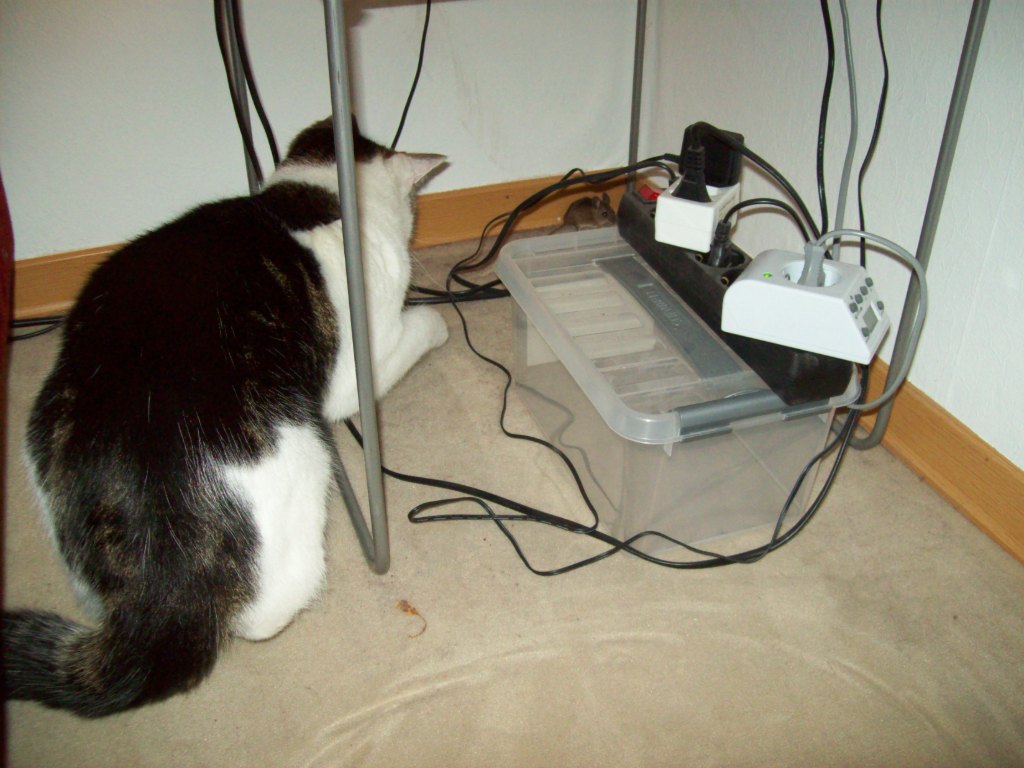
Does the smell of a cat keep mice away?
Not reliably. Mice do react to cats by smell, and the 2011 study found the chemical behind part of that reaction. But the 2021 lab study showed a weak and short-lived effect: some female mice avoided cat odor at first, males did not, and neither sex stayed away for long. The authors add that cat body odor does not travel far through the air, which limits it as a repellent.
There is also evidence that mice can stop fearing it. Russian researchers reported in 2015 that mice exposed to cat urine odor in their first two weeks of life, while still nursing, did not avoid that smell as adults, although their stress hormones still rose. A mouse that grows up in a house with a cat may have learned that the smell is part of the background.
No official guide we checked recommends cat litter, cat fur or predator urine to keep mice out. ICWDM says rodents find some tastes and odors objectionable but that chemical repellents are seldom practical solutions for mice. The two repellents people ask about most do no better: our guides to peppermint oil and ultrasonic repellers go through the evidence.
Can a cat stop mice from coming back?
This is where the guides give cats some credit. ICWDM says that once mice or rats have been removed, a cat that is a good hunter may prevent re-infestation in some situations. That fits the picture from the studies: a cat is better at catching the first few mice that wander into a space it patrols than at removing a colony that is already hidden in the walls.
So the order matters. Clear the mice that are already there with traps, seal the openings they used, and treat the cat as a backup, not the plan. The full sequence is in how to get rid of mice, with trap choice in best mouse traps and sealing in how to seal mouse entry points.
What hunting mice can cost your cat, and you
| Risk | What the sources say | What to do |
|---|---|---|
| Toxoplasmosis | Cats get it by eating infected rodents, birds or other small animals, and can shed the parasite in their feces for up to 3 weeks (CDC). ICWDM lists it as a risk of using cats for rodent control | CDC: change the litter box daily; if you are pregnant or have a weakened immune system, have someone else do it or wear gloves and wash your hands; keep indoor cats indoors |
| Poisoned mice | UC IPM says there is evidence that the rodenticide bromethalin can pass to predators that eat mice that took the bait; ICWDM says anticoagulant residues in dying rodents can poison predators | Do not use poison where a cat can catch the mice; see mouse poison around dogs and cats |
| Pet food | Mice often live near pets and feed on their food (ICWDM); UC IPM advises feeding pets only what they eat at one meal | Pick up bowls after meals and store pet food in sealed containers; see what attracts mice |
| Wildlife | ICWDM calls the impact of free-ranging cats on native wildlife a concern; the authors of the New York study say cats prefer smaller, easier prey such as birds | Do not get or release a cat outdoors to control rodents |
Mice and their droppings can carry disease to people too, whether or not a cat is involved. If your cat leaves a dead mouse in the house, handle it as you would any dead rodent; see what to do with a dead mouse and are mouse droppings dangerous.
More questions about cats and mice
Should I get a cat to get rid of mice?
Not as the solution. The pest guides say cats rarely control a population that is already there, and ICWDM points to the disease and wildlife risks. Get a cat because you want a cat. If it also discourages new mice after you have trapped and sealed, that is a bonus.
Do mice leave a house if they smell a cat?
No source we found shows that. In the lab, cat odor made some female mice cautious for a short time and had no clear effect on males. Mice living in walls and cabinets are out of the cat’s reach and often keep feeding at night.
Can a cat find mice in the walls?
A cat may hear or smell them and watch a spot for hours, which can help you find where the mice are. It cannot reach them inside a wall void. See mice in walls for how to deal with them there.
Do dogs keep mice away?
Not on their own. ICWDM says mice often live under dog houses and feed when the dog is away or asleep. In the 2017 study, only homesteads with both cats and dogs had clearly less rodent activity.
Is it safe for my cat to eat a mouse?
It carries risks. CDC says cats can get toxoplasmosis from infected rodents, and a mouse that ate poison bait can pass it on. If your cat may have eaten a poisoned mouse, contact a veterinarian or an animal poison control service.
In short
Cats catch mice, but university pest guides and the studies we found agree that they rarely get rid of mice already living in a house, and seeing fewer mice can mean they are hiding. The smell of a cat has only a weak, short-lived effect. Where a cat can help is keeping new mice from settling in once the existing ones have been trapped and the entry points sealed. Keep poison away from a cat that hunts, and change the litter box daily.
Sources and verification
- UC IPM — Pest Notes: House Mouse (UC ANR Publication 7483)Dogs and cats catch house mice and rats but seldom control the population; predators make rodents more cryptic; mice hide and rear young out of predators’ reach; bromethalin passing through the food chain to predators; feeding pets only one meal at a time.
- ICWDM — House Mouse Damage Prevention and Control Methods and Norway Rat Damage Prevention and Control MethodsMice and rats living near pets and feeding on pet food; living under dog houses; pets do not control large populations; cats may prevent re-infestation; toxoplasmosis and wildlife concerns; chemical repellents seldom practical; anticoagulant residues in dying rodents.
- Parsons, Banks, Deutsch and Munshi-South — Temporal and space-use changes by rats in response to predation by feral cats in an urban ecosystem (Frontiers in Ecology and Evolution, 2018)Feral cats and tagged rats at a New York City waste facility, 306 videos over 79 days; 20 stalks, 3 kill attempts, 2 kills; rats hid rather than declined; average rat about 337 grams. Read through the ScienceDaily summary.
- Mahlaba, Monadjem, McCleery and Belmain — Domestic cats and dogs create a landscape of fear for pest rodents around rural homesteads (PLOS ONE, 2017)Forty homesteads in Swaziland; less rodent foraging only where cats and dogs were both present. Read through the ScienceDaily summary.
- Adduci, León, Schlötelburg, Busch and Fraschina — Avoidance behaviour in laboratory house mice and Norway rats towards predator odours (PLOS ONE, 2021)Cat urine, cat body odor and fox odor; fewer visits by female mice to cat odors, no effect in males; no effect on time spent near the odors; cat body odor of limited use as a repellent.
- Harvard Medical School — The Smell of Danger (on Ferrero and Liberles, PNAS, 2011)2-phenylethylamine in the urine of 18 of 19 carnivore species tested; inborn avoidance by rats and mice.
- ScienceDaily — Mice exposed to cat odor early in life (Society for Experimental Biology, July 2015)Mice exposed to cat urine odor while nursing did not avoid it as adults; stress hormone response unchanged.
- CDC — Toxoplasmosis: Causes and How It Spreads (February 2025) and Toxoplasmosis: An Important Message for Cat OwnersCats infected by eating rodents, birds or other small animals; shedding for up to 3 weeks; change the litter box daily; precautions in pregnancy; keep indoor cats indoors.