
Traps and materials
Best Mouse Traps: Which Type Works, Where to Put It, and Why It Fails
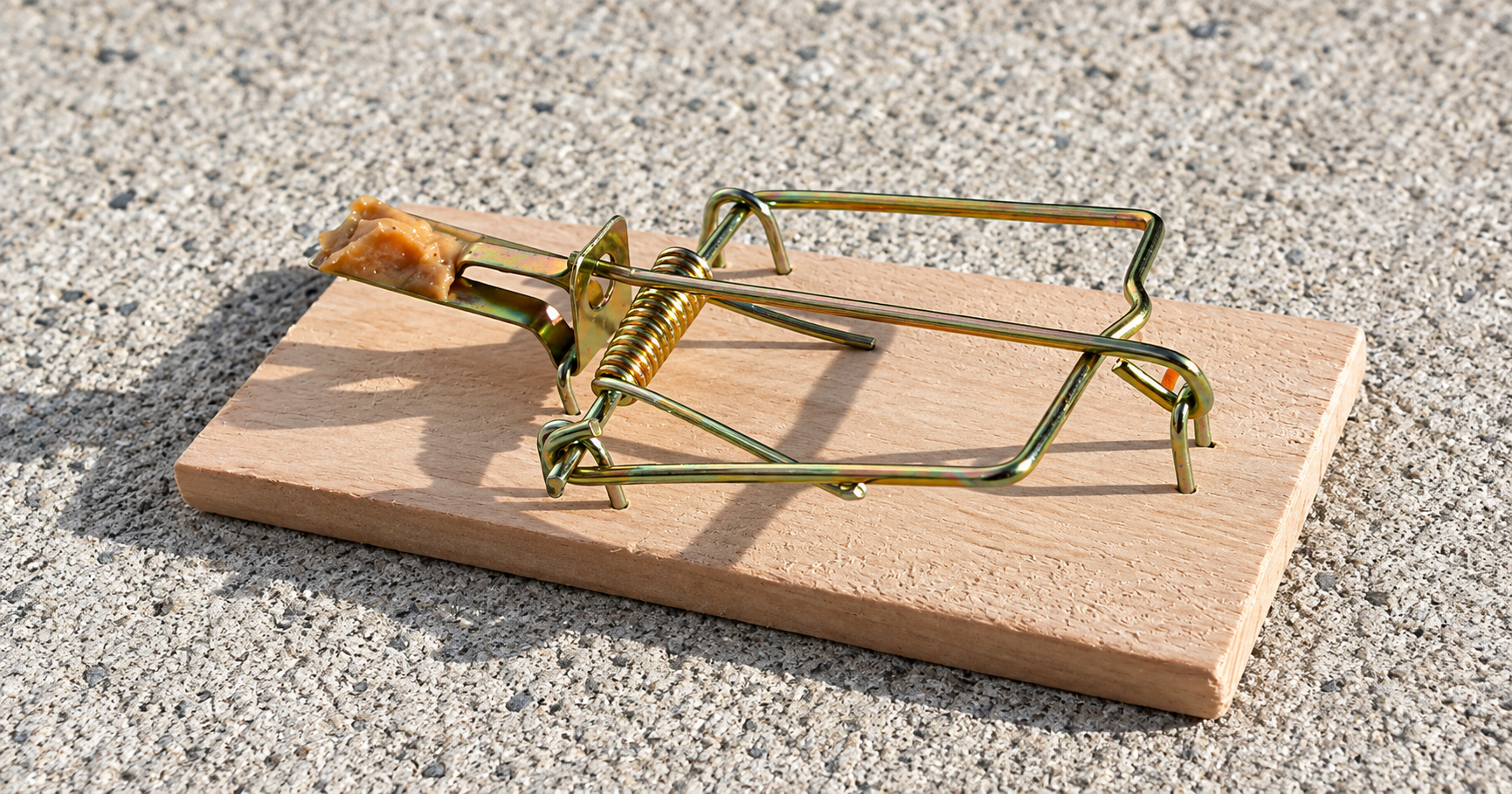
RodentVerify has not lab-tested every trap on the shelf, and this page does not pretend to rank brands. What public-health and university guidance does support is clear enough: for most homes, the best-supported choice is a mouse-size snap trap with a wide trigger, used in enough numbers along the walls where mice actually travel, and kept where children and pets cannot reach it. Placement matters more than the name on the box.
Before you set anything: if you have found droppings or nesting material, do not sweep or vacuum them. Clean them up wet, following the cleanup procedure. And if you are not sure the animal is a mouse, check that first — mouse and rat traps are not interchangeable. For rats, see best rat traps.
The short answer
- Use mouse-size snap traps. CDC says traditional snap traps are recommended to reduce rodent populations around the home.
- Look for a wide trigger plate. UC IPM notes that mouse traps with a wide trigger plate have higher catch rates.
- Put them against the wall, where the signs are, with the baited end touching the wall.
- Use more than one. UC IPM advises enough traps to make trapping short and decisive, spaced no more than about 10 feet apart where mice are active.
- Skip glue traps and live traps. CDC advises against both.
- Seal the entry points too. Trapping removes the mice already inside; it does not stop the next ones.
Mouse trap types compared
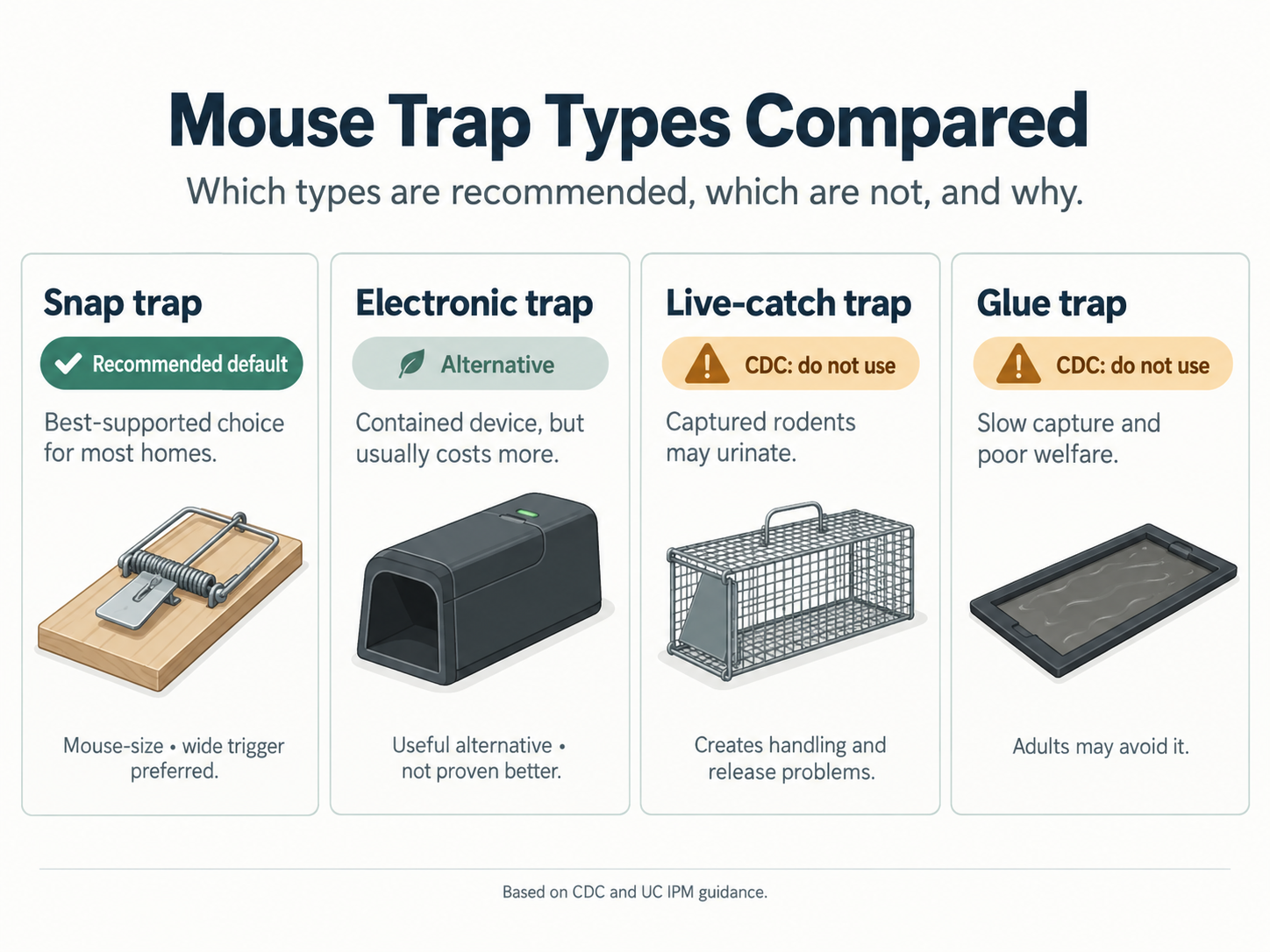
This table reflects what the sources below support. It is a comparison of trap types, not of brands.
| Trap type | RodentVerify’s position | What supports it | Watch out for |
|---|---|---|---|
| Mouse-size snap trap | Recommended default | CDC recommends traditional snap traps; UC IPM says trapping works well for most situations | Must be kept away from children and pets; too few traps or poor placement cuts success |
| Wide-trigger snap trap | Preferred design feature | UC IPM: wide trigger plates have higher catch rates | Not every wide-trigger model performs the same |
| Plastic easy-set snap trap | Convenience option | UC IPM: some people prefer them because they are easier to set and clean | Easier to use is not the same as more effective |
| Snap trap in a box or cover | Useful where contact is a concern | NC State: snap traps can go inside boxes designed to hold them | An enclosure is not automatically child-proof or pet-proof |
| Electronic (electrocution) trap | Reasonable alternative, not proven better | UC IPM: some users have found them to give good house mouse control | Considerably more expensive; you still need enough of them, checked often |
| Live-catch trap | Not recommended | — | CDC: scared rodents may urinate, raising your exposure; the mouse still has to be dealt with |
| Glue board | Not recommended | — | CDC advises against; UC IPM notes avoidance by adults, slow death and nontarget captures |
| Rodenticide bait station | Not a trap; outside this guide | CDC: only for infestations that persist | Poison risk; mice may die inside walls; follow the label |
Why snap traps are the default
CDC’s trapping guidance is direct: traditional snap traps are recommended around the home, and poison or bait stations are for infestations that persist. UC IPM says that for most situations, trapping works well and is a great first step in controlling house mice, especially when enough devices are placed near rodent activity.
UC IPM lists the practical advantages: trapping does not rely on rodenticides, it lets you see whether it is working, and it lets you remove the dead mouse — avoiding the odor that can follow when poisoned mice die inside a building. UC IPM also calls it the preferred method in homes, garages and other structures where only a few mice are present.
What to look for in a mouse snap trap
- The right size. CDC notes that there are different snap traps for mice and for rats. NC State Extension goes further: rat snap traps should never be used for mouse management, and they can easily break fingers. If a product says it is for both, check that it is actually designed and labeled for mice.
- A wide trigger plate. This is the one design feature the sources tie to catch rate. UC IPM also advises setting triggers lightly so the trap springs easily.
- A way to keep it out of reach. Either a placement that children and pets cannot get to, or a box or cover designed to hold a snap trap. More on this below.
- Ease of setting and cleaning, if that matters to you. UC IPM notes that the plain wooden mouse-size trap is the least expensive option, while some people prefer plastic traps because they are easier to set and clean. That is a convenience choice, not a performance one.
- Reuse, if you plan on it. CDC confirms traditional snap traps can be reused, but only after the disinfection steps in the disposal section below.
Are electronic mouse traps worth it?
They can be. UC IPM describes battery-operated electrocution traps as considerably more expensive than other traps, and says some homeowners, commercial building managers and pest control companies have found they give good house mouse control. The same rules apply as for snap traps: use enough of them, check them frequently, and remove dead mice for disposal.
What the sources reviewed here do not show is that electronic traps control mice better than correctly placed snap traps, or that they are more humane. They are a reasonable choice if you accept the extra cost and prefer a contained device — not an upgrade you need.
Why RodentVerify does not recommend glue traps or live traps
CDC’s instruction is plain: do not use glue traps and live traps. Both can scare the captured rodent, causing it to urinate, which can increase your chance of getting sick. That is a health reason, and it applies whatever you think about the animal’s welfare.
Glue boards have further drawbacks that UC IPM lists: adult rodents can often detect and avoid the glue, so captures tend to be mostly young mice; rodents caught on glue boards and other live-catch traps may not die quickly and will need to be euthanized; dust reduces their effectiveness; extreme temperatures affect the glue; and other animals get caught too. Not every source rules them out — NC State Extension still describes glue boards as an option in places like crawlspaces and basements — but RodentVerify follows CDC here.
Live-catch traps leave you with a live mouse to deal with. EPA notes that released rodents may find their way back into the house unless you have sealed the entry points. UC IPM adds that mice moved as far as half a mile from their home range have been shown to navigate back, that released mice in a new place face other mice, predators and exposure, and that multiple-capture live traps require removing and humanely euthanizing the mice frequently. Relocating wildlife is also restricted in some places — in California, for example, it is illegal to move house mice off the property without a permit — so check your local rules.
If you searched for a humane mouse trap, that is the honest picture: a live trap is not a simple kind option once the health risk and what happens after release are counted.
Where to place mouse traps
Placement is the part you control most. CDC’s method:
- Put traps where you have seen evidence: the mice themselves, nesting material, urine and droppings, nibbled food or gnaw marks.
- Use closed, secluded spots: behind the stove and refrigerator, and at the back of cabinets and drawers. Where to set traps in a kitchen.
- Cover likely entry areas: attics, basements, crawlspaces and other places without regular human traffic. Mice in the basement and rats or mice in the attic cover those spaces in detail.
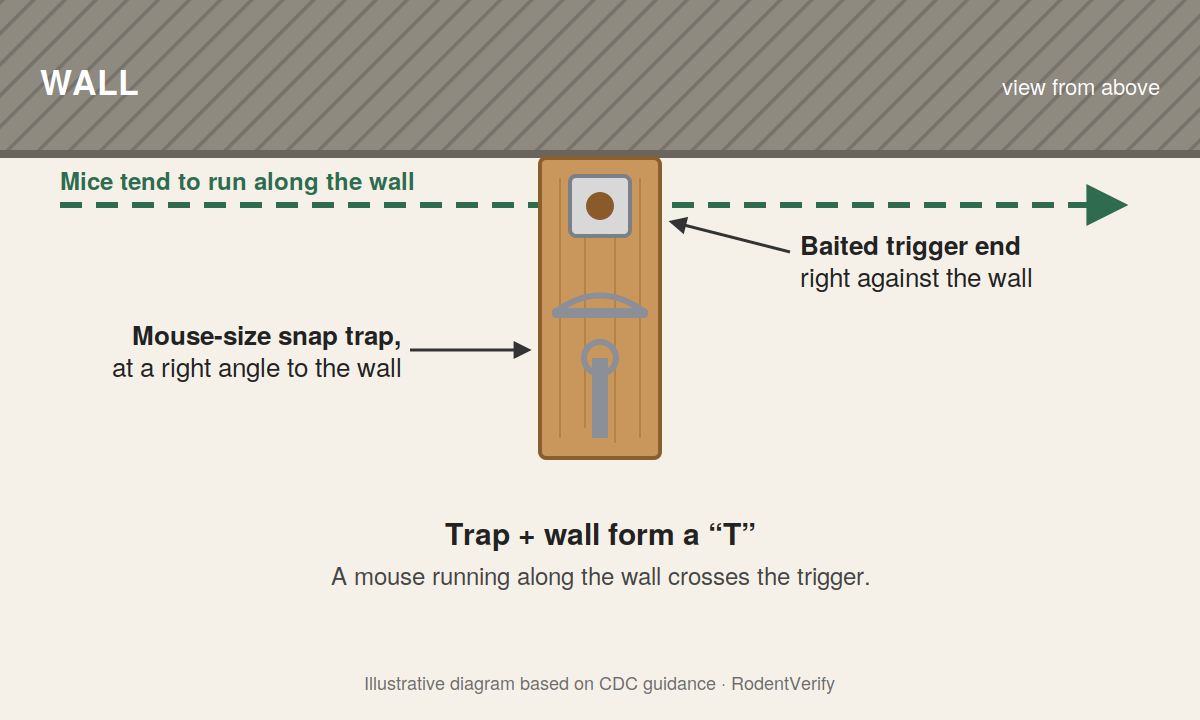
- Set the trap on the floor against the wall, with the baited end next to the wall so the trap forms a “T” with it. CDC explains that rodents prefer to run next to walls or other objects for safety.
UC IPM adds behind objects and dark corners, and says to place traps close to walls so mice pass directly over the trigger. Traps can also go on ledges or on top of stored materials where mice are active, as long as children, pets and other animals are unlikely to reach them.
If you are not sure where the activity is, the droppings are your map. Checking droppings by size and shape also confirms you are setting the right size of trap.
How many mouse traps should you set?
More than one, and enough to cover the routes the mice are using. There is no reliable traps-per-mouse number, and a catch count does not tell you how many mice were in the house — why a catch count is not a population count. What UC IPM does give is a working rule:
- Use enough traps to make the trapping period short and decisive.
- Space them no more than about 10 feet apart in areas where mice are active. UC IPM’s reason: house mice seldom go more than about 30 feet from their nest and food.
- Consider pairs. Two traps set 1 to 2 inches apart can increase captures of mice that jump over obstacles.
Bait: small, and ideally what they are already eating
- Use a small amount. CDC says to put a small amount of bait on the bait pan, and names chunky peanut butter or mutton fat. UC IPM explains why size matters: with too much bait, the mouse may be able to remove it without setting off the trap.
- Match what they are eating. UC IPM says the best bait is often the food the mice are already eating.
- Mind allergies. Peanut butter is popular and attractive to mice, but UC IPM notes it can pose allergy risks for some people.
- Try nesting material. UC IPM notes that a small ball of cotton wool or dental floss can work, because reproductive females are highly motivated to build nests. NC State suggests cotton balls or a ball of string for some traps.
Every source’s bait list, how to fix bait to the trigger and what to do when it disappears are in best bait for mouse traps.
Why your mouse traps are not working
Check these before you blame the trap:
- Wrong place. The trap is out in the open, not against a wall on a route where signs are. Move it to where the evidence is.
- Wrong orientation. The baited end is facing away from the wall. CDC’s “T” placement puts the trigger in the mouse’s path.
- Too few traps. One or two traps across a large active area. UC IPM ties success to using enough devices in the right spots.
- Wrong size. A rat trap for a mouse. CDC notes that mouse and rat snap traps are different, and NC State says rat snap traps should never be used for mice.
- Too much bait, or a stiff trigger. The mouse takes the bait and leaves. Use less, and set the trigger lightly.
- Food elsewhere. UC IPM treats trapping as one tool that has to be combined with sanitation — removing the food, water and shelter mice are using.
- The way in is still open. New mice keep arriving. See how to seal mouse entry points.
- It may not be mice. CDC notes that if new droppings, urine spots or gnawing persist after a week of trapping, you may be dealing with rats.
One thing not on the list: pre-baiting. CDC recommends baiting traps without setting them for rats, which tend to fear new objects. Its trapping page does not extend that advice to mice.
Children and pets
CDC: always keep traps and bait out of reach of children and pets. NC State Extension spells out the risk — snap traps can injure fingers, especially small, curious hands, and pets — and says snap traps should not be used where children, pets or other nontarget animals can get to them. Its alternative is to place snap traps inside cardboard or plastic boxes designed to hold them.
In practice, an exposed snap trap belongs only where children, pets and other animals cannot reach it. Where that is not possible, use a box or cover designed for the trap and follow the manufacturer’s instructions. A “pet-safe” label is a marketing claim unless the product can back it up; do not treat it as a guarantee.
How long to keep trapping
Check traps every day. CDC says to check them daily and dispose of any dead rodents immediately, and to continue trapping until there are no more rodents. Its trapping page gives a stopping point: a week with no captures and no new signs. If new droppings, urine spots or gnawing continue past a week, CDC suggests you may be dealing with rats — which sends you back to the species check.
That week is CDC’s criterion for the trapping program specifically. It is not a rule for judging droppings or any other sign on its own. How to know if mice are gone covers how to read the rest of the evidence.
How to dispose of a caught mouse safely
CDC’s procedure for a dead mouse: put on rubber or plastic gloves. Spray the mouse, the trap and the area around it with disinfectant, and let it soak for 5 minutes or as the product label directs. Place the mouse — and the trap, if it is disposable — in a plastic bag, tie it shut, put it in a second bag and tie that shut. Throw it in a covered garbage can that is emptied regularly. Wash your gloved hands, remove the gloves, then wash your hands with soap and warm water.
Reusing a snap trap? CDC’s steps: wearing rubber gloves, submerge the trap with the mouse in disinfectant for 5 minutes, hold it over a plastic bag and lift the bar so the mouse drops in, then rinse the trap with water and let it dry completely before double-bagging the mouse and washing up as above.
UC IPM adds the basic rule: do not touch mice with bare hands, and wash your hands thoroughly after handling traps. What to do with a dead mouse covers the full procedure, including a mouse that dies somewhere you cannot reach. For droppings and nesting material found while trapping, follow the full cleanup procedure.
Trapping is half the job: seal the entry points
CDC’s own sequence starts before the traps: when you see evidence of rodents, first check inside and outside to see how they got in, seal those openings, and set traps to catch the rodents still inside. If you only trap, new mice keep arriving. If you only seal, the ones already inside stay. How to seal mouse entry points covers finding the gaps and choosing materials that hold.
Poison is not the next step for most homes. CDC reserves bait stations for infestations that persist, and UC IPM points out that because house mice stay close to their nest, rodenticide often means mice dying inside the structure. If that would be a problem, trapping may be the better approach. If you are weighing bait in a home with pets, see mouse poison and pet safety before buying.
When professional help makes sense
- Activity continues after a thorough trapping and sealing effort.
- The evidence points to rats, or you cannot tell which animal you have.
- You cannot place traps safely because of children, pets or access.
- Rodents are in the heating or cooling ducts. CDC says to contact a professional rodent exterminating service when there is evidence they have accessed ventilation systems.
- The infestation is heavy, or rodents are in places you cannot reach to trap or clean. When to call a professional, in more detail.
The bottom line
The best mouse trap for most homes is the plain one, used well: a mouse-size snap trap with a wide trigger, set in enough numbers against the walls where the signs are, out of reach of children and pets, and checked every day. Pair it with sealing the way in, dispose of catches wet and bagged, and judge the result by CDC’s week of no captures and no new signs. The full sequence, from inspection to cleanup, is in how to get rid of mice.
Sources & verification
- CDC — How to Trap Up to Remove RodentsSnap traps recommended; no glue or live traps and why; different traps for mice and rats; small amount of bait; T-placement against the wall; placement areas; children and pets; daily checks; the one-week stopping point; pre-baiting for rats; bait stations only for persistent infestations; sealing alongside trapping.
- CDC — How to Clean Up After RodentsDisposing of a dead rodent and trap; 5-minute or label soak; double-bagging; the procedure for reusing a snap trap; professional help when rodents are in ventilation systems.
- UC IPM — House Mouse (Pest Notes 7483)Trapping as a first step and its advantages; placement near walls; 10-foot spacing and paired traps; wide trigger plates and light triggers; wooden versus plastic traps; bait choice and quantity; electrocution traps; glue board and live-trap drawbacks; relocation; rodenticide and mice dying indoors; sanitation alongside trapping.
- NC State Extension — Surveillance and Management of Common Structure-Invading MiceInjury risk from snap traps; boxes designed to hold snap traps; no rat traps for mice; nesting-material bait; glue boards as an option in some extension guidance.
- EPA — Options for Dealing With Rodent InfestationsLethal and live traps; released rodents returning unless entry points are sealed; keeping traps and baits away from children and pets.