
Evidence and signs
Mouse Nest Signs: What a Nest Looks Like, Where to Find It, and How to Remove It Safely
A mouse nest is one of the stronger signs you can find: it means mice have been living in that spot, not just passing through. It is also easy to mistake, hard to locate, and one of the things you should not handle carelessly. This guide covers what a nest looks like, where mice build them, how to tell whether one is still in use, and how to remove it the way CDC describes.
Before you touch it: do not pull a nest apart dry, sweep it up or vacuum it. CDC says sweeping or vacuuming rodent urine, droppings or nesting material can put tiny virus-containing droplets into the air. Put on gloves, soak the nest and the area around it with disinfectant, and only then bag it. Step-by-step removal is below.
The short answer
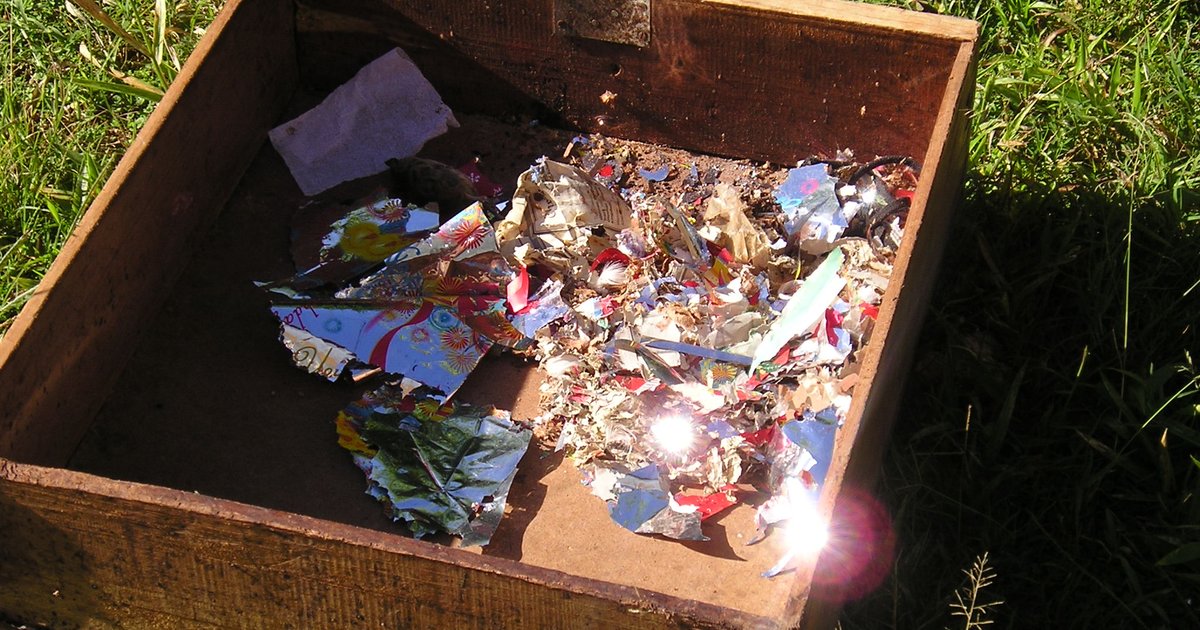
A house mouse nest is a loose ball of finely shredded soft material, usually about 4 to 6 inches across, tucked into a sheltered, undisturbed spot. UC IPM describes house mouse nests as built in sheltered locations from finely shredded paper or other fibrous material, and the University of Nebraska wildlife-damage manual gives the 4-to-6-inch size.
Finding one tells you mice have been living there. It does not tell you on its own whether they are there now, how many there are, or whether the nest belongs to a house mouse rather than another rodent. Check for fresh droppings and gnawing nearby, then remove the nest wet, as CDC describes for nests, and watch the cleaned area for new signs.
What does a mouse nest look like?
Like a messy, loosely woven ball of chewed-up material. The sources agree on the basics:
- Material. Paper, fabric, insulation and other soft fibers that the mice have chewed and collected. The National Park Service lists shredded paper, textiles and insulation; University of Arizona IPM adds cardboard, furniture stuffing, wool and plant material.
- Shape and size. A loosely woven ball, usually 4 to 6 inches (10 to 15 cm) in diameter, according to the University of Nebraska wildlife-damage manual and University of Arizona IPM.
- Smell. NPS notes that a nest may be smelled before it is seen, because urine and droppings are concentrated there. UC IPM describes the odor that goes with house mice as musky — what that smell can and cannot tell you.
- What is around it. Droppings, gnawed edges and scraps of the same material scattered nearby. Chewed paper or cloth on its own is a common find in homes with mice, even when the nest itself is out of reach.
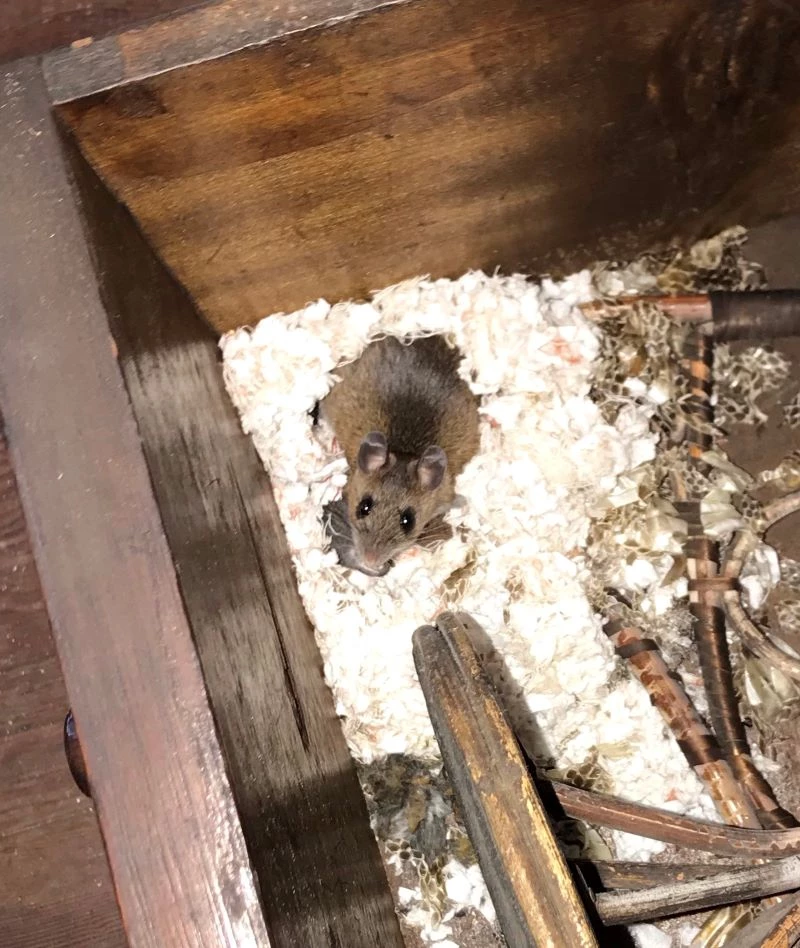
Do not expect a neat structure. Shredded material can also sit in a loose pile, and in a wall or attic it may simply look like insulation that has been pulled out of place. University of Arizona IPM points out that insulation pulled out or found in unexpected places can be a sign of mouse activity in itself.
Where do mice build nests?
Close to food, in places that are warm, quiet and rarely disturbed. UC IPM notes that house mice seldom go more than about 30 feet from their nest sites and food supply, so a nest is usually not far from where you are finding droppings and gnawing. Places the sources name:
- Drawers, cupboards and storage closets, especially ones that are seldom opened. UC IPM tells you to search behind boxes and in drawers; NPS lists desk drawers and storage closets.
- Stored boxes and containers. NC State Extension notes that when people come across a nest, it is likely to be in a box or container mice can easily get into. Cardboard boxes of paper or fabric are both shelter and building material.
- Kitchens and pantries. NPS includes food preparation areas; mice nest near what they eat. If you have found droppings among food, see what to throw away from a cabinet.
- Wall voids, ceiling voids and false floors. NC State says nests are frequently hidden in wall cavities and voids, and NPS lists wall voids, holes for electrical wiring, and false ceilings and floors. What to do when the nest is inside a wall is in mice or rats in the walls.
- Basements, attics, garages and outbuildings. The University of Nebraska manual notes nests are often found when people clean out garages, closets, attics, basements and outbuildings. Mice in the basement, mice in the garage and rats or mice in the attic cover those spaces in detail.
- Inside appliances. The same manual notes that mice often settle in large electrical appliances, where they can chew wiring and insulation. University of Arizona IPM reports mice pulling the fabric insulation out of modern stoves for nesting.
- Vehicles, campers and equipment that sit unused. CDC says rodents may nest in cars, trucks, campers and other vehicles, especially ones used infrequently — including the engine air intake.
- Near water. NPS includes dripping air conditioning units and leaking pipes among the places to check.
The nest is often the hardest sign to find. University of Arizona IPM notes that actual nests can be very difficult to locate even for pest professionals. If you cannot find it, you do not need to open walls to look: the droppings, gnawing and rub marks around it tell you where to trap.
Is it a mouse nest, a rat nest, or something else?
The nest alone usually cannot tell you. Mice and rats use the same kinds of material — NPS describes mouse and rat nests together — and other animals build nests too. Use the nest’s location and the evidence around it:
| What you find | What it points toward | What it does not prove |
|---|---|---|
| A loose ball of shredded paper or fabric in a drawer, box or cupboard, with small pointed droppings nearby | House mice | How many, or whether they are still active |
| Shredded material in an attic, wall void, ceiling void or high cabinet, with larger droppings | Possibly roof rats, which UC IPM says nest in enclosed, elevated spaces | That mice are not also present |
| Nest material in a burrow along a foundation, under a woodpile or rubbish | Norway rats, which UC IPM says burrow and may line nests with leaves, paper or cloth | What is happening inside the house |
| A nest of grass, twigs or leaves lined with fur, feathers or cloth, with stored acorns, seeds or nuts nearby, in a cabin, shed or rural home | Possibly deer mice — UC IPM says they cache food near nests far more than house mice do | The species on its own; deer mouse nests and droppings look similar to house mouse signs |
| A bulky nest of leaves and twigs outdoors or in an attic, with no droppings | Possibly a bird or squirrel; UC IPM notes deer mice may also move into abandoned squirrel and bird nests | That it is safe to handle bare-handed |
To settle it, compare the droppings at actual size with mouse vs rat droppings, check the size of gnaw marks, and use the full checklist in do I have mice or rats?. The distinction matters for traps — mouse traps are the wrong size for rats — and for cleanup risk, because the deer mouse is the main hantavirus carrier in the United States.
Is the nest still in use?
You usually cannot tell by looking at the nest. No source gives a reliable way to date nesting material by its appearance. What does show current activity is new evidence around it: the University of Nebraska manual says fresh accumulations of wood shavings, insulation and other gnawed material indicate an active infestation, and CDC treats new droppings after cleaning as the sign of active rodent presence.
So the practical test is the same one used for droppings:
- Look at what is around the nest — fresh gnawing, new shredded material, droppings that look recent. Fresh vs old droppings explains what appearance can and cannot tell you.
- Remove the nest and clean the area the way CDC describes (below).
- Watch the cleaned area over the following days. New droppings, new gnawing or new nesting material mean activity is continuing. How to know if mice are gone covers what counts as proof.
Do not poke the nest apart dry to see whether anything is inside. If you need to deal with it, wet it first.
What if there are baby mice in the nest?
Pups confirm that mice have been breeding there. According to the University of Nebraska manual, house mice are born hairless with their eyes closed, have fur and open eyes at about 2 weeks, and start making short trips out of the nest and eating solid food at about 3 weeks. UC IPM reports that a female may have 5 to 10 litters a year of about 5 or 6 pups, and that young mice are usually sexually mature at 5 to 6 weeks.
None of the sources gives a homeowner procedure for live young found in a nest. RodentVerify’s editorial view: do not handle them with bare hands, treat the nest material as contaminated, and if you are not prepared to deal with live animals, this is a reasonable point to bring in a pest professional. Either way, there are adults nearby, so trapping and sealing still have to happen. One mouse or an infestation? covers what pups and other evidence say about scale.
What does finding a nest mean?
That mice have been living in your home, not just visiting. NC State Extension describes nests as where mice live and raise their young, which makes a nest stronger evidence than a single dropping or a sighting.
It does not give you a count. One nest does not mean one mouse, and not finding a nest does not mean there is none: nests are often hidden in places you cannot see. Because house mice stay close to their nests, signs in several widely separated rooms are worth treating as separate activity areas until the evidence says otherwise.
Is a mouse nest dangerous?
The nest is contaminated material, and it is the part people tend to handle carelessly. CDC says rodent-borne diseases are mainly spread to people when they breathe in contaminated air, and it names nesting materials together with urine and droppings as what must not be swept or vacuumed.
- LCMV. UC IPM says lymphocytic choriomeningitis is contracted from exposure to fresh urine, droppings, saliva or nesting materials from infected house mice. It is a particular concern during pregnancy and with a weakened immune system.
- Hantavirus. UC IPM describes the deer mouse as the principal carrier of Sin Nombre virus, the hantavirus that causes hantavirus pulmonary syndrome, and says people can be exposed by breathing contaminated dust after disturbing or cleaning droppings or nests. That is why a nest in a closed-up cabin, shed or rural home deserves extra care. What the numbers actually say.
- Fleas. CDC notes that fleas are common on rodents and suggests considering an insect repellent on clothing, shoes and hands when cleaning up nesting materials.
- Insects. NPS warns that nests and dead rodents can host clothes moths and dermestid beetles, and University of Arizona IPM notes that pantry pests can sometimes be traced back to a mouse nest or food stash.
You cannot tell by looking whether the mice that built a nest were infected, so treat every wild rodent nest the same way. If you have handled nesting material and feel unwell, contact a clinician and tell them about the exposure.
How to remove a mouse nest safely
Wet it, bag it, double-bag it, then clean the area. The order of the work matters as much as the steps:
- Deal with the mice. Removing a nest from a space mice are still using only resets the problem. Set traps where you found the nest and other signs, and close the way in: which traps to use and where, and how to seal entry points.
- Air the space. For a room, closed-up home, shed or cabin, CDC says to open doors and windows for 30 minutes before cleaning and leave the area while it airs out.
- Remove the nest following CDC’s steps for cleaning up dead rodents or nests, below.
- Clean and disinfect the surrounding area, including droppings and urine beyond the nest itself.
- Re-check the cleaned spot over the following days for new signs.
CDC’s steps for a nest
- Put on rubber or plastic gloves. Consider insect repellent on clothing, shoes and hands for fleas.
- Spray the nest and the surrounding area with disinfectant. Use a household product with the word “disinfectant” on the label, or CDC’s bleach solution: 1.5 cups of household bleach in 1 gallon of water (1 part bleach to 9 parts water), made fresh. Let it soak for 5 minutes, or for the time on the disinfectant label.
- Place the nesting material in a plastic bag, together with any dead mouse and any used traps you are throwing away.
- Tie the bag closed with a knot, put it inside a second plastic bag, and knot that one too.
- Throw it in a covered garbage can that is regularly emptied.
- Wash your gloved hands with soap and water or disinfectant before taking the gloves off.
- Wash your bare hands with soap and warm water.
Then disinfect the area the nest was in and clean up any droppings and urine around it. The full cleanup guide covers each surface; if there is a dead mouse with the nest, what to do with a dead mouse covers reusing or disposing of the trap.
Never mix bleach with other cleaners or disinfectants, including ammonia-based products. CDC warns that mixing can release dangerous vapors. Use one product at a time, keep the space ventilated, and follow the label. See CDC bleach safety guidance.
Nests in stored boxes, papers and fabric
CDC’s instructions depend on the material. Cardboard boxes contaminated with urine or droppings should be thrown away; plastic, glass and metal containers can be disinfected. Clothing, bedding and other washables go through a hot wash with detergent, then a hot dryer or line drying in the sun. Rugs and upholstered furniture are shampooed with a commercial disinfectant or a commercial-grade steam cleaner or shampoo. Books, papers and other items you cannot wet can be left outdoors in the sunlight for several hours, or kept in a rodent-free indoor area for at least three weeks — CDC strongly suggests six. CDC also says to move stored boxes with potentially contaminated contents outside to a well-ventilated, sunny spot and to sort them there, standing upwind.
Nests in insulation, walls and attics
CDC says exposed insulation contaminated with urine and droppings should be placed into plastic bags for removal, not cleaned in place. A nest you can reach in a small, exposed patch can be handled with the steps above. A nest inside a wall or ceiling, or spread through a large area of insulation, is a different job — see when to call a professional.
Nests in a car, truck or camper
CDC has a separate vehicle procedure. In brief: open the hood, doors and trunk and let the vehicle air out for 20 minutes; inspect the air intakes and filters before starting an engine that has been idle; disconnect the battery before inspecting the engine compartment; wear plastic gloves and a long-sleeved shirt; and do not use a vacuum or high-pressure sprayer on nesting material until it has been soaked with disinfectant for 5 minutes or the label time. If you find nesting material in the air intake system, CDC says to remove both the nest and the air filter and fit a new filter. A mechanic can help with parts you cannot safely reach. Mice in your car covers where rodents nest in a vehicle and how to clean it out.
When a nest is a job for a professional
CDC’s explicit instruction is about ventilation systems: contact a professional rodent exterminating service when there is evidence rodents have got into heating and cooling ducts. Beyond that, RodentVerify’s editorial view is that these situations have moved past a homeowner cleanup:
- The nest is inside a wall, ceiling or subfloor you cannot open and clean safely.
- Nesting material is spread through a large area of insulation.
- There are many nests or heavy contamination, or the building has been closed up with large numbers of rodents. CDC calls for special precautions in those conditions, including coveralls, goggles and a respirator with HEPA filters.
- New nests or other signs keep appearing after you have trapped, sealed and cleaned.
When to call an exterminator covers how to decide and what to ask.
How to keep mice from nesting again
Take away the shelter and the way in. UC IPM notes that if house mice have few places to hide, rest, build nests or rear young, they cannot survive in large numbers — and also that good sanitation alone seldom controls them completely. So combine the two:
- Seal entry points. UC IPM calls exclusion the most successful and permanent form of house mouse control: close gaps and openings larger than 1/4 inch with materials mice cannot chew through. How to seal mouse entry points.
- Cut down on clutter and cardboard in basements, garages, closets and attics, especially boxes of paper and fabric that are rarely moved.
- Keep food in sealed containers, and feed pets only what they will eat at one feeding, as UC IPM advises.
- Check seldom-used spaces — drawers, stored boxes, idle vehicles, appliances — from time to time, rather than once a year.
- Remove old nests when you find them. For roof rats UC IPM is specific: they have strong nest-site affinity and return if nest sites are not removed. None of the sources says the same about house mice, but an old nest is still contaminated material you do not want to leave in place.
Common questions
How big is a mouse nest?
Usually about 4 to 6 inches across, according to the University of Nebraska wildlife-damage manual and University of Arizona IPM. Shredded material can also be spread out in a loose pile rather than formed into a ball.
Can I just vacuum up a mouse nest?
No. CDC rules out vacuuming and sweeping nesting material, because it can put contaminated droplets into the air. Soak it with disinfectant, bag it and double-bag it.
Will mice come back to the same nest?
UC IPM says roof rats do return if their nest sites are not removed. We found no comparable statement for house mice. Either way, remove the nest, and judge whether mice are still around by new evidence in the cleaned area, not by whether the old nest was occupied.
Does finding a nest mean I have an infestation?
It means mice have been living in that spot. Whether that is a few mice or many is a separate question — one mouse or an infestation? explains what the evidence can and cannot tell you.
Can I use nesting material as trap bait?
Yes. UC IPM notes that reproductive females are highly motivated to build nests, so a small ball of cotton wool or dental floss on the trigger can work as bait. Use a small amount, so the mouse cannot take it without setting the trap off.
The bottom line
A mouse nest is a loose ball of shredded soft material in a sheltered, undisturbed spot, usually close to where you are finding droppings. It proves mice have been living there, but not whether they still are, how many there are, or which rodent built it. Confirm the animal from droppings and gnaw marks, deal with the mice first, then soak the nest with disinfectant, double-bag it and clean the area. Judge whether the problem is over by what appears in the cleaned area afterwards.
Sources & verification
- CDC — How to Clean Up After RodentsNo sweeping or vacuuming of nesting material; diseases spread mainly through contaminated air; the seven steps for dead rodents and nests, including disinfectant or 1.5 cups bleach per gallon (1:9), 5-minute or label contact time and double-bagging; fleas and insect repellent; airing out for 30 minutes; insulation, cardboard, washables, upholstery, books and papers; vehicle inspection and air intakes; professional help for ventilation systems; special precautions for heavy infestation.
- CDC — Controlling Wild Rodent InfestationsNew droppings after cleaning as the sign of active rodent presence.
- CDC — Cleaning and Disinfecting with BleachNever mix bleach with other cleaners or disinfectants.
- UC IPM — House Mouse (revised July 2025)Nests in sheltered locations, made from finely shredded paper or other fibrous material; where to search; mice seldom more than 30 feet from nest sites and food; litters and maturity; LCMV from nesting materials; sanitation and exclusion; nesting material as trap bait.
- UC IPM — Deer MouseDeer mouse nest materials and sites, including abandoned squirrel and bird nests; food caches near nests; signs similar to house mice; hantavirus exposure from disturbing or cleaning nests.
- UC IPM — Rats (revised June 2025)Roof rats nesting in enclosed elevated spaces and returning to nest sites that are not removed; Norway rat burrows and nest linings.
- National Park Service — Conserve O Gram 3/12: Identifying Mouse and Rat DamageNest materials; nests seen or smelled because of concentrated urine and droppings; where to look; nests and remains hosting clothes moths and dermestid beetles.
- R. M. Timm — House Mice, in Prevention and Control of Wildlife Damage (University of Nebraska–Lincoln, 1994; copy hosted by the Maine Department of Agriculture)Nests as loosely woven balls 4 to 6 inches in diameter; where nests are found, including appliances; fresh gnawed material as a sign of active infestation; development of pups.
- University of Arizona IPM — House Mice: Signs of Uninvited Four-legged Visitors (2022)Nest materials and 4-to-6-inch size; nests hard to locate; pulled-out insulation and stove insulation; food stashes and pantry pests.
- NC State Extension — Surveillance and Management of Common Structure-Invading Mice (2024)Nests hidden in wall cavities and voids, where mice live and raise young; nests often found in accessible boxes and containers.
