
Rooms and places
Mouse in the Kitchen: Where to Look, Where to Set Traps, and How to Keep Mice Out
Mice settle in kitchens because food and shelter are close together, and they get in through gaps you can find. Confirm the signs, set traps in the closed spaces mice use behind appliances and cabinets, seal the routes in, and store food so the kitchen stops feeding them.
Before you clear out a cupboard: do not sweep or vacuum droppings, urine or nesting material. CDC warns that this can put tiny virus-containing droplets into the air. Wet it first, then clean. If droppings were near food, what to throw away and how to clean the cabinet covers that step on its own.
Quick answer: what to do about a mouse in the kitchen
- Confirm the signs. Droppings, chewed packaging, nesting material or the animal itself.
- Deal with exposed food first. Food in paper or plastic that mice reached goes in the trash.
- Find the way in. Under the sink, behind the stove and refrigerator, inside and behind the cabinets.
- Set snap traps in those closed spaces, against the walls.
- Seal the gaps at the same time, with materials mice cannot chew through.
- Take the food away: sealed containers, pet food put up, lidded trash.
- Clean wet, then watch the cleaned spots for anything new.
What actually tells you a mouse is in the kitchen?
Physical signs, in the places food is kept. EPA’s list of infestation signs reads like a kitchen inventory: droppings around food packages, in drawers or cupboards and under the sink; chewing on food packaging; nesting material such as shredded paper or fabric; and stale smells from hidden areas. EPA also notes you may never see the animal itself unless an infestation is severe.
Look along the backs of shelves, in the bottom drawer, under the sink around the pipes, and in the gap under and behind the stove and refrigerator. A torn corner on a bag of rice or cereal is often the first thing people notice. How to read gnaw marks helps tell fresh chewing from old.

A smell or a sound on its own is a reason to look, not a confirmation. A musky smell in a closed cupboard points to mice but is a clue, not proof, and a nest of shredded material in a drawer or behind the dishwasher is stronger evidence than either.
A mouse running across the floor in daylight does not, by itself, mean a severe problem. UC IPM notes house mice are most active at night but can be seen during the day. One mouse or an infestation? covers what the signs can and cannot tell you about numbers.
Mouse or rat? Check before you buy traps
The trap has to match the animal. CDC says there are different snap traps for mice and rats, and UC IPM notes that mice often won’t set off a rat-size trap. Start with dropping size or a clear look at the animal and confirm it with a second sign: how to tell mice from rats by the signs, or, if you have droppings, compare them by size and shape.
Droppings near food: what to throw away
This is its own step, and it comes before trapping. In short: food in paper or plastic packaging that was exposed to mouse droppings or urine is discarded, including unopened boxes and bags; undamaged all-metal cans and commercially sealed jars can be saved only after a specific washing and sanitizing procedure. The rules come from the FDA, and the full table, the can-and-jar steps and the cabinet cleanup are on mouse droppings in kitchen cabinets.
How mice get into a kitchen
Through gaps the width of a pencil. CDC puts the size at 1/4 inch. UC IPM adds that house mice frequently move into homes in autumn, when nighttime temperatures drop. More on the ways in, and how to find the one your mice use, in how do mice get in your house.
Several points on CDC’s inside-the-home inspection list are in or next to the kitchen. Check:
- inside, under and behind kitchen cabinets;
- behind appliances;
- around the pipes under sinks;
- around every electrical, water and gas line where it comes through a wall or floor;
- between the floor and the wall;
- around windows and doors.
Under the sink, look at every place a pipe passes through the back or floor of the cabinet: any gap around the pipe counts, not just a hole beside it. Pull the stove and refrigerator out, with a flashlight, and look at the wall and floor behind them for droppings, gnawing and gaps around gas, water and power lines.
A gap inside the kitchen is not always where the mouse first entered the house. It can come up through a wall or floor from a basement, crawl space or garage. If you find the kitchen gap but activity continues, check below it too; mice in the basement covers that inspection.
Why mice stay in a kitchen
Steady food in small amounts. UC IPM describes house mice eating about 200 small meals a night and seldom going more than 30 feet from their nest and food supply. A kitchen with an open bag of pet food, a crumb line under the toaster or a cabinet of cereal boxes can support them indefinitely without ever leaving the room.
UC IPM also says house mice don’t need to drink water to survive; they get moisture from food. A dripping tap is worth fixing, but taking the food away matters more.
- Containers: CDC advises keeping food sealed in thick plastic, metal or glass containers with tight lids. UC IPM warns that mice can chew through storage containers meant to protect food, which is why thin bags and clip-closed packages fail.
- Pet food: CDC says to put pet food away after use and not to leave food or water bowls out overnight. UC IPM suggests feeding pets only what they will eat at one feeding.
- Trash: CDC advises keeping indoor garbage in thick plastic or metal containers with tight lids and emptying it regularly. EPA gives the same advice for kitchen garbage.
Cleaning up helps, but on its own it rarely solves the problem. UC IPM is direct about it: good sanitation will seldom completely control house mice. It limits how many the kitchen can support; traps and sealing do the rest.
Where to set mouse traps in a kitchen
In the closed spaces mice use, against the wall. CDC’s placement guidance names kitchen spots directly: put traps in closed areas such as behind the stove and refrigerator and in the back of cabinets and drawers, as well as anywhere you have seen droppings, nesting material, nibbled food or gnaw marks.
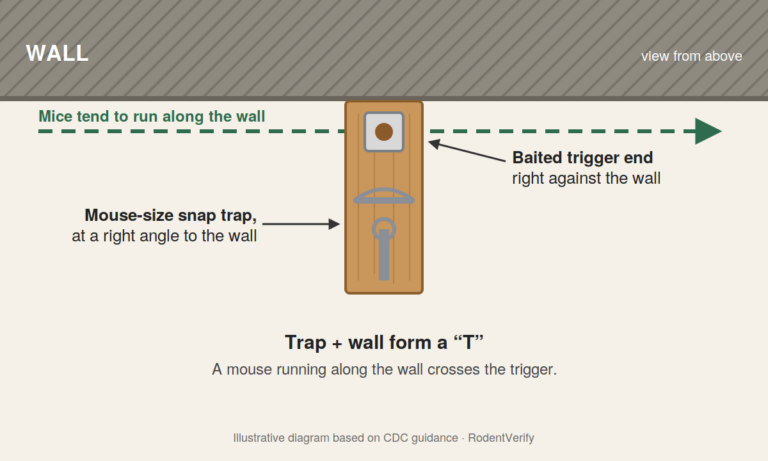
- Set them as a “T” with the wall. CDC says to place the trap against the wall with the baited end touching it, because rodents run along walls.
- Use snap traps, not glue or live traps. CDC advises against glue and live traps because a scared rodent may urinate, which raises your exposure. In a kitchen that is exactly what you are trying to avoid. Choosing a mouse trap compares the types.
- Use more than one. UC IPM suggests spacing traps no more than about 10 feet apart where mice are active, and notes that pairs set 1 to 2 inches apart catch mice that jump over obstacles.
- Bait lightly. CDC suggests a small amount of chunky peanut butter. UC IPM notes too much bait lets the mouse take it without setting off the trap, that peanut butter can be an allergy risk for some people, and that a ball of cotton wool or dental floss can work instead. More in best bait for mouse traps.
- Keep traps out of reach of children and pets. CDC says so.
- Check them every day. CDC says to check traps daily and dispose of dead rodents promptly; the cleanup guide covers handling one.
Poison is not the first step, and least of all in a kitchen. CDC says to use poison or bait stations only for infestations that persist, and to follow the label exactly. UC IPM adds that rodenticide often results in mice dying inside the structure, and a mouse that dies inside a wall behind the cabinets is hard to reach and leaves an odor.
Ultrasonic plug-ins are not a substitute for traps. UC IPM says high-frequency electronic devices aren’t effective and that mice quickly become used to regularly repeated sounds. Why ultrasonic repellers fall short.
Seal the gaps while you trap
Do both at once, not one after the other. CDC’s order is to check inside and outside for how rodents got in, seal those entry points, and set traps for any that are still inside. Sealing alone shuts the current mice in with your food; trapping alone leaves the door open for the next ones.
- Small holes, such as gaps around the pipes under the sink: CDC says to fill them with steel wool and hold it in place with caulk or spray foam. UC IPM notes steel wool is a good temporary plug but may rust.
- Larger holes, such as an oversized pipe cutout: CDC lists lath screen or metal, cement, hardware cloth or metal sheeting, cut to fit around the pipes.
Expanding foam on its own does not stop a mouse. UC IPM lists insulating (expanding) foam with plastic screening, rubber, vinyl and wood as ineffective for plugging mouse holes. Where CDC mentions spray foam, it is to hold steel wool in place.
The full sealing guide goes through each type of opening and the materials that hold.
Chewed cords behind appliances
UC IPM notes that house mice can chew on appliance cords and on wires in walls, and that many fires of unknown origin are believed to be caused by rodents gnawing on wires. When you pull out the stove or refrigerator, look at the cords and any visible wiring. Damaged wiring is a job for an electrician, not tape, and it is one of the reasons to bring in professional help below.
Cleaning the kitchen safely
CDC’s procedure in brief: open doors and windows for 30 minutes before you start and leave the room while it airs out; put on rubber or plastic gloves; spray droppings and urine with a fresh bleach solution of 1.5 cups of household bleach in 1 gallon of water, or an EPA-registered disinfectant, until very wet; let it soak for 5 minutes or as the label directs; wipe it up with paper towels and put them in a covered garbage can. CDC then says to clean all hard surfaces, including floors, countertops, cabinets and drawers, with disinfectant.
For surfaces that touch food, follow the disinfectant label, including any rinse it requires. The complete cleanup guide covers nests, a dead mouse and when CDC’s heavier precautions apply, and the kitchen cabinet guide covers the food.
How to know the mice are gone
Watch the spots you cleaned. Once a shelf or the floor behind the stove has been cleaned, anything that appears there afterwards is new.
- CDC says to check the bait every week and refill or move it as needed for at least 15 days.
- CDC’s end point: if no rodents are caught for a week and there are no new signs, they are likely gone.
- If new droppings, urine spots or gnawing continue after a week, CDC says you may be dealing with rats rather than mice, which sends you back to the species check.
How to know if mice are gone has the full checklist.
When professional help makes sense
Reasonable triggers: activity continues after trapping and sealing; you can’t find the way in, or it is inside a wall behind built-in cabinets; you find gnawed wiring; there is a smell from inside a wall you can’t reach; or the evidence points to rats. CDC suggests contacting your local or state health department if you are concerned about an infestation, and a pest control specialist when rodents have got into areas that can’t be reached to clean. When to call an exterminator goes through each of these.
The bottom line
A mouse in the kitchen is there for food and shelter, and it got in through a gap. Deal with any exposed food first, then trap behind the stove, the refrigerator and inside the cabinets while you seal the routes in with materials that hold. Put food, pet food and trash where mice can’t reach them, clean wet, and judge the result by what turns up on the surfaces you have already cleaned.
Sources and verification
- CDC — How to Seal Up to Prevent RodentsThe 1/4-inch mouse opening; inspection points inside, under and behind kitchen cabinets, behind appliances and around pipes under sinks; sealing materials; food storage in thick plastic, metal or glass containers; pet food and bowls; indoor garbage; when to contact a health department or pest control specialist.
- CDC — How to Trap Up to Remove RodentsChecking entry routes and sealing while trapping; snap traps over glue and live traps; traps for mice and rats; trap placement behind the stove and refrigerator and in the back of cabinets and drawers; T-placement; bait; children and pets; daily checks; the 15-day and one-week criteria; poison only for persistent infestations.
- CDC — How to Clean Up After RodentsNo sweeping or vacuuming; airing out for 30 minutes; the bleach solution and soak time; cleaning floors, countertops, cabinets and drawers.
- UC IPM — Pest Notes: House MouseNight and daytime activity; autumn entry; feeding habits and the 30-foot range; not needing drinking water; chewing through food containers and appliance cords; sanitation; ineffective exclusion materials; trap spacing, paired traps and bait; rodenticide and mice dying inside structures; ultrasonic devices.
- UC IPM — Pest Notes: RatsMice often not setting off rat-size traps.
- EPA — Identify and Prevent Rodent InfestationsSigns of infestation, including droppings around food packages, in drawers, cupboards and under the sink, and chewed packaging; kitchen garbage in containers with tight-fitting lids.