
Rooms and places
Rats or Mice in the Attic: Sounds, Signs, Insulation and What to Do
Noises overhead at night are often the first sign, but a sound does not tell you what is up there. Find the physical evidence, work out whether it is mice or rats, because the traps and the way in are different, then trap, seal the roofline and deal with the insulation carefully. These steps overlap; you do not have to finish one before starting the next.
Before you go up: do not sweep or vacuum droppings, urine, nesting material or soiled insulation. CDC warns that this can put tiny virus-containing droplets into the air. And if the attic has loose, pebble-like gray-brown or silver-gold insulation, it may be vermiculite: EPA says to assume it contains asbestos and not to disturb it or try to remove it yourself. Insulation is covered below.
What to do if you hear rats or mice in the attic
- Confirm with physical evidence. Droppings, gnawing, rub marks, shredded insulation or nests. A noise alone is a reason to look.
- Decide: mouse or rat? It changes the trap size, where you set traps and what you check outside.
- Check the insulation type before you walk through it or move it.
- Set snap traps sized for the animal, on its travel routes.
- Find and seal the way in, including the roofline, vents and anything rats can climb to reach the roof.
- Clean wet and bag contaminated insulation rather than cleaning it in place.
- Watch for new signs before you call it finished.
Mouse or rat in the attic?
Either can be up there, but rats are the classic attic problem. UC IPM says roof rats typically nest in enclosed and elevated spaces such as attics, wall voids, ceiling voids and cabinets. Norway rats usually stay in basements and on ground floors, but UC IPM adds that infestations of ceiling voids are not uncommon for them either. When both species share a building, Norway rats tend to stay low and roof rats take the upper floors. How to tell the two apart is in roof rat vs Norway rat. House mice nest in attics too: the University of Nebraska wildlife-damage manual lists attics among the places mouse nests are often found.
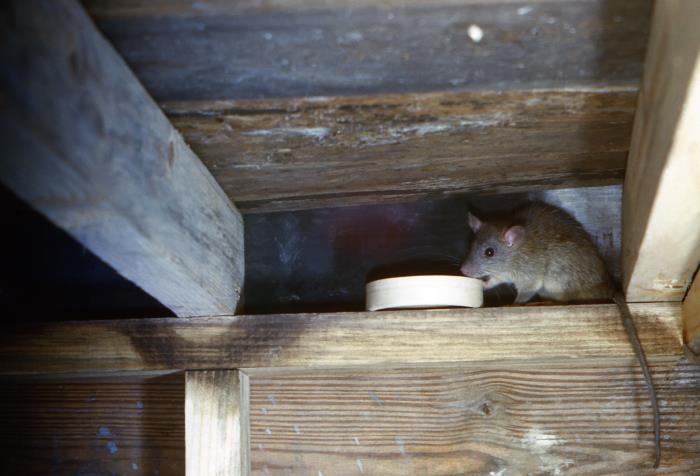
| Mice | Rats | |
|---|---|---|
| Gnaw marks | Fine, “scratchy” marks about 1/12 inch wide | Larger tooth marks about 1/6 inch wide |
| Droppings | Small, pointed | Much larger; compare at actual size |
| Trap | Mouse-size snap trap | Rat-size snap trap; mice and small young rats often won’t set one off |
| Where to set traps | Against walls and along edges where you find signs | Roof rats: also off the ground, on beams, ledges and pipes |
| Gaps to seal | Anything larger than 1/4 inch, for both. UC IPM adds that young rats can squeeze under a door with a 1/2-inch gap. | |
Gnaw-mark widths and trap advice are from UC IPM. One sign is not enough: confirm it with a second, using the full mouse-or-rat checklist. In rural homes and cabins, a mouse with a sharply white belly may be a deer mouse, which changes the hantavirus risk of the droppings.
What the noises in the attic can and cannot tell you
UC IPM lists noises from the attic or drop ceilings as one of the signs of a rat problem, and notes that rats are mostly active at night. House mice are also most active at night. So the timing fits both, and it fits other animals as well.
Penn State Extension points out that squirrels and mice in an attic make scurrying and squeaking noises that sound like bats. It gives a way to tell them apart that does not rely on sound: bat droppings pile up below the spots where bats roost, while mouse droppings are scattered in small amounts across the attic. Penn State also notes that bats do not gnaw. Fresh gnawing points to a rodent.
No source gives a reliable way to identify the animal from the sound alone. What scratching in walls and ceilings can tell you covers how to narrow it down without opening anything up.
Signs of rats or mice in the attic
With a flashlight, from the attic hatch or from a floored area, look for:
- Droppings along the edges of the attic floor, on top of insulation and near the eaves.
- Gnawing on wood, pipes, ducts and wiring. How to read gnaw marks.
- Smudge marks on beams, rafters, pipes and walls. UC IPM describes these as caused by rats rubbing their fur along their routes. How to recognize rub marks.
- Shredded or disturbed insulation. UC IPM notes that rats shred insulation in walls and ceilings for their nests.
- Nests of shredded insulation, paper or fabric in sheltered corners and near the eaves. What a mouse nest looks like.
- A smell from the attic or the ceiling below. On its own it proves little; what a musky smell can tell you.
Outside, UC IPM suggests watching for rats traveling along utility lines or the tops of fences at dusk.
Insulation: what to check before you touch it
Vermiculite: leave it alone
EPA describes vermiculite insulation as a pebble-like, pour-in product, usually gray-brown or silver-gold. Most vermiculite sold in the U.S. from 1919 to 1990 came from a mine near Libby, Montana, and was contaminated with asbestos, so EPA says to assume any vermiculite insulation contains asbestos. EPA recommends leaving it undisturbed, not storing boxes in that attic, keeping trips into it few and short, and not attempting to remove it yourself. If it has to be disturbed or removed, EPA says to hire a professional asbestos contractor.
In practice, a rodent problem in an attic with vermiculite is a job for professionals from the start. Do not dig through it looking for nests or droppings.
Other insulation with droppings or urine
CDC’s instruction is specific: if exposed insulation is contaminated with urine and droppings, place it into plastic bags for removal. It is not cleaned in place. A small, reachable patch can be wetted with disinfectant and bagged with the steps below.
A large area is a different job. CDC calls for special precautions for heavy rodent infestation: coveralls, rubber boots or disposable shoe covers, gloves, protective goggles and a respirator with HEPA filters, with local and state fit-testing requirements followed first. CDC does not set a number of droppings or rodents that makes an infestation “heavy.” RodentVerify’s editorial view: if soiled insulation runs across much of the attic, that is the point to bring in a professional rather than buy the equipment.
How rats and mice get into an attic
Usually from above, not through the house. UC IPM describes roof rats as agile climbers that often travel along overhead utility lines and fence tops, and says that because they climb so well, openings above ground level must be plugged too. CDC includes the roof among the outside places to inspect: the rafters, gables, eaves and soffits, and the holes for electrical, plumbing, cable and gas lines.
Cut off the routes to the roof
- Trees. UC IPM gives two figures in the same publication: its Quick Tips say to prune tree limbs within 3 feet of a roof, and its full Pest Notes say overhanging limbs within 6 feet of roofs should be removed, to keep rats and tree squirrels off the roof and out of attics and soffit vents.
- Climbing plants. UC IPM says to remove them from buildings; ivy, star jasmine and honeysuckle on fences or walls help roof rats forage.
- Utility wires. If roof rats are traveling on overhead utility wires, UC IPM says to contact a pest professional or the utility company. Do not work on them yourself.
Seal the openings
- Size. UC IPM says all holes larger than 1/4 inch should be sealed to exclude both rats and mice.
- Vents. UC IPM specifies vent covers of 18-gauge, 1/2-inch mesh galvanized expanded metal or 16-gauge, 1/2-inch mesh galvanized wire cloth, and says to repair or replace damaged screens on roof and attic vents and under the eaves.
- Roof penetrations. UC IPM says to screen the tops of rooftop plumbing vent pipes more than 2 inches in diameter, cover chimneys with a spark arrester, and seal openings around pipes, cables and wires.
- Materials. UC IPM notes rats can chew through plastic, foam, wood and caulk, and says never to use lightweight chicken wire, because rats pass through the openings. CDC lists steel wool held with caulk or spray foam for small holes, and metal, cement or hardware cloth for larger ones.
A note on roof work. RodentVerify’s editorial view: sealing eaves, soffits and roof vents means working at height. If you are not set up to do that safely, hire a contractor. Use the vent-cover specifications above so screening keeps rodents out without blocking the vent.
The full sealing guide goes through each type of opening and the materials that hold.
Trapping in the attic
Snap traps, sized for the animal, on its routes. CDC recommends traditional snap traps, notes that there are different traps for mice and rats, and names attics among the places to set them. UC IPM calls snap traps the safest, most effective and most economical way to trap rats. For rats, trap types, pre-baiting and how many to use are in best rat traps.
- Mice: CDC says to set the trap against the wall with the baited end touching it, forming a “T,” because rodents run along walls. UC IPM suggests mouse traps no more than about 10 feet apart where mice are active.
- Roof rats: UC IPM says traps often need to go both on the ground and above it, on ledges, shelves, pipes or overhead beams, and secured to the surface where possible so the snap has full force.
- Norway rats: close to walls, behind objects and in dark corners where you have found signs, at right angles to the wall with the trigger end nearly touching it.
- Number and spacing for rats: UC IPM suggests rat traps about 10 to 20 feet apart, and says a heavily infested home might need a dozen or more.
- Rats avoid new objects. UC IPM says rats often avoid traps for the first several days or weeks. CDC suggests pre-baiting: bait the traps without setting them until the bait is being taken, then set them.
- Bait: UC IPM suggests a pea-sized amount of nuts, dried fruit, bacon, dry pet food or peanut butter. CDC suggests chunky peanut butter. Roof-rat baits and how to fix them to the trigger are in best bait for mouse traps.
- Check daily. CDC says to check traps daily and dispose of dead rodents right away. An attic is easy to forget; if you cannot check it every day, that is a reason to get help.
- No glue or live traps. CDC advises against both: a scared rodent may urinate, raising your exposure.
Keep traps out of reach of children and pets, as CDC advises. Choosing a mouse trap compares the types in more detail.
Poison and repellents
CDC says to use poison or bait stations only for infestations that persist, and to follow the label. In an attic there is a practical problem: an animal that eats bait can die inside a wall or under the insulation, where you cannot reach it. UC IPM says to minimize entry points before baiting outside so poisoned rats do not come inside to die, and notes that roof rats may not enter bait stations even when they are placed on established runways. If a smell starts after baiting, see what to do about a dead mouse you cannot reach. EPA’s bait station tiers explain which stations can be used where.
Ultrasonic devices do not solve it. UC IPM says rats quickly get used to repeated sounds, making high-frequency and ultrasonic devices ineffective for rats in homes, and says the same about high-frequency devices for house mice. More in do ultrasonic pest repellers work?
Scents such as peppermint oil are not a fix either. UC IPM says rats have an initial aversion to some odors and tastes, but no repellent has been found to solve a rat problem for more than a very short time. See what the research on peppermint oil shows.
Chewed wiring, gas lines and ducts
UC IPM says roof rats living in an attic can cause considerable damage and safety concerns, including electrical sparks and fires, through their gnawing and nesting, and that rats may even chew on natural gas lines. If you find gnawed wiring or a chewed gas line, treat it as a safety problem first: the U.S. Fire Administration says electrical work should be done only by a qualified electrician. RodentVerify’s editorial view: if you suspect a gnawed gas line, leave it alone and contact your gas utility.
If there is evidence rodents have got into heating and cooling ducts, CDC says to contact a professional rodent exterminating service.
Cleaning up the attic safely
CDC’s steps for homes and outbuildings start with airing the space: open doors and windows for 30 minutes before cleaning and leave while it airs out. Then:
- Put on rubber or plastic gloves.
- Spray droppings and urine with a disinfectant or a fresh bleach solution of 1.5 cups of household bleach in 1 gallon of water until very wet. Let it soak for 5 minutes, or as the disinfectant label directs.
- Wipe it up with paper towels and put them in a covered garbage can.
- Nests and dead rodents: spray them and the area around them, let it soak, place them in a plastic bag, knot it, put it inside a second bag and knot that too.
- Contaminated insulation goes into plastic bags for removal.
- Stored boxes: CDC says to move them outside to a well-ventilated area and sort them there. Contaminated cardboard is thrown away; plastic, glass and metal containers can be disinfected.
- Wash your gloved hands, remove the gloves, then wash your bare hands with soap and warm water.
CDC also notes that fleas are common on rodents and suggests insect repellent on clothing, shoes and hands when picking up dead rodents and nesting material. The complete cleanup guide covers each surface in detail.
How to tell whether they are gone
- CDC’s test: if no rodents are captured for a week and there are no new signs, they are gone. If new droppings, urine spots or gnawing persist after a week, CDC says you may be dealing with rats.
- Remove old nests. UC IPM says roof rats have very strong nest-site affinity and will return to a site if the nests are not removed.
- Keep a few traps. UC IPM notes that traps can be set and left indefinitely in places such as attics where rats have been a problem.
- Recheck the seals at vents, eaves and pipe openings for fresh gnawing.
How to know if mice are gone has the full checklist.
When to call a professional
Reasonable triggers: the attic has vermiculite insulation; soiled insulation covers a large area; you find gnawed wiring or gas lines; rodents have reached the ducts; signs continue after trapping and sealing; the way in is on the roof and you cannot reach it safely; or rats are using overhead utility wires. When to call an exterminator goes through how to decide.
The bottom line
Noises in the attic are a reason to look, not an answer. Confirm the animal from droppings and gnaw marks, because rats and mice need different traps and roof rats need traps off the floor. Check the insulation before you disturb it, and leave vermiculite to professionals. Seal everything larger than 1/4 inch, cut off the routes to the roof, clean wet, bag soiled insulation, and judge the result by new evidence over the following weeks.
Sources and verification
- UC IPM — Pest Notes: Rats (updated June 2025)Roof rats nesting in attics and other elevated spaces; Norway rats in ceiling voids; noises from the attic as a sign; night activity; smudge marks; shredded insulation; gnaw-mark widths; 1/2-inch door gaps; sealing holes larger than 1/4 inch; materials rats chew; vent-cover mesh and gauge; chicken wire; tree limbs within 3 and 6 feet of the roof; climbing plants; utility wires; trap types, placement, spacing, numbers and bait; neophobia; bait stations and roof rats; ultrasonic devices; sparks, fires and gas lines; nest-site affinity; leaving traps in attics.
- UC IPM — Pest Notes: House MouseNight activity; trap spacing for mice; high-frequency devices.
- CDC — How to Clean Up After RodentsNo sweeping or vacuuming; airing out; bleach solution and soak time; nests and double-bagging; fleas; contaminated insulation bagged for removal; storage boxes; ventilation ducts; special precautions and PPE for heavy infestation.
- CDC — How to Trap Up to Remove RodentsSnap traps; different traps for mice and rats; attics as trap locations; T-placement; bait; pre-baiting; daily checks; glue and live traps; poison only for persistent infestations; the one-week test.
- CDC — How to Seal Up to Prevent RodentsRoofline entry points and utility openings; sealing materials.
- EPA — Protect Your Family from Asbestos-Contaminated Vermiculite Insulation (updated April 2026)Identifying vermiculite; assuming it contains asbestos; leaving it undisturbed; limiting attic trips; hiring an asbestos contractor.
- EPA — Choosing a Bait Station Product for Household UseBait station tiers and where each may be used.
- Penn State Extension — BatsMice and squirrels sounding like bats; bat droppings in piles versus scattered mouse droppings; bats not gnawing.
- R. M. Timm — House Mice, in Prevention and Control of Wildlife Damage (University of Nebraska–Lincoln, 1994)Mouse nests found in attics.
- U.S. Fire Administration — Prevent Home Electrical FiresElectrical work only by a qualified electrician.